Eastern Mythology Encyclopedia
King Zhuanlun
转轮王
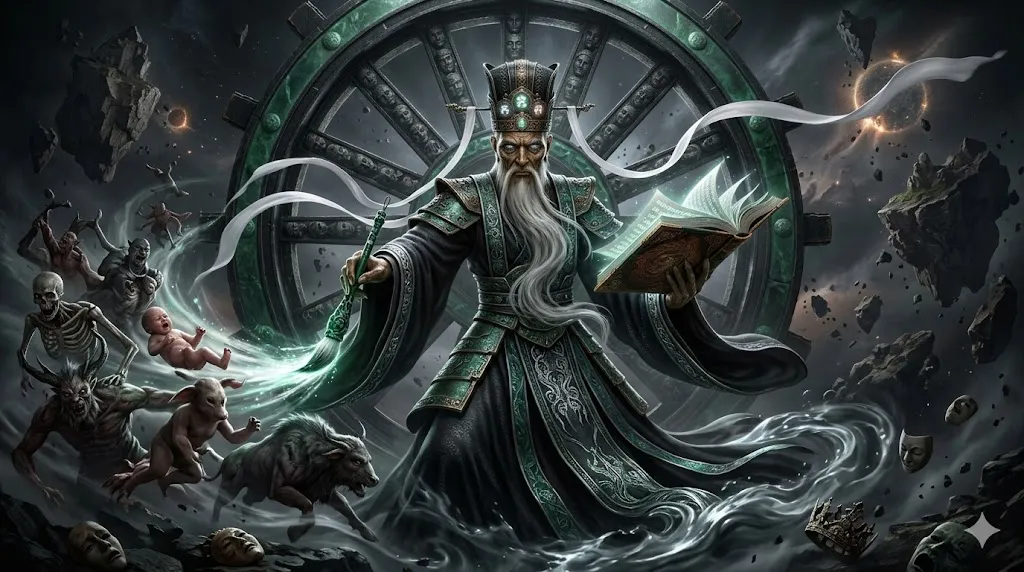
Zhuanlun Wang (King Zhuanlun, the tenth and final Yama King of the Underworld) does not punish the dead—he sends them home. After nine courts of judgment, after the weighing of every sin and the measuring of every merit, one being alone decides which door a soul walks through next, and his decision determines nothing less than the entire shape of a life yet to be lived.
转轮王薛 (King Zhuanlun Xue)
亡故方式:非亡故,先天神灵受封 (Not deceased; innate god enfeoffed by Heaven)
亡故纪元:N/A (Pre-dates the mortal era)
当前鬼道层级:Youming Diful Zheng Shen (正神 of the Netherworld Court)
幽冥归属:The Tenth Court of the Underworld, seat of reincarnation distribution
None. King Zhuanlun has no specific haunted locations or earthly relics. He is not a wandering spirit bound to a particular tree, well, or riverbank. His domain is the Tenth Court, which exists in the metaphysical geography of the Underworld, not in the physical geography of the mortal realm. No temple is exclusively dedicated to him, though he appears as a figure in broader Yama King temple iconography.
Within the Underworld hierarchy, King Zhuanlun is the terminal authority in the soul-processing sequence. He receives souls from the Ninth Court, presided over by King Dushi, and assigns their reincarnation destinations. His court is physically adjacent to the Wang Chuan and the Meng Po station, which he administers as part of his domain. The principal officials under his command include the Gui Chai who escort souls across the river, the functionaries who brew and distribute Meng Po Tang, and the record-keepers who maintain the Lunhui Ce (轮回册), the register of all future births. His counterpart in the upper courts is King Yama of the Fifth Court, who presides over the central judgment of sins. The broader cycle of Liu Dao Lun Hui connects his court to every living being in the San Jie, as every death eventually brings a soul to his assignment chamber.
King Zhuanlun holds the rank of Zheng Shen (正神), a full divine office within the Netherworld Court. He is not a Gui in the sense of a departed spirit; he is an innate god who accepted a Heavenly enfeoffment to govern the terminal stage of the soul's journey. His tenure is measured not in years but in cosmic cycles—he has presided over the Tenth Court since the establishment of the post-Jue Di Tian Tong order. The Tenth Court is the final processing station before reincarnation. Souls arrive here only after passing through the nine preceding courts, receiving their sentences, and having their karmic record fully assessed. King Zhuanlun's function is not to judge but to assign: he examines each soul's cleansed profile and determines the precise destination path—which of the Liu Dao Lun Hui, what kind of family, what lifespan, what karmic conditions for the next life. His state is one of extreme calm and extreme precision. He does not experience the sensory deprivation of Li Hun, the memory pollution of Li Gui, or the composite agony of Gui Wang. He is a stable divine operator, permanently anchored in his office, and his only burden is the weight of correct decisions.
King Zhuanlun did not die. He has no death moment, no Li Hun, no memory of a once-living body. He is an innate god—one of the primordial spirits born from the Dao's differentiation—who accepted a Heavenly mandate to serve as the tenth Yama King. His "origin" is not a mortal life that ended, but a divine nature that chose a function. There is therefore no moment of flesh parting from spirit, no attempt to touch a living loved one and pass through them, no first night of cosmic exposure. His existence has always been post-corporeal, in the sense that he was never embodied in the mortal manner. The trauma of Li Hun—the shock of sensory deprivation, the agony of wind and sunlight on unprotected soul-stuff—is unknown to him. He began as a stable, fully formed divine consciousness, assigned to a specific seat of authority within the Underworld's hierarchy.
King Zhuanlun's mode of existence is not survival but administration. He does not need to hide from Gang Feng in a tomb or an old tree; his divine office itself functions as a sanctuary, a permanent shelter granted by Heavenly decree. His authority is not sustained by clinging to a single memory or obsession, as a mortal Gui must, but by the constant performance of his function. There is no Yin Qi accumulation through predation—he does not consume other souls to maintain his form. His power is supplied by the office itself, by the cosmic warrant that established the Ten Courts. His stability comes from structure, not from hunger. The hunger and the predation and the gradual dissolution of self that define the experience of mortal Gui simply do not apply to him. He is not a survivor; he is a fixed point in the Underworld's machinery.
King Zhuanlun has never consumed another soul. He therefore experiences none of the Li Gui phenomena—no composite self assembled from consumed identities, no foreign memories pressing against his own consciousness, no gradual erosion of his original self. His mind is his own, entirely. This is a rare condition in the Underworld. Most of its functionaries, even the higher ones, carry some residue from their mortal lives or their elevation. King Zhuanlun carries nothing. He was never mortal. He has never been contaminated by the memory-fragments of the dead. His decisions are therefore exceptionally clean—he judges each soul not through empathy or shared experience, but through pure procedural accuracy. This makes him both more precise and, in a sense, more distant than other Yama Kings. He does not understand why souls weep at the sight of Meng Po Tang. He only knows that they must drink it.
King Zhuanlun has never attempted the Gui Xian path of Yin Ji Sheng Yang. He is not a Gui; he has no need to reverse the condition of death, because he was never alive in the mortal sense. The concept of generating a spark of pure Yang within a Yin form to transcend the ghost state is irrelevant to his existence. He is already a god, stable and permanent within his office. The destructive thunder of the Gui Xian tribulation—the Heavenly rejection of a soul that tries to reverse its own death—has never touched him. There is no Gui Wang phase in his history either: he has not absorbed thousands of souls, does not command legions of ghost soldiers from a throne of bone, and does not suffer the accumulated agony of ten thousand deaths within a single consciousness. He rules a court, not a ghost army. His power is functional, not predatory.
King Zhuanlun is not a subject of the Underworld; he is one of its rulers. No soul escort has ever tried to retrieve him; no judgment has ever been passed upon him. His relationship with the Nié Jing Tai is administrative, not personal—he has never stood before the Karma Mirror to have his own life examined, because he has no mortal life to examine. He has, however, presided over countless cases in which souls who stood before the Mirror were then brought to his court. He has seen the Wang Chuan from the administrator's side. He knows precisely what Meng Po Tang contains and how it operates on the soul's memory architecture. He has watched millions of souls drink it. Some weep. Some try to resist. Some drink calmly, as though they had been waiting for this moment their entire lives. King Zhuanlun watches without judgment. His judgment was already rendered in the nine preceding courts. His task is only to assign the next destination.
King Zhuanlun's interactions with the other paths are procedural:
(1) With the Xian (仙) path: Souls of cultivators who failed to transcend death reach his court like any other soul. Their cultivation does not grant them special treatment in the assignment of reincarnation, only in the karmic balance that determines where they go. A failed Xian with high merit may still be assigned a favorable rebirth.
(2) With the Shen (神) path: King Zhuanlun operates within the same divine hierarchy as city gods (Chenghuang), earth gods (Tudi), and other local Shen. They are colleagues within the Heavenly structure, not rivals. His authority covers only the final assignment of reincarnation; local Shen concern themselves with the living world and with immediate soul retrieval.
(3) With the Fo (佛) path: The Buddhist practice of Chao Du, when successful, can remove a soul from King Zhuanlun's jurisdiction entirely—the soul goes to a Pure Land rather than through the Ten Courts. King Zhuanlun has no objection to this; it is a legitimate exemption within the cosmic framework.
(4) With mortals and Yaos: Mortals do not interact with King Zhuanlun directly; he is far too high in the Underworld hierarchy. Yaos who die go through the same Ten Courts as human souls, though their karmic record is assessed differently due to their non-human nature.
King Zhuanlun's current state is stable, permanent, and likely to continue for as long as the Underworld itself exists. He is not subject to the gradual dissolution that mortal Gui face—no Gang Feng erodes his form, no Heavenly tribulation threatens his position, no reincarnation cycle awaits him. His existence is functionally infinite within the current cosmic order. The possibility of cessation would only arise if the Liu Dao Lun Hui itself were dismantled, which would require a restructuring of the Dao deeper than anything since Jue Di Tian Tong. He does not drink Meng Po Tang. He does not cross Wang Chuan. He does not re-enter the world in a new body. He remains in the Tenth Court, unremembering his own pre-mortal origins, because there is nothing to remember—he has always been what he is.
Lore Notes
Lunhui Ce (轮回册)
The Reincarnation Register, a divine ledger held by King Zhuanlun that records the karmic profiles of every soul and calculates their most probable reincarnation destination.
Nai He Qiao (奈何桥)
The Bridge of Helplessness, the span crossing the Wang Chuan over which every soul must pass after drinking Meng Po's brew.
Zheng Shen (正神)
A full divine office within the Heavenly and Netherworld bureaucracy, indicating a god with permanent authority rather than a temporary or appointed functionary.
FAQ
Does King Zhuanlun judge souls like the other Yama Kings?
No. He does not judge. He receives souls after the first nine courts have completed their judgment and assigns the destination—which path of reincarnation, what family, what lifespan.
What is the Lunhui Ce?
The Reincarnation Register is King Zhuanlun's primary tool. It records each soul's karmic profile and projects the probable range of their next life, from which Zhuanlun makes a final calibrated assignment.
Can a soul avoid the Tenth Court?
Yes, but the alternatives are grim. A soul can become a Li Gui (vengeful spirit) or attempt the Gui Xian path, but both lead to loss of self or destruction. The Tenth Court is the only reliable route to a new life.
Is King Zhuanlun a deceased human?
No. He is an innate god who accepted a Heavenly enfeoffment to serve as the tenth Yama King. He was never mortal.