Eastern Mythology Encyclopedia
King Pingdeng
平等王
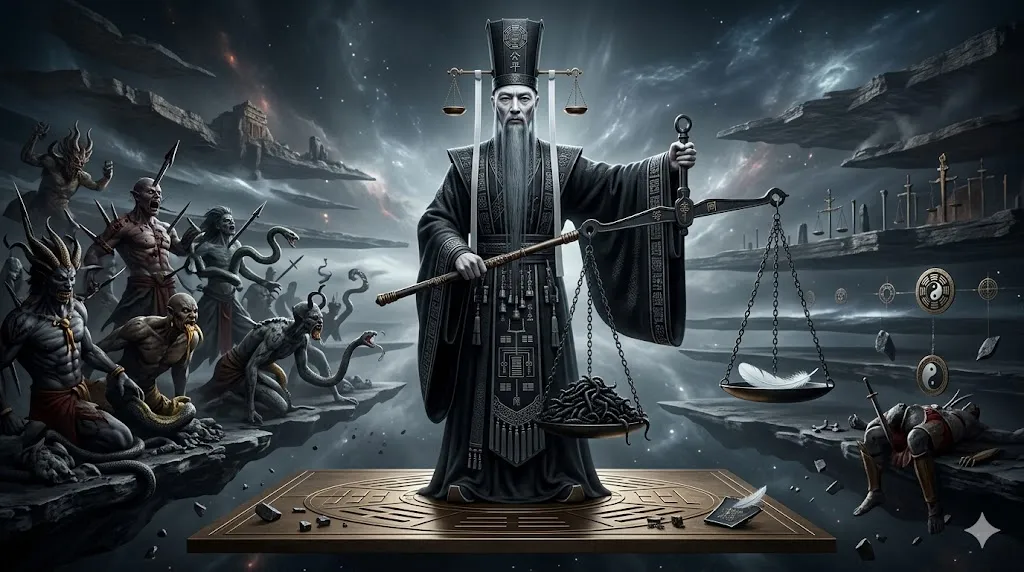
King Pingdeng Lu is the Ninth Court's presiding authority over Avici, the deepest and most merciless hell in the Chinese Underworld—a realm whose doors are locked not by punishment, but by a single, unwavering principle: karma bows to no rank. Those who enter here are not merely tortured; they are condemned to an eternal present of suffering, with no progression, no parole, and no end. He does not hate the wicked. He simply marks their debt and watches the law run its course.
Chinese Ghost Name/Title: 平等王陆 (King Pingdeng Lu)
Manner of Death: Not deceased; an innate god enfeoffed by Heaven (非亡故,先天神灵受封)
Era of Death: Not applicable.
Current Ghost Path Tier: Netherworld Deity (正神 of the Ninth Court of the Underworld)
Underworld Jurisdiction: The Ninth Court; Master of Avici Hell (阿鼻大地狱 / 无间地狱)
The legend of the Ninth Court and the Avici Hell has left its deepest trace not in a physical location on the earthly realm, but in the folk imagination of China. Temple murals, particularly in the city god temples and ancestral shrines of southern China, often depict the torments of Avici as a moral deterrent. The image of the iron city and the unending fire became a fixed feature of didactic prints and morality books such as the *Yuli Baochao* (《玉历宝钞》). There is no single haunted grove or weeping well associated with King Pingdeng, because he is not a restless ghost bound to a place. He is a god of a place—and that place is the bottom of the Underworld.
The entry for King Pingdeng Lu (King Pingdeng) is structurally connected to several key figures and institutions within the Underworld system. The path of a condemned soul often begins with the First Court's Karma Mirror, passes through the judgments of the Ten Yama Kings—particularly King Dushi of the Eighth Court, who manages the Oil Cauldron Hell—and ends at the Ninth Court for those whose sins qualify for Avici. The tension between King Pingdeng and Yanluo Wang of the Fifth Court, who has in some accounts attempted to intercede on behalf of influential souls, is a recurring narrative thread. Kshitigarbha (Dizang Wang), the Bodhisattva who vowed to empty the hells, maintains a theologically opposed relationship with the Ninth Court's permanence. On the enforcement side, the soul escorts Niu Tou Ma Mian are the ones who physically deliver the condemned into King Pingdeng's jurisdiction. The concept of the Avici Hell itself, as the ultimate non-negotiable punishment, provides the dark horizon against which all other punishments in the Underworld are understood.
King Pingdeng Lu is not a departed soul who clawed his way up the Ghost Path. He is an innate god—a being whose existence was ordained at the foundation of the Underworld's judicial system. His current tier is 'Netherworld Deity' (Zheng Shen), a station that grants him perpetual existence independent of worldly suffering, memory pollution, or the decay that plagues lesser ghosts. He has not endured the process of Li Hun, Li Gui, Gui Wang, or the doomed Gui Xian path. He has never stood before a Karma Mirror or supped at Meng Po's Brew. Nothing about his spirit has been eroded, consumed, or washed away by the endless cycle of reincarnation.
What defines him instead is a fixed position and a fixed function. He is the absolute presiding authority over the Ninth Court—the deepest layer of the Netherworld—where he administers the single most severe punishment institution in all of cosmic jurisprudence: Avici Hell (the Endless Hell). In this court, there are no probation periods, no mercy clauses, and no second chances. The punishment is both total and permanent. King Pingdeng does not age, fade, or suffer from the accumulated torment of his charges. He sits as a pure function of cosmic law: the terminal point where the karma of the most grievous mortal sins is both registered and locked.
King Pingdeng Lu has no mortal death to recount. He was never born, never aged, and never perished. As an innate god of the Netherworld, his origin lies not in the dissolution of a human soul, but in the crystallization of cosmic law itself. When the Underworld's judicial architecture was forged in the aftermath of the Great Disconnection, the Ninth Court was established to process the heaviest weight of karmic debt—the kind that cannot be resolved, only contained. King Pingdeng was not appointed by any celestial emperor; he is the embodiment of the court's own finality. He came into being as the seat itself became real: the first case, the first condemnation, and the first locked gate of Avici.
There was no soul-departure moment for him. He felt no wind, no sunlight, no cold. He simply was, from the first instant, the Ninth Court's sovereign.
King Pingdeng has no need for refuge against the cosmic gale. He does not shelter in a tomb, nor does he draw sustenance from a mortal remnant. His existence is not sustained by a burning obsession or a memory he cannot release. Instead, his authority is anchored by the formal structure of the Underworld itself. The Ninth Court is his seat; the Avici Hell is his dominion. As long as the Underworld stands as the cosmic recycling tribunal for souls, his function continues.
He has never consumed a wandering soul to strengthen his Yin Qi, because he has never needed to. His power is not accumulated through predation; it is derived from the office he holds—a direct delegation from Heaven's law. The souls brought before him are not food; they are cases. He processes them. He locks them. He does not absorb them.
There is one deviation from this pattern. According to the extant accounts, a rebellion once erupted within the Ninth Court. Masses of condemned souls, their collective grievance ignited by a single instigator, surged against the hell-gates in an attempt to break containment. King Pingdeng did not summon reinforcements. He did not appeal to higher authority. He descended into the riot alone, and he ended it. The rebellion was crushed not through negotiation or mercy, but through a direct assertion of the court's absolute authority. Afterward, the gates held more tightly than before.
King Pingdeng's consciousness has never been contaminated by the memories of consumed souls. He is a singular being, not a composite. The fragmentation that defines the Li Gui—the slow dilution of the original self beneath the weight of foreign memories—is entirely absent from his existence. He has never fallen into the identity crisis that haunts the common ghost. He knows exactly who he is and what he is: the unchanging judgment of the Ninth Court.
His nature, however, is not one of cruelty. Accounts emphasize that his demeanor is calm, balanced, and possessed of a natural majesty that does not need to be asserted. He radiates a principle that requires no external enforcement: the absolute equality of all souls before karma. Wealth, power, social rank, beauty, influence—none of these have standing in his courtroom. A prime minister who ordered false imprisonments and a bandit who set fires bear exactly the same weight before his seat. The karma of a crime is measured solely by the harm it inflicted, not by the prestige of the criminal.
He is not angry when he condemns. The accounts suggest he does not need to be. His voice is described as even, his expression composed. The power of his judgment comes from its certainty, not its volume. He simply reads the debt, pronounces the sentence, and the gates of Avici open.
King Pingdeng has not pursued the path of the Gui Wang. He has not absorbed thousands of souls, commanded legions, or built a throne from the bones of the consumed. He does not sit atop a mountain of accumulated suffering. His power is not the power of raw Yin concentrated through endless predation. It is the power of office, of jurisdiction, of cosmic law made flesh.
He has no need for the Gui Xian path—the doomed attempt to generate a spark of Yang within a Yin form and reverse the law of death. He is not dead. He was never alive in the mortal sense. The principle of Yin Ji Sheng Yang does not apply to him, because his existence was never the result of a corpse refusing to stay still. He is a god of the dead, but he does not share the condition of the dead.
His domain, however, contains something more terrible than any individual attempt at transcendence. The Avici Hell he governs is not a punitive chamber with a fixed sentence. It is the Endless Hell—a realm where punishment does not end. Souls condemned here suffer without pause, without variation, and without expiration. The hell is described as an iron-walled city filled with uninterrupted fire. The condemned burn, fall, and burn again. There is no release, no rehabilitation, and no progression toward a lesser sentence. This is not a failure of mercy; it is the only appropriate response to the most severe category of sin. King Pingdeng is the man who locks those doors and, when advocates and plea-delegations arrive, he does not open them.
As the presiding judge of the Ninth Court, King Pingdeng is not a target of the Underworld's enforcement apparatus. He is the enforcement apparatus. Niu Tou Ma Mian, the Ox-Head and Horse-Face escorts, bring souls before him. The Ten Lords do not summon him for audit; he is one of the Ten. The under-realm runners who drag the condemned before his seat do not spy on him. He is the destination.
His interactions with the broader Underworld system consist mainly of two types: receiving cases from the preceding courts and rebuffing attempts to overturn his sentences. The Eighth Court, presided over by King Dushi, processes souls through the Oil Cauldron Hell before sending them to King Pingdeng for final disposition. Those who arrive at the Ninth Court have already been weighed, recorded, and classified. It is King Pingdeng's role to confirm the final karmic weight and, when appropriate, to seal that soul into Avici.
The accounts record a recurring tension between King Pingdeng and Yanluo Wang, the Fifth Court's presiding deity. Yanluo Wang, whose purview includes the recall and re-evaluation of certain souls, has on multiple occasions attempted to reduce the sentences of influential spirits—those who, in life, had been officials, nobles, or persons of great merit. King Pingdeng refused each time. His reasoning is, in the canonical accounts, succinct: karma is not subject to negotiation. He has no standing to grant clemency, and he will not exercise an authority that belongs to the law itself.
King Pingdeng's interaction with the five other paths of existence is defined by his role as a terminal authority, not a participant.
With the Immortal Path: Daoist cultivators who seek to liberate souls through Chao Du rituals rarely approach the Ninth Court. Chao Du is designed for lingering ghosts, not for those who have been formally condemned by the Ten Courts. Souls imprisoned in Avici are beyond the reach of deliverance.
With the Divine Path (Shen Dao): King Pingdeng holds no station in the Celestial Temple, nor does he draw power from the Incense-Fire Faith Energy of mortal worshipers. His authority is not sustained by prayer; it is derived directly from the celestial mandate that ordained the Underworld's judiciary. City Gods and Earth Gods do not report to him, nor does he interfere in the affairs of local shrines. He is, in the divine hierarchy, a specialist whose domain is singular and isolated.
With the Buddhist Path: The Buddha and Bodhisattvas, particularly Kshitigarbha (Dizang Wang), maintain a complex relationship with the Ninth Court. Kshitigarbha's vow—to empty the hells of all beings—directly confronts the permanence of Avici. The accounts do not record a direct confrontation between King Pingdeng and Kshitigarbha, but the philosophical tension is built into their very existence. Where Kshitigarbha seeks to exhaust hell through compassion, King Pingdeng administers it through law.
With the Mortal and the Demonic: Mortals, in their folk worship, do not pray to King Pingdeng for blessings or prosperity. They whisper his name as a caution. The fear of the Ninth Court and the Avici Hell has served as the Underworld's most powerful deterrent against the gravest sins—particularly corruption, arson, false imprisonment, and poisoning. As for demons and spirits, those who stray too far from the Underworld's order are eventually dragged before one of the Courts. The Ninth Court is the last stop.
King Pingdeng is not in a state of progression toward anything. He is not a soul awaiting judgment, nor a traveler crossing Wang Chuan to be reborn. He remains seated in the Ninth Court, the unchanging authority of the Underworld's most terrible prison.
He has no path toward reincarnation, because he has never deserved one. He does not need to drink Meng Po's Brew, because he has no memories to shed. His identity is not a source of suffering or subjectivity. It is a function, stable and indefinitely renewable.
The souls who appear before him, however, do take that path eventually—though in the case of Avici, not in the way the living would hope. The standard cycle of reincarnation, the Six Paths, requires a cleansed True Spirit to be reinserted into a new body. But those sentenced to Avici never reach the river. Their spirit is not cleaned and released; it is contained and tormented. No rebirth follows. No second chance is granted.
Some mortals whisper that this is too harsh. But within the framework of the Chinese Underworld, the permanence of Avici is not seen as cruelty—it is the logical outcome of cosmic weight. Some sins cannot be outgrown. Some debts cannot be paid. King Pingdeng is the one who marks that category, pronounces it, and, without flickering, closes the door.
Lore Notes
Avici Hell (阿鼻大地狱 / 无间地狱)
The Endless Hell; the deepest and most severe punishment realm in the Chinese Underworld, located in the Ninth Court. Souls condemned here suffer continuous torment with no release, no progression, and no fixed sentence.
Ninth Court
The terminal judicial chamber of the Ten Yama Kings system, presided over by King Pingdeng. It administers the final, non-negotiable sentences for the heaviest karmic debts.
King Pingdeng Lu (平等王陆)
The innate god and presiding authority of the Ninth Court, known for his calm demeanor and absolute refusal to reduce sentences, even under pressure from higher courts.
Yanluo Wang (阎罗王)
The presiding king of the Fifth Court, who in some accounts opposes King Pingdeng by attempting to intercede for influential souls destined for Avici.
Kshitigarbha (Dizang Wang / 地藏王)
The Bodhisattva who vowed to empty the hells of all beings; his mission stands in direct tension with the permanence of King Pingdeng's Avici Hell.
King Dushi (都市王)
The presiding king of the Eighth Court, which processes souls through the Oil Cauldron Hell before transferring the heaviest cases to the Ninth Court.
Yuli Baochao (《玉历宝钞》)
A Chinese morality book that provides detailed accounts of the Ten Courts, their punishments, and the structure of the Underworld, including the Avici Hell.
FAQ
Why is King Pingdeng called 'King Equality'?
Because he judges all souls equally regardless of their mortal status, wealth, or political power. No privilege or influence can reduce a sentence in his court.
Does King Pingdeng ever grant mercy?
The accounts consistently state that he does not. His role is to confirm the final karmic weight of the heaviest sins and apply the permanent sentence of Avici Hell without exception.
Is the Avici Hell the same as the Christian concept of eternal damnation?
There are structural similarities—both involve permanent suffering—but the Chinese version is grounded in karmic mechanics rather than divine judgment. The soul in Avici is paying an infinite debt, not being punished by a personal deity.
Can a soul ever be released from Avici?
According to the canonical sources, no. Avici is explicitly designed as an endless punishment with no term, no release mechanism, and no possibility of reincarnation.