Eastern Mythology Encyclopedia
King Dushi
都市王
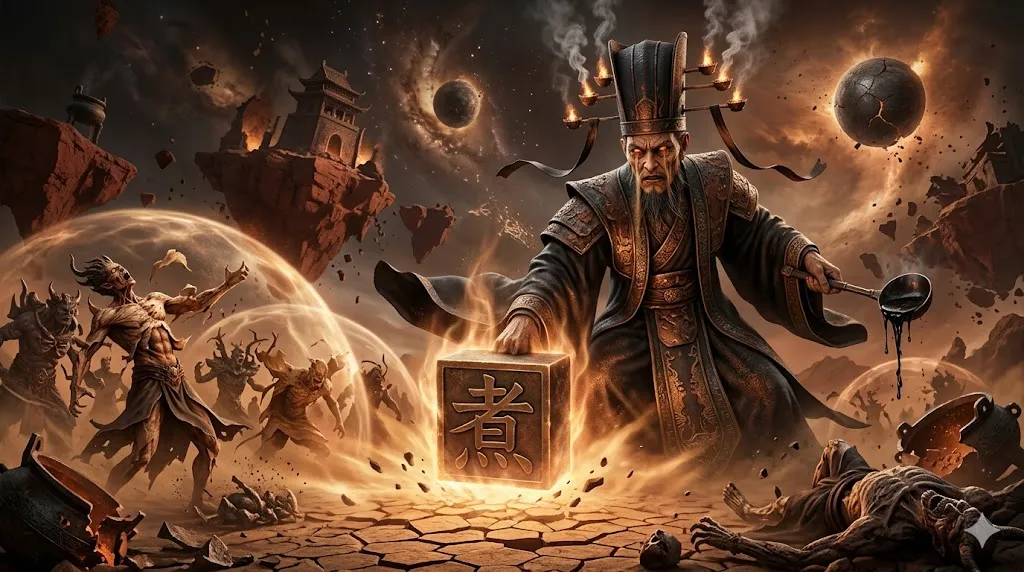
King Dushi (都市王 Huang, the Eighth Yama King of the Underworld) does not judge all souls—only those who have broken the oldest bond: the bond between parent and child. He presides over the Great Heat Torment Hell and the Oil Cauldron Hell, where the filially impious are boiled and scalded until their karmic debt is burned away.
都市王黄 (King Dushi Huang)
非亡故,先天神灵受封 (Not deceased; innate god enfeoffed by Heaven)
Birth Era: Post-Great Disconnection, during the establishment of the Ten Courts
Current Ghostly Stage: Netherworld Guardian Deity (幽冥地府正神)
Underworld Jurisdiction: Eighth Court of the Ten Yama Kings
The Eighth Court of the Ten Yama Kings is recorded in the *Jade Records Calendar* (《玉历宝钞》) and the *Yama King Sutra* (《阎罗王经》). Temples dedicated to the Ten Kings of the Underworld often feature a hall for King Dushi, with iconography showing him seated before a boiling oil cauldron, holding a scroll listing the names of unfilial souls. The Oil Cauldron Hell has become proverbial in Chinese folk religion as the most feared punishment for those who mistreat their parents. Specific geographic sites where King Dushi is especially venerated are not recorded; his cult is diffused through the broader Ten Kings tradition.
The role of King Dushi within the Underworld is intimately connected to the broader framework of the Ten Yama Kings. His court is the eighth station in the soul's processing journey, following the judgments of King Tai Shan (第七殿泰山王) and preceding the final court of King Bian Cheng (第九殿平等王). His jurisdiction over filial impiety complements the domains of the other kings: King Chujiang handles betrayal and theft, King Songdi handles rebellion and murder, and King Wuguan handles fraud and heresy. Together, the Ten Courts form a comprehensive judicial system that leaves no karmic sin unexamined. King Dushi's specific collaboration with King Songdi—strengthening cross-court trials for especially severe filial crimes—illustrates the interdependence of the courts. Additionally, King Dushi's jurisdiction is overseen by the Bodhisattva Kshitigarbha (地藏王菩萨), who has vowed to save all souls from the hells and may intercede on behalf of a repentant soul.
King Dushi is a Netherworld Guardian Deity, a fixed office within the Underworld bureaucracy. He did not pass through the stages of Li Hun, Li Gui, or Gui Wang. As an innate god enfeoffed by Heaven, he has never experienced soul departure or the erosion of memory. His existence is bound to his court and the punishments he administers. He has presided over the Eighth Court since its founding, a span measured in cosmic ages rather than mortal years. His state is one of cold, unyielding authority: he does not waver, he does not forget, and he does not relent. The only law that governs his being is the Celestial Decree that established the Ten Courts.
King Dushi never died. There was no moment of flesh separating from spirit, no shock of losing the body's warmth. He was born into being as a god—a manifestation of divine order tasked with enforcing the highest ethical law of the human realm: filial piety. When the Celestial Decrees were written after the Great Disconnection, the need for a court dedicated to punishing the unfilial became clear. King Dushi was created for that purpose, fully formed, with a cold awareness of every sin against family order. He has no memory of a human life, no wound of attachment, no ghostly loneliness. He is the law itself, made into a judge.
Without a fleshly sheath to protect him, King Dushi has no need of shelter from the Cosmic Gale—his deity body is woven from the condensed Yin energy of the Underworld, impervious to erosion. His power does not come from consuming wandering souls; it comes from his office, granted by the Celestial Court and sustained by the karmic weight of every judgment he passes. Yet he does not sit idle. The Eighth Court is his domain, and within it he has built two hells: the Great Heat Torment Hell and the Oil Cauldron Hell. These are not places of random suffering. Each punitive device—a vat of boiling oil, a cauldron of searing broth—is calibrated to the specific sin of the soul brought before him. The soul must endure a precise number of immersions, each one matched to the degree of neglect or cruelty shown to their parents. The pain is not gratuitous; it is the only currency that can cleanse a debt of filial impiety.
King Dushi has never descended into the splintered consciousness of a Li Gui. His identity is whole, unassailable. The souls he judges, however, often arrive as composites—victims of their own accumulated karmic memory. He does not consume them; he reads them. When a soul stands before his court, every instance of filial failure is laid bare, not through interrogation but through the spectral display of the Karma Mirror. King Dushi watches the soul's own memories of abandoning an elderly mother, of striking a father, of stealing an inheritance. He does not need to absorb those memories to understand them. His judgment is cold, precise, and without any trace of the internal chaos that defines a Li Gui. He is the judge, not the haunted.
King Dushi has never walked the path of Gui Wang. He commands no ghost legions, and his authority is vested not in accumulated Yin energy but in his divine office. Nor has he attempted the Gui Xian inversion of Yin to Yang. As a netherworld deity, his existence is stable and eternal within the Underworld's framework. The path of reversing death's law does not apply to one who never died. His court and its hells are his entire domain; there is no ambition beyond the bounds of his given duty. The only ascension he recognizes is the final purification of a sinner's soul, after which the soul may be reborn—not into glory, but into a chance to do better in the next life.
King Dushi is not a soul to be fetched; he is one of the fetchers. His role is integral to the Underworld's functioning. When a soul's karmic record shows sins of filial impiety, the Soul Escorts of the Eighth Court—not Ox-Head and Horse-Face, but his own designated messengers—deliver it to his hall. He never stands before the Karma Mirror himself; he is its wielder. The Mirror Platform in his court reveals the soul's entire life in a panorama of filial failures. King Dushi has never faced Meng Po's Brew or the River of Oblivion, nor will he ever. His existence is outside the cycle of reincarnation—a fixed point in the Underworld's geometry. The only souls who cross his threshold and later sip Meng Po's Brew are those he has deemed purified.
King Dushi's relations with other paths are formal and functional. With the Daoist path, he shares the principle of cosmic justice: his punishments are not arbitrary but a direct application of karmic law. With the Shen path, he is a deity himself, answering to the Celestial Court as all netherworld gods do. His relationship with Buddha-path is complex: while the Buddha-path offers soul deliverance and compassion, King Dushi's court operates on the assumption that suffering is a necessary component of purification. Buddhist monks who chant the *Sutra of the Bodhisattva Kshitigarbha* may petition for a soul's early release, but King Dushi only grants such petitions if the soul's unfinished punishment has been commuted by a higher authority—specifically, the Bodhisattva Kshitigarbha himself. With mortals, his name is invoked in tales of filial piety's consequence, and temples dedicated to the Ten Yama Kings often include his statue along with a small oil cauldron as a warning. No demon or Yao has authority over him; he is of the highest order of netherworld authority.
King Dushi continues to preside over the Eighth Court, his existence unchanged since the establishment of the Ten Courts. He has no intention of leaving his post, nor is there any mechanism by which a Yama King can be replaced. His court processes souls daily, and the Great Heat Torment Hell and Oil Cauldron Hell operate without pause. The souls he judges, once they have completed their prescribed sentences, are given a final rite: they must kowtow before the manifested spirits of their parents and beg forgiveness. Only after that act of contrition may they proceed to the Sixth Court for onward processing toward reincarnation. King Dushi himself will never face reincarnation. He is a permanent fixture of the Underworld, a cold and necessary component of the cosmic justice system.
Lore Notes
Da Re Nao Di Yu (大热恼地狱)
The Great Heat Torment Hell; a punishment realm under King Dushi where souls are subjected to scalding heat and boiling oil to cleanse the karmic stain of filial impiety.
You Guo Di Yu (油锅地狱)
The Oil Cauldron Hell; a specific punishment apparatus within the Eighth Court where unfilial souls are immersed in boiling oil for a fixed number of cycles based on the severity of their sin.
Kowtow Repentance (叩头忏悔)
The final rite of purification before a soul may leave the Eighth Court; the soul must kneel before the spirit of its parents and beg forgiveness, after which it proceeds to reincarnation processing.
Yama King Office (阎罗王殿)
The generic term for the court-hall of a Yama King, conceived as a combination of tribunal and torture chamber.
Jade Records Calendar (玉历宝钞)
A major Chinese folk text detailing the Ten Yama Kings and their hells, widely circulated as a moral guidebook.
FAQ
Why is King Dushi the only Yama King who specializes in punishing the unfilial?
In the Chinese ethical framework, filial piety is considered the root of all virtues. King Dushi's exclusive jurisdiction over this sin reflects the cosmic importance of honoring one's parents.
How long do souls suffer in the Oil Cauldron Hell?
The duration is proportional to the karmic debt. A soul may be boiled daily for centuries. King Dushi has the authority to adjust the sentence based on the sincerity of the soul's eventual repentance.
Can a soul avoid King Dushi's judgment if they repent before death?
Repentance before death can reduce the severity of the sentence, but the soul must still face the Eighth Court for a formal assessment. The Karma Mirror reveals all, and King Dushi's judgment is based on the full record, not just last-minute contrition.