Eastern Mythology Encyclopedia
King Taishan
泰山王
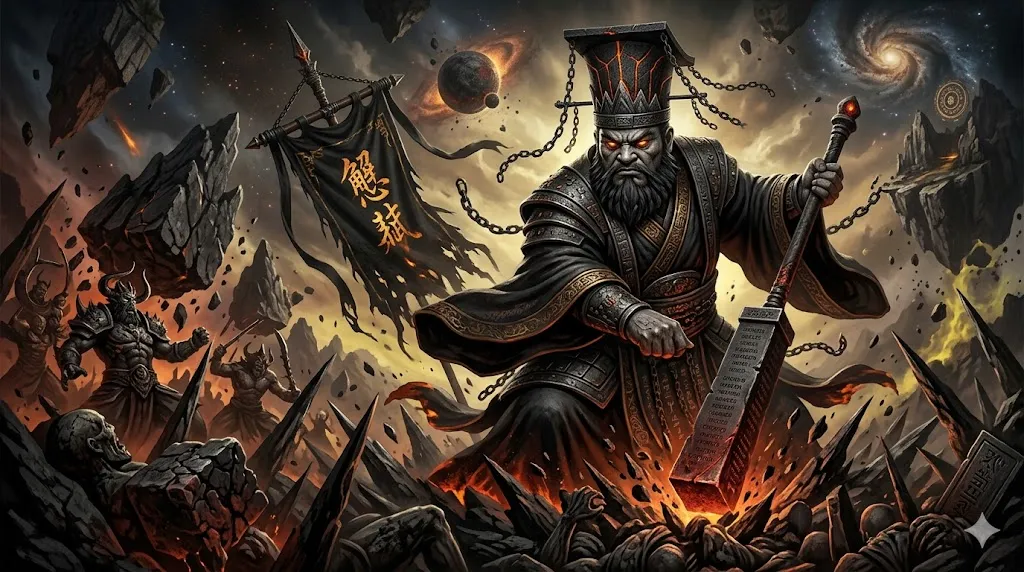
King Taishan (泰山王), the ruler of the Seventh Court of the Underworld, does not judge the dead for their sins against the cosmos or the gods — he judges them for sins against family and fair commerce. His chamber is not a throne room of terror, but a cold, quiet hall where the crunching of stone grinding human flesh can be heard through the walls.
泰山王董 (King Taishan Dong)
非亡故,先天神灵受封 (Not deceased; innate god enfeoffed by Heaven)
Enfeoffment Era: Unknown (Post-Great Disconnection, during the establishment of the Ten Courts of Yama)
Current Gui Path Level: Netherworld Deity (幽冥地府正神)
Underworld Jurisdiction: Seventh Court, Millstone Hell Domain
* **Mount Tai (泰山):** In the mortal world, Mount Tai is considered the physical gateway to the Underworld. Temples to King Taishan are found in notable clusters in Shandong and Henan provinces.
* **Millstone Hell Folklore:** The image of the grinding millstone has passed into folk idiom as the ultimate symbol of merciless retribution against cheats and swindlers.
* **Folk Curse Sites:** On certain old trees along pilgrimage routes to Mount Tai, pieces of paper naming fraudulent merchants are nailed with a written plea: "Send this to King Taishan."
This entry connects to the broader cosmic framework of the Seven Paths, specifically the Shen Dao and the Gui Dao. King Taishan is one of the Ten Yama Kings, and his jurisdiction aligns closely with that of King Wuguan of the Fourth Court. His relationship with Ksitigarbha Bodhisattva provides a dynamic tension between strict justice and compassionate mercy. The Millstone Hell he administers is a key feature of the Underworld geography described in the *Jade Records* scriptures. Souls who have committed fraud and family betrayal are processed by his court before entering the cycle of reincarnation.
King Taishan is not a Gui who ascended through the ghostly ranks of Li Hun, Li Gui, or Gui Wang. As an innate god, he was directly enfeoffed by Heaven to serve as the warden of the Seventh Court of the Underworld. His existence is that of a Netherworld Deity — a being who possesses a divine office granted by cosmic authority, sustained by the collective incense-fire faith of mortals who fear his judgment. He has never experienced the sensory deprivation of Li Hun, the memory pollution of Li Gui, or the desperate Yin Ji Sheng Yang gamble of Gui Xian. His state is stable, permanent, and bound by the iron framework of Tian Tiao.
King Taishan has no moment of death to narrate. He did not perish in war, disease, or unresolved grief. As an innate god — a being born directly from cosmic energies rather than from a mortal womb — he was never subject to the separation of San Hun Qi Po. His appointment to the Seventh Court was a transfer of cosmic office, not a passage through death. He did not watch his hand pass through a loved one's shoulder, nor did he cower from the Gang Feng in a hollow grave. His existence began already clothed in authority, already established as a pillar of the Netherworld's bureaucratic machinery.
Without a mortal death, King Taishan had no initial shelter to seek. His "shelter" is the Seventh Court itself — a vast, stone-hewn chamber deep within the You Ming Di Fu, perpetually lit by the cold flame of karma lamps. His Yin Qi is not a thing he accumulated through survival and predation; it is the power of his divine office, drawn from the collective dread and awe of mortals who know his name. He does not need to consume wandering souls to sustain himself. The Millstone Hell beneath his court is not a place where he feeds — it is the tool of his craft, the mechanism through which he enforces cosmic justice. He is not a consumer of souls; he is their processor.
King Taishan remains wholly himself. He has not experienced the identity contamination that defines the Li Gui. His memory is not a patchwork of stolen lives; his thoughts are not interwoven with the dying screams of strangers. He knows exactly who he is: the warden of the Seventh Court, the judge who grinds the wicked into paste and reforms them only to grind them again. This clarity is not a privilege of mercy — it is a requirement of his office. A judge who cannot separate his own voice from the voices of the damned cannot render just sentences. King Taishan's voice is his own, and it has never wavered.
King Taishan has not walked the path of the Gui Wang or the Gui Xian. He has never needed to ingest thousands of souls to gain power, nor has he needed to attempt the impossible reversal of Yin Ji Sheng Yang. His domain — the Millstone Hell — is his expression of power. Here, souls guilty of fraudulent commerce and the destruction of family bonds are cast into a great millstone. Their ghostly bodies are crushed into a paste, every bone, organ, and ligament ground to a fine slurry. Then, by the laws of the Netherworld, they are restored to their original form, only to be cast into the millstone again. This cycle repeats for a fixed term — often centuries, depending on the severity of the crime. King Taishan does not see this as cruelty. He sees it as a proportional reckoning: a soul that squeezed the life savings from the elderly must itself endure the sensation of being squeezed into nothing.
King Taishan *is* the Underworld's authority for the judgment he administers. He sits at the Nie Jing Tai of the Seventh Court, before which every soul convicted of financial fraud or familial rupture is brought. The Nie Jing Tai shows the full scope of the soul's karmic record — every lie told to a dying parent, every contract forged to steal an inheritance, every false medicine sold to desperate patients. King Taishan reads this record without expression, then announces the sentence. The soul is then taken to the Millstone Hell. King Taishan has not stood before the Wang Chuan or faced Meng Po Tang; his role is to send others there, not to cross it himself.
King Taishan interacts with the other paths in his capacity as a Netherworld Deity:
* **Xian Dao (仙道):** During his initial tenure, a Daoist cultivator with advanced soul-seeing ability once accused him of excessive cruelty. King Taishan replied that the cultivator had never been cheated out of his dying mother's medicine money. The cultivator left the Underworld in silence.
* **Shen Dao (神道):** He maintains a formal alliance with King Wuguan of the Fourth Court, with whom he standardized the sentencing guidelines for fraud across the Ten Courts. The local City God and Earth Gods in his domain report to him regularly, providing records of notable fraudulent acts committed among the living.
* **Fo Dao (佛道):** Ksitigarbha Bodhisattva (地藏菩萨) once admonished him directly, noting that the Millstone Hell's sentence of over a thousand years for a repentant offender was excessive. King Taishan accepted the guidance and introduced a commutation clause: souls who actively repented and whose family had returned the stolen wealth while they lived could have their sentence reduced.
* **Mortal World:** King Taishan has no direct interaction with the living, but his name is invoked in folk curses against unscrupulous merchants. The phrase "May the King of Mount Tai grind your bones" is still used in rural markets.
King Taishan remains in his current state — a Netherworld Deity presiding over the Seventh Court. He has not been reassigned, demoted, or retired. His court processes a steady stream of souls, and the Millstone Hell grinds continuously. He is not at risk of dissipation, as his existence is not sustained by self-cultivation but by the cosmic office of judge and the faith-energy of those who fear and respect his judgment. His tenure is as permanent as the law itself.
Lore Notes
King Taishan Dong
The full designation of the ruler of the Seventh Court; Dong is his clan name, given upon cosmic enfeoffment.
Seventh Court of the Underworld
One of the Ten Courts of Yama, overseen by King Taishan, specializing in the judgment of fraud and family destruction.
Millstone Hell (磨磨地狱)
The specific punishment realm under King Taishan where guilty souls are repeatedly ground into paste by a great millstone and then restored, cyclically, for a fixed term.
Ksitigarbha Bodhisattva (地藏菩萨)
A bodhisattva who protects beings in the Underworld; he once counseled King Taishan toward tempering justice with mercy.
King Wuguan (五官王)
The ruler of the Fourth Court of the Underworld, who cooperated with King Taishan to standardize fraud sentencing guidelines.
Commutation Clause
A reduction in punishment offered to souls who actively repent and whose families have returned the stolen wealth; introduced after counsel from Ksitigarbha.
FAQ
Is King Taishan a ghost?
No. He is a Netherworld Deity, an innate god enfeoffed by Heaven. He was never born, never died, and does not follow the ghostly path of sensory deprivation or memory contamination.
What crimes does King Taishan judge?
He judges financial fraud — selling fake medicine, tricking the elderly out of their savings — and actions that tear apart family bonds, such as manipulating relatives for gain.
What is the Millstone Hell?
A specific punishment realm where the condemned soul is repeatedly ground into paste by a millstone and then restored, only to be ground again, for a fixed term proportional to the severity of the crime.
Can a soul be forgiven in King Taishan's court?
Yes. After counsel from Ksitigarbha Bodhisattva, King Taishan introduced a commutation clause: if the soul genuinely repents, and if the stolen wealth was returned while the soul was alive, the sentence may be reduced.
Does King Taishan interact with the living world?
Not directly, but his name is used in folk curses against corrupt merchants, and temples to him exist along the Mount Tai pilgrimage route.