Eastern Mythology Encyclopedia
King Biancheng
卞城王
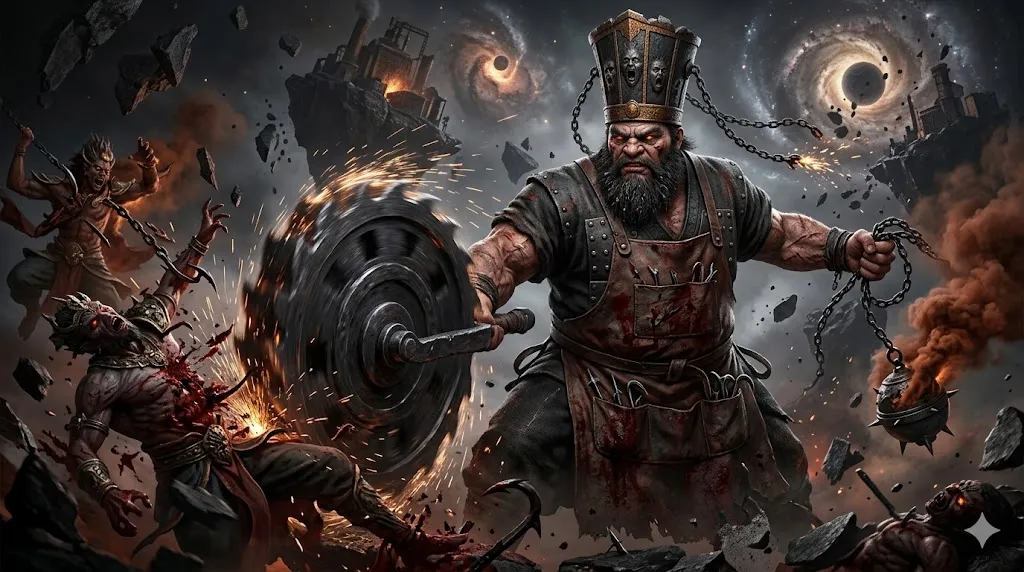
King Biancheng Bi (卞城王毕) is not a ghost—he is the iron-handed judge of the Sixth Court of the Underworld, a deity whose blazing hells exist to burn the resentment out of souls who dared curse heaven and earth. His court is the final reckoning for those who chose death by their own hand, and his fires are the only mercy they will ever know.
卞城王毕 / King Biancheng Bi (Lord of the Sixth Court, also known as King Biancheng)
亡故方式: 非亡故,先天神灵受封 / Not deceased; innate god enfeoffed by Heaven
亡故纪元: Not applicable (born from the Dao as a primordial spirit; court enfeoffment occurred after the Great Disconnection)
当前鬼道层级: Netherworld Deity (Yanluo King of the Sixth Court)
幽冥归属: Underworld, Sixth Court (第六殿)
Shrines dedicated to King Biancheng exist in many Chinese temples, often as part of a complex of Ten Yama Kings. The most notable is within the Dongyue Temple (东岳庙) in Beijing, where a full court of the Ten Kings is enshrined. Folk tradition holds that on the day of a suicide’s funeral, family members should burn spirit-money and pray to King Biancheng for leniency. Some regions also maintain a small “City of Wrongful Death” festival, where paper replicas of the city are burned to comfort the souls of the restless dead.
This entry is closely associated with the broader structure of the Underworld court system. King Biancheng’s court interfaces directly with King Qinguan’s First Court, which processes initial judgment, and the Fifth Court, which handles the hells for greed and theft. His own Sixth Court oversees the City of Wrongful Death and the Great Burning Hell. The Burning-Tongue Hell, a subsection of his domain, is reserved for those who blasphemed gods during life. His policy linking suicide punishment to the blessings of surviving families is a unique karmic innovation shared with King Qinguan. For a full understanding of the Ten Yama Kings and the Underworld processing pipeline, readers should consult the entries for Qinguang, the City of Wrongful Death, and the Great Burning Hell.
King Biancheng is a Netherworld deity, not a wandering ghost. He holds a fixed divine office within the Underworld’s bureaucratic hierarchy, sustained by the Celestial Decrees and the incense-fire faith energy of mortals who pray to him. His existence is stable and eternal—neither decaying like a lingering soul nor progressing toward transcendence. He has presided over the Sixth Court since the Underworld’s court system was established after the Great Disconnection. Unlike the Li Hun (departed souls) who are dragged into his hall trembling, he has never known the weakness of bodiless exposure. His Yin power is immense, but it is channeled entirely through his office: he does not consume ghosts, he judges them. The core feature of his state is absolute authority within his domain—a cold, unyielding permanence that mirrors the iron law of retribution he enforces.
King Biancheng’s own death does not exist. He was never born, never lived, never died. But every soul brought before his throne carries a death—and he sees it. The noose-burnt neck, the shattered skull from a jump, the grey-blue skin of a drowning. Through the Karma Mirror Platform (Nie Jing Tai) in his court, he witnesses the final moments of each accused: the moment resentment curdled into self-destruction, the last breath that was a curse against heaven. He does not flinch. He has watched this scene a million times. The souls who stand before him have already lost the protection of flesh; they are bare consciousness, exposed in the cold air of the court. But King Biancheng is not here to protect them. He reads their death like a sentence, and then he pronounces their true sentence—the punishment that will burn away the poison they carried into the afterlife.
King Biancheng needs no shelter from the cosmic wind. His throne is the Sixth Court, a vast stone hall lit by the glow of distant hell-fires. But the souls he judges do need shelter—from their own unresolved hatred. He built one: the City of Wrongful Death (枉死城), a precinct within his domain where souls who died by suicide or violent accident are held until their resentment cools. Inside, they cannot harm others; they can only pace and remember. The walls are etched with the faces of those they left behind. For those whose resentment burns too hot, he has a harsher shelter: the Great Burning Hell (大火烧地狱). There, the soul is wrapped in flames that do not kill—they purify. King Biancheng does not believe in gentle persuasion. He believes that a soul must be made to feel the weight of its own curse before it can let go. The fire is his only method of speech.
King Biancheng does not consume other souls. He is not a Li Gui (vengeful spirit) who accumulates foreign memories and loses himself. His consciousness is whole; his identity has never been contaminated. But he is surrounded by Li Gui—the souls he judges are almost all composite beings, stitched together from the memories of those they harmed or the people they absorbed before being dragged to court. He sees them clearly: a merchant who cursed the gods after bankruptcy, his soul faintly stained with the tears of his employees; a woman who threw herself into a well after a broken heart, her ghost now tinged with the lingering touch of every man who betrayed her. King Biancheng feels no confusion about who he is. His self is fixed—anchored in his duty. But he understands that the souls before him have lost themselves, and that the only way to give them back a clean start is to burn the contaminations away. He does not mourn them. He sentences them.
King Biancheng is not a Gui Wang (Ghost King) nor a Gui Xian (Ghost Immortal). He is a deity—a permanent office-holder within the Underworld, not a creature of accumulated ghostly power. Still, his domain contains horrors that rival any ghost king’s. The Great Burning Hell (大火烧地狱) is his creation: a realm where the fire never dies, fed by the Yin energy of the vengeful. Souls are immersed in this flame for decades, centuries—until every knot of resentment is vaporized. One scholar who had cursed the gods was thrown into the Fire-Tongue Hell (火烧舌狱) for a hundred years; his screams could be heard through the stone walls. King Biancheng watches without pleasure or pity. He considers this the only real justice for those who rejected the gift of life. His path is not one of transcendence; it is the steady, endless administration of cosmic balance through pain. There is no thunder from heaven to challenge him—he is heaven’s own wrath in the underworld.
King Biancheng is the Sixth Court. He does not flee from soul escorts—he commands them. Ox-Head and Horse-Face (Niu Tou Ma Mian) deliver the condemned directly to his hall. The Ten Yama Kings (Shi Dian Yan Luo) are his peers; he has conferred with King Qinguang of the First Court to link the punishment term of suicides to the blessings of their surviving families—a policy that discourages self-destruction while preserving karmic continuity. He has never stood before the Karma Mirror; he is the one who gazes into it on behalf of the court. He has never approached the River of Oblivion (Wang Chuan) or been offered Meng Po’s Brew. He is the gatekeeper of the path—not the traveler. His only interaction with the final crossing is to release cleansed souls from his hells, sending them onward to the Seventh Court or directly to the river, stripped of their anger and ready to forget.
King Biancheng interacts with all five other paths, but he is firmly within the Shen (神) path—a god bound by the Celestial Decrees and sustained by incense-fire faith energy. Daoist cultivators occasionally recite sutras to deliver souls under his jurisdiction, but those souls must still face his judgment first; the sutras can ease the pain but not cancel the sentence. Buddhist monks offer the Deliverance Ritual (Chao Du) for the dead, especially for suicides; King Biancheng respects their compassion but insists that the fire must come first—even the Buddha’s mercy cannot erase a debt that has not been paid. Local earth gods (Tudi) and city gods (Chenghuang) report to him on cases of unnatural death within their regions; he expects thorough reports. Mortals fear him. They light incense and leave offerings at his shrines not out of love, but to ask him to be lenient with their dead—or to warn the living not to take the path of self-harm. He does not seek their affection. He only demands that they understand: life is a loan from heaven, and those who throw it away owe a debt that even death cannot cancel.
King Biancheng’s current state is permanent. He sits on his throne in the Sixth Court, day and night without end, judging the endless stream of souls that arrive from the Fifth Court. He will never be reborn, never dissipate, never transcend. The only change is the accumulation of knowledge: each soul he judges teaches him a new shade of human despair, a new reason to despise ingratitude. But he does not tire. The cosmic machinery of the Underworld requires his presence, and he will perform his function until the heavens themselves dissolve. For the souls he judges, the outcome is always either release after purification or transfer to deeper hells. Those who complete their sentence in the Great Burning Hell are sent onward, their memories of resentment scoured clean, ready to receive Meng Po’s Brew and enter a new life—innocent, light, and utterly forgetful of the fire that saved them. King Biancheng never sees them again. He does not look back.
Lore Notes
City of Wrongful Death (枉死城)
A precinct within King Biancheng's Sixth Court that holds souls who died by suicide or violent accident until their resentment fades; a holding cell for the restless dead.
Great Burning Hell (大火烧地狱)
The primary punishment realm of the Sixth Court, where souls are immersed in everlasting fire to burn away resentment and karmic stains from cursing heaven or self-inflicted death.
Fire-Tongue Hell (火烧舌狱)
A sub-hell under King Biancheng's jurisdiction reserved for those who actively cursed heaven or divine beings during life; their tongue is perpetually burned for a set term.
Burning-Tongue Hell (火烧舌狱)
Alternate spelling of Fire-Tongue Hell; see above.
King Qinguan (秦广王)
The Yanluo King of the First Court, who reviews initial karma before souls are sent to lower courts; collaborated with King Biancheng on linking suicide punishment to family blessings.
Dongyue Temple (东岳庙)
A major Taoist temple complex in Beijing that contains a full shrine to the Ten Yama Kings, including King Biancheng.
FAQ
Why does King Biancheng punish suicides so harshly?
In Chinese cosmic law, life is a loan from heaven. Taking one’s own life is a rejection of that loan, and the resentment disrupts natural balance. The fire burns away that negative energy so the soul can re-enter the cycle clean.
Is King Biancheng a ghost or a god?
He is a god—an innate spirit enfeoffed by Heaven as a Yanluo King. He never died, never wanders, and his existence is sustained by divine office and incense offerings, not ghostly survival.
What is the City of Wrongful Death?
A holding area within the Sixth Court where souls who died by suicide or accident wait until their natural lifespan would have ended. It is not a torture realm, but a place of forced reflection and cooling of resentment.
Can a suicide’s family help reduce the punishment?
Yes. King Biancheng worked with King Qinguan to link the sentence length to the blessings of surviving family members. If the family performs good deeds or offers sincere prayers, the soul’s time in the burning hell may be shortened.
Does the Great Burning Hell destroy the soul?
No. The fire does not annihilate the True Spirit (Zhen Ling). It only burns away accumulated resentment and karmic stains, leaving the core soul clean for reincarnation. The soul still remembers nothing after Meng Po’s Brew.