Eastern Mythology Encyclopedia
King Yanluo
阎罗王
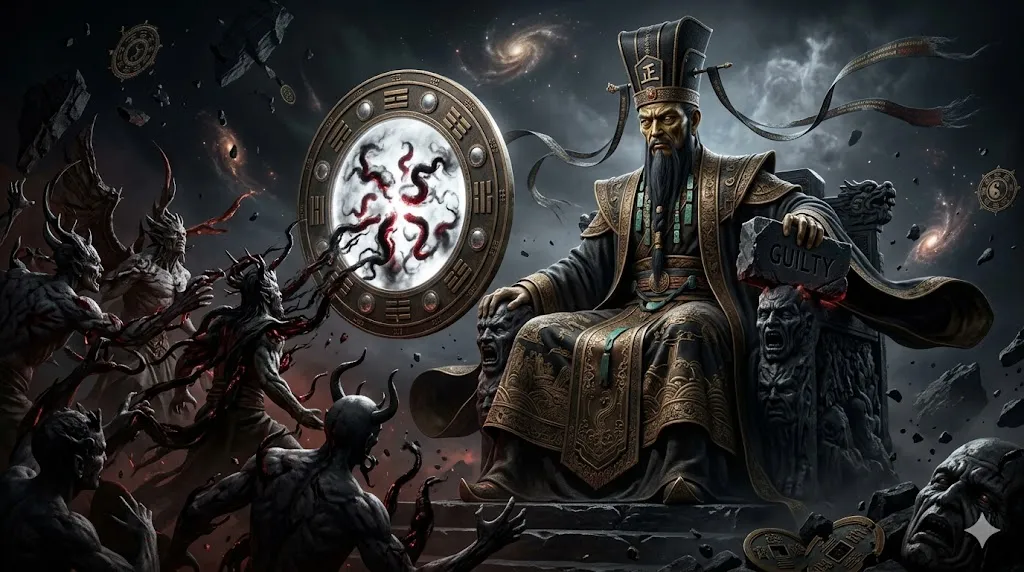
Yanluo Wang (King Yanluo, the fifth and most feared judge of the Underworld) does not merely weigh your sins—he has the authority to overturn every verdict passed before you arrived at his court. The dead who plead, repent, or stall their way through the first four courts find no mercy here: King Yanluo reviews the entire record, and if he finds a miscarriage of justice, he corrects it. And if he finds there is no error, he will see that the sentence is carried out without a single day of leniency.
阎罗王 (King Yanluo) / 阎罗王包 (King Yanluo Bao)
亡故方式: 非亡故,先天神灵受封,民间常认为由包拯死后担任 (Not deceased; a primordial spirit appointed to the office, often popularly identified as the posthumous incarnation of Bao Zheng)
魂之道龄: Since the establishment of the Ten Courts at the dawn of the current cosmic order
当前鬼道层级: You Ming Di Fu Zheng Shen (正神, a properly appointed divine official of the Netherworld Court)
幽冥归属: The Fifth Court of the Underworld (第五殿), located in the deeper precincts of the Netherworld
The Fifth Court is not a physical location accessible to the living, but it has left traces in the mortal world through texts and temples. The most important is the jade-bound scroll of the *Yuli Baochao* (玉历宝钞), the illustrated manual of Underworld punishments, which describes the Fifth Court in exacting detail. Temples dedicated to King Yanluo exist in many Chinese communities, typically as part of a larger complex of the Ten Courts, where worshippers burn incense and spirit money in the hope that their deceased relatives will receive a favorable review. The song-dynasty legend of Bao Zheng's posthumous appointment has left a mark in the folk imagination, and many a village elder has warned: "Be good, or King Yanluo will judge you."
King Yanluo's court is one of ten such tribunals in the Underworld, each presided over by a distinct Yama King. His jurisdiction intersects with the work of King Chujiang, whose Second Court administers lower-hell punishments, and with the Bodhisattva Kṣitigarbha, who oversees the ultimate redemption of souls. The Wangxiang Terrace he administers is a landmark feature of the Underworld geography, and the Wailing Great Hell he commands is one of the largest punishment realms. His role as a reviewer of prior judgments makes him a structural pivot in the judicial flow of the Netherworld. His relationship with the mortal official Bao Zheng, as a posthumous identity attribution, is a widely debated but persistently influential element of his legend.
King Yanluo is not a ghost who rose through the ranks of the Six Paths, but a divinely appointed official who presides over the Fifth Court of the Underworld. His existence is defined by judicial authority, not by the process of soul-departure or ghostly survival. He does not suffer the corrosive effects of the cosmic gale or the pain of memory dissolution—he is, in the cosmic taxonomy, a god of the Dead, a You Ming Di Fu Zheng Shen, whose spirit-form is sustained by the celestial bureaucracy itself. His power is not measured in Yin Qi reserves but in the weight of his verdicts. Within the architectural hierarchy of the Netherworld, his court is the final station of review: a soul that reaches the Fifth Court has already passed through the first four, and its karma has been assessed four times over. King Yanluo's authority lies in his right to overturn any previous judgment and to order a re-trial or a revised sentence. His core function is one of cosmic quality control—he ensures that no error, no bribe, no oversight allows a soul to be misdirected to the wrong path of rebirth.
King Yanluo's origin does not follow the typical sequence of death, soul-departure, and exposure to cosmic environment. By the most authoritative accounts, he is a primordial spirit appointed to the office of the Fifth Court at the time when the Ten Yama Kings were established as the judicial framework of the Netherworld. There was no moment of sensory deprivation, no first loss of touch, no realization that the flesh had become unreachable. He was born into his office as a fully formed soul-administrator. The tradition, however, has long linked his figure with the historical Bao Zheng (包拯), the famously incorruptible Northern Song dynasty magistrate. In popular religion, Bao Zheng is said to have been appointed King Yanluo after his death because of his uncompromising integrity in life. This narrative imagines a moment of death and a ritual ascension to the Underworld throne, but even within this variant, the transition is smooth—Bao Zheng's spirit does not wander, does not face the cosmic gale, does not suffer. He is met by celestial escorts and conducted directly to his post.
In the Bao Zheng variant, his time of vulnerability is short. The historical magistrate dies in his bed, surrounded by his family, and his soul is immediately received by Underworld officials who recognize his authority. There is no period of hiding in an abandoned tomb, no desperate accumulation of Yin Qi. He is taken directly to the Fifth Court, shown the cosmic ledger, and handed the seal of office. The moment of transformation is not a struggle for survival but a confirmation of a pre-ordained cosmic duty. The Bao Zheng tradition emphasizes that his incorruptibility in life was a proof of his fitness for this office—he had already demonstrated that he could not be swayed by gold, rank, or personal attachment. The Underworld simply gave him a jurisdiction worthy of his capacity.
King Yanluo does not accumulate memories through ghostly predation. His understanding of the suffering of sentient beings comes not from consuming other souls but from the daily work of his court. Every day, souls from the first four courts are brought before him. He reviews their records, listens to their last attempts at explanation, and measures their karmic weight against cosmic law. Over millennia, he has seen every form of human cruelty, every shade of self-deception, every species of regret. The tradition describes him as a judge without personal animus—he is not angry at the murderers, not moved by the pleas of the falsely accused. He reads the record as it is, and he applies the law as it is. The danger for him is not identity dissolution through memory pollution, but the slow erosion of compassion through sheer volume of exposure. The ninth-century scripture *Yanluo Wang Jing* describes him as a figure of profound solitude, seated alone in his chamber after the day's judgments, watching the souls cross the Wangxiang Terrace toward their punishment.
King Yanluo does not walk the path of the Ghost King or Ghost Immortal. His existence within the cosmic machinery is fundamentally different: he is a divinely appointed official, not a ghost who has climbed out of the desperate pit of loss. He harbors no illusion of reversing yin and yang to regenerate a fleshly body. His domain is not the violence of thunder and heavenly tribulation, but the cold and patient architecture of the tribunal. The only tension unique to his station is the one between mercy and law. The tradition records a famous episode: when the Bodhisattva Kṣitigarbha (Di Zang Wang) personally descended to the Fifth Court to plead for the release of a damned soul, King Yanluo refused. The Bodhisattva argued for compassion; the king cited the karmic record. In the end, a compromise was reached: King Yanluo agreed to install the Karma Mirror Platform (Nie Jing Tai) in his court, allowing every soul a final moment of self-confrontation before the sentence is pronounced. This is the only mercy he admits: that the condemned may see their own deeds clearly before they accept the consequence.
King Yanluo is not summoned by soul escorts—he is the one who dispatches them. His relationship with the Underworld system is one of executive authority. He commands the judges (Pan Huang) of his court, receives reports from Niu Tou and Ma Mian, and issues verdicts that bind the entire bureau. When a soul arrives at the Fifth Court, its journey through the first four courts has been complete: it has stood before King Qin'guang (First Court) for initial sorting, before King Chujiang (Second Court) for punishment if necessary, before King Songdi (Third Court) for review of remaining debts, and before King Wuguan (Fourth Court) for final assessment of family karma. King Yanluo receives the package with full documentation. His job is to check for errors. If he finds one, he sends the soul back to the appropriate prior court for correction. If no error is found, he confirms the judgment and sends the soul to the Wangxiang Terrace (望乡台), a raised platform where the condemned may look back one last time at the world of the living—at their families, their homes, their unfinished lives—before being led into the Wailing Great Hell (叫唤大地狱) to serve the sentence. The terrace is perhaps his most distinctive invention: it is not a punishment but a ritual of final farewell, a moment of clarity before the long ordeal begins.
King Yanluo's interactions with the other six paths are governed by his role as a cosmic post-mortem judge. With Daoist cultivators and Chan Buddhist monks who have achieved high merit, he maintains a relationship of professional distance: he does not pursue their souls when they die naturally, and they do not interfere with his court. With local earth gods (Tudi Gong) and city gods (Chenghuang), his connection is hierarchical—they report to the Underworld system, and he is one of its highest authorities. With fox-spirits and other cultivators who have accumulated merit, he treats them according to their karmic record, without prejudice for their non-human origin. The one exception is the Bodhisattva Kṣitigarbha, who serves as a kind of spiritual supreme court above the Ten Courts. King Yanluo has argued with the Bodhisattva, refused his requests, and maintained his judicial autonomy. The relationship is one of mutual respect and clear jurisdictional boundaries. The living world sends him prayers from desperate families who hope to spare their departed ancestors from punishment; he does not answer them. The Fifth Court has been called the place where "the iron-faced judge watches" (铁面无私).
King Yanluo continues to preside over the Fifth Court. He has not dispersed, he has not been deposed, and he has not sought reincarnation. His existence is sustained by the continuous function of the Underworld system itself: as long as there are souls requiring review, he has a post. Unlike the wandering ghosts who face eventual dissolution, his position is permanent within the current cosmic order. There is no mention of him ever drinking from Meng Po's brew—he has no past-life memories to forget, and his identity is not pre-cyclical. He is, within the structure of the Gui volume, the most stable of entities: an unchanging standard of justice at the heart of a system that processes endless change.
Lore Notes
Wangxiang Terrace (望乡台)
The raised platform of the Fifth Court where condemned souls look back at the living world one last time before being led to punishment.
Wailing Great Hell (叫唤大地狱)
The primary punishment realm under King Yanluo's jurisdiction, where souls undergo agonizing penance calibrated to their specific karmic debts.
Nie Jing Tai (孽镜台)
The Karma Mirror Platform; a device that displays the soul's entire life history without distortion. Installed at King Yanluo's court as a final means of self-confrontation.
Bao Zheng (包拯)
The historical Northern Song magistrate widely believed in folk tradition to have been appointed King Yanluo after his death, praised for his incorruptibility.
Kṣitigarbha (地藏王)
The Bodhisattva who vowed to save all suffering souls from the hells. He has a formal relationship with King Yanluo, including an agreement to install the Karma Mirror.
Ten Yama Kings (十殿阎罗)
The ten judges of the Underworld who collectively process and judge the souls of the dead. King Yanluo is the fifth.
FAQ
Is King Yanluo the same as Yama from Hindu mythology?
The name Yanluo derives from Yama, the Hindu god of death, but the Chinese figure has been significantly transformed into a bureaucratic judge with a specific role in a ten-court system, not a single sovereign of death.
Did Bao Zheng really become King Yanluo?
This is a widespread folk tradition, not a canonical scriptural fact. The historical Bao Zheng (999–1062) was a famously incorruptible magistrate; his posthumous association with King Yanluo is a popular belief, not an official Buddhist or Daoist doctrine.
Can King Yanluo be overruled?
The Bodhisattva Kṣitigarbha, as a transcendent being, has authority above the Ten Courts, but the tradition shows King Yanluo refusing the Bodhisattva's request and negotiating a compromise (the Karma Mirror) rather than being overruled directly.
Does King Yanluo punish the living?
No. He presides over the dead only. His judgments affect the post-mortem fate of souls, not the lives of the still-alive. He does not send illness or misfortune to the living.
What happens to a soul that King Yanluo finds wrongly sentenced?
The soul is sent back to the relevant earlier court for correction. The system is designed to prevent irreversible errors. If no error is found, the judgment is confirmed and the punishment is executed.