Eastern Mythology Encyclopedia
King Wuguan
五官王
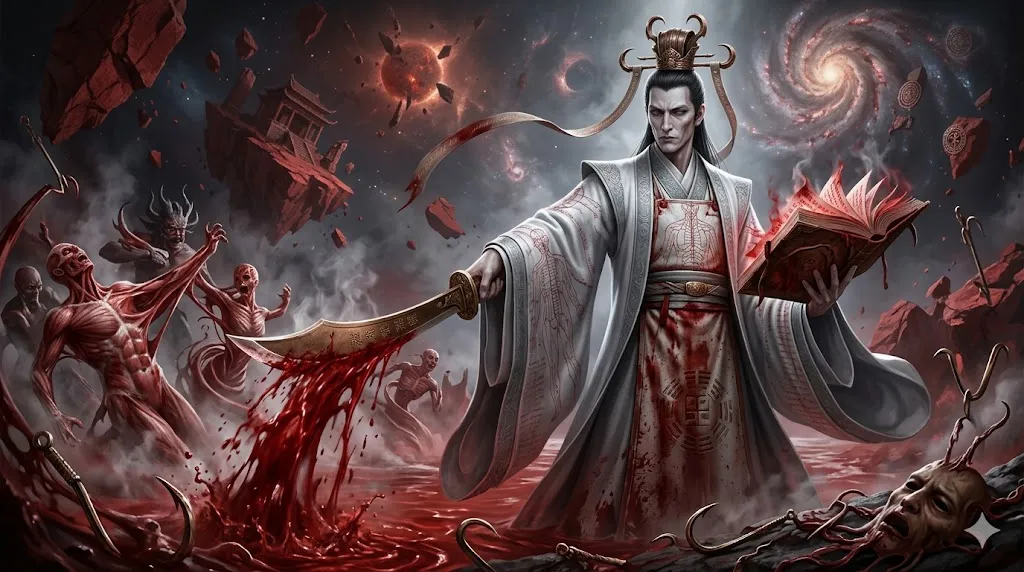
King Wuguan (the Fourth Court Yama King, arbiter of fraud and perjury) does not judge the dead by their crimes alone—he judges them by their words. Every lie ever spoken is preserved in the fabric of karma, and before his mirror, no falsehood survives exposure.
五官王吕 (King Wuguan Lü)
Non-deceased; innate god enfeoffed by Heaven
Epoch of Death: None (timeless origin, born from celestial decree)
Current Ghost Path Level: You Ming Di Fu Zheng Shen (Underworld Justice Deity, Fourth Court)
Underworld Jurisdiction: Fourth Court (第四殿), dedicated to fraud, perjury, and tax evasion
None. King Wuguan is not a wandering ghost with a legendary haunting site. He is a Yama King whose presence is felt in courtrooms, marketplaces, and the quiet terror of a merchant who knows his scales are false. Mortal temples sometimes include a small statue of him alongside the Ten Yama Kings, but no specific location is tied to his name.
King Wuguan’s domain is linked to the broader structure of the Ten Yama Courts. He shares the Karma Mirror Platform with King Qin Guang of the First Court, who also uses a mirror for judgment—but King Wuguan’s mirror is specialized for detecting written and spoken fraud, not for surveying a life’s entirety. He collaborates closely with King Songdi of the Third Court, who sentences those who disrupt family order; many such cases involve forged documents or perjured testimonies, which are then forwarded to the Fourth Court for completion. After the Fourth Court, souls pass to King Yanluo of the Fifth Court, who oversees non‑fraud‑related offenses. The Gou She Hell and the Cheng Gan Hell are also unique to this Court. These two punishment hells, while part of the Underworld’s penal apparatus, are directly under King Wuguan’s authority and reflect his specific mandate: the punishment of those who weaponize untruth.
King Wuguan is a Zheng Shen (orthodox deity) of the Netherworld Court, a permanent celestial office rather than a wandering soul or a vengeful spirit. He has no lifespan—his existence is coterminous with the cosmic order itself. Unlike the common Gui who cling to ghostly existence through Yin Qi and obsession, King Wuguan is sustained by the Xiang Huo Yuan Li (Incense-Fire Faith Energy) of the living and the authority vested in him by the Celestial Decrees (Tian Tiao). His state is one of absolute stability: he neither ages, decays, nor dissipates, so long as the Fourth Court remains functional within the Underworld bureaucracy.
King Wuguan did not die. He was never born into a mortal body, and thus never experienced the soul’s separation from flesh. Instead, his consciousness was precipitated directly from the cosmic law of justice—a condensation of Tian Di Gang Chang (the Cosmic Order) into a personal, judging intelligence. At the moment of his enfeoffment, the Dao assigned him the Fourth Court, the Karma Mirror Platform (Nie Jing Tai), and the authority to punish those who pervert truth. There was no loss of warmth, no sensory deprivation, no Gang Feng tearing at his form. There was only the sudden, crystalline clarity of purpose: to weigh words against deeds, and to make liars pay.
Instead of hiding in a grave or consuming other souls, King Wuguan inhabits the Fourth Court—a vast, stone hall perpetually lit by the cold glow of the Karma Mirror. The Court is his sanctum and his instrument. The walls are etched with every contract, every sworn oath, every tax record ever falsified. His signature tool is the Nie Jing Tai (Karma Mirror Platform), a polished obsidian slab that, when a soul stands upon it, displays every dishonest utterance the soul ever made, surrounded by the exact consequences that followed. He does not need to absorb Yin Qi from others; his power flows from the netherworld’s own energy grid, the Di Fu’s own structure, and his own unyielding adherence to cosmic law.
King Wuguan’s consciousness is not stitched from foreign memory. He is a pure, unruptured intelligence: the Fourth Court’s singular awareness. His clarity is his defining trait. Every fraud he judges, every perjurer he sentences, every tax cheat he consigns to a hundred years of hook-and-chain punishment—all these serve to reinforce his understanding of justice, not to pollute his identity. He remembers every case in perfect detail, yet remains himself. There is no dissonance, no inner parliament of ghosts. What others might call obsession—his relentless focus on truth—is in fact his innate nature as a Yama King.
King Wuguan governs two punishment hells beneath the Fourth Court. The first is the Gou She Di Yu (Hook Tongue Hell), where the tongues of liars are pulled out—inch by inch, year by year—with a red-hot iron hook. The second is the Cheng Gan Di Yu (Weighing Beam Hell), where fraudsters who used false weights or doctored contracts are suspended by the intestines from a large steelyard hook, their bodies stretched and twisted as the beam swings. These torments are exact and proportional: one lie of moderate harm earns a century under the hook; a forged deed that dispossessed a family earns two centuries on the beam. The purpose is not cruelty but calibration—the pain is precisely measured against the harm caused by the deceit.
King Wuguan interacts closely with the broader Underworld machinery. Souls arrive at the Fourth Court after completing their sentences in the Third Court (King Songdi’s domain), where crimes against family order are punished. He receives them, re‑examines any fraud or perjury that factored into those earlier judgments, and either passes them to the Fifth Court (King Yanluo) for further processing or, if the fraud was egregious, sends them to his own punishment hells for a fixed term. He has stood before the Karma Mirror himself—not as a soul on trial, but as the Mirror’s custodian. He has never approached the Wang Chuan (River of Oblivion) for his own case, because he has no karma to wash away. His existence is that of a mechanism, not a traveler.
King Wuguan’s interactions with other paths are few. With the Daoist immortal tradition, he has no direct connection; he is a product of the Celestial Bureaucracy, not the cultivation path. With the Shen Dao (God Path), he is a fellow functionary: the city gods (Chenghuang) and earth gods (Tudi) report to him any fraud uncovered in the mortal world, so that the culprit’s soul can be properly flagged before death. With the Buddhist tradition, he is said to have been instructed by the Bodhisattva Ksitigarbha (Di Zang Wang) not to punish excessively, and to allow spirits a chance for repentance—hence his rule of **Zhen Yan Mian Xing** (True Speech Avoids Punishment): any soul who voluntarily confesses all fraud upon arrival at the Fourth Court may have their sentence reduced by half. With the mortal world, he is the target of many prayers from merchants and officials who fear false accusations or seek justice against swindlers.
King Wuguan remains in perpetual active service. He does not age, does not weaken, and faces no risk of dissipation. The Fourth Court processes millions of souls each cycle, and his presence is constant. There is no reincarnation for him—he is a permanent fixture of the Underworld bureaucracy. Should the Dao ever decide to disband the Ten Courts, his consciousness would dissolve back into the law from which it came, not into a new body. For now, he sits in his stone hall, watching the Karma Mirror, waiting for the next liar to step onto its surface.
Lore Notes
Fourth Court (第四殿)
The fourth of the Ten Yama Courts in the Chinese Underworld, dedicated to the judgment of fraud, perjury, and tax evasion. King Wuguan presides here.
Karma Mirror Platform (Nie Jing Tai)
A polished obsidian slab that reveals every lie and deception the judged soul ever committed, including the full consequences of each falsehood.
Hook Tongue Hell (Gou She Di Yu)
A punishment hell beneath the Fourth Court where souls of liars have their tongues pulled out with a red-hot iron hook over a prescribed period.
Weighing Beam Hell (Cheng Gan Di Yu)
A punishment hell where fraudsters who used false weights or forged contracts are suspended by the intestines from a large steelyard hook.
Zhen Yan Mian Xing (真言免刑)
The rule of "True Speech Avoids Punishment": a soul who voluntarily confesses all fraud upon arrival at the Fourth Court receives a halved sentence.
Cheng Gan (秤杆)
The weighing beam—a traditional Chinese balance scale with a movable counterweight. In the Fourth Court, it is repurposed as an instrument of punishment for false‑measurement crimes.
Gou She (钩舌)
The hook‑tongue—a hot iron tool used in the Fourth Court to physically extract the tongue of a liar as retribution for deceptive speech.
FAQ
What crimes does King Wuguan judge?
He judges fraud, perjury, tax evasion, contract violations, impersonation of officials, and any crime that involves lying for material gain.
How does the Karma Mirror work?
When a soul stands on the Karma Mirror Platform, it displays every deceptive act the soul ever committed, along with the exact harm caused by each lie.
What is the rule of "True Speech Avoids Punishment"?
Any soul who confesses all fraud upon arrival at the Fourth Court receives a halved sentence. This is King Wuguan's policy of encouraging honesty even after death.
How long do souls stay in the Hook Tongue or Weighing Beam Hells?
The duration is proportional to the harm caused. A single minor lie might earn a month on the hook; a large fraud that destroyed a family could earn centuries on the beam.
Is King Wuguan a ghost?
No. He is an innate god enfeoffed by Heaven, a permanent Yama King who was never born and never dies. His existence is sustained by celestial decree and the incense‑fire faith of mortals.