Eastern Mythology Encyclopedia
King Songdi
宋帝王
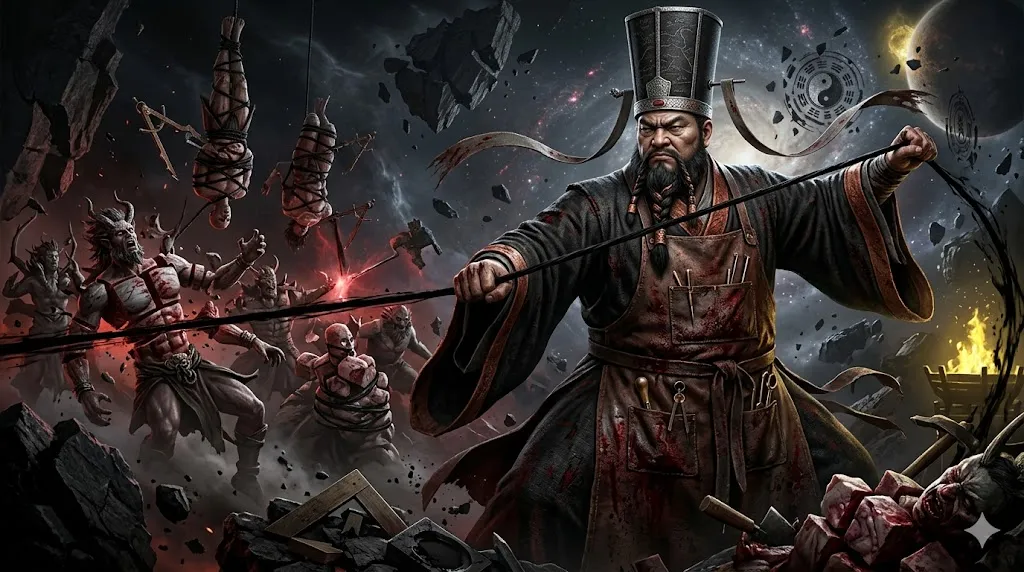
King Songdi (宋帝王 Yu), the Third Yama King of the Netherworld Court, does not punish the wicked—he punishes the ones who broke the home. Presiding over the Black Rope Great Hell, his court is not concerned with murder or theft, but with the slow, corrosive sins that splinter families, silence the elderly, and turn brother against brother. In the Eastern mythic system, he is not a demon of wrath, but a cosmic magistrate who believes that filial piety is the root of all order—and that the roots must be defended with fire and iron.
宋帝王余 (King Songdi Yu)
Not deceased; innate god enfeoffed by Heaven.
Title: Yama King of the Third Court of the Netherworld.
Birth Era: Primordial Age (Honghuang Era); born as an innate god of divine law and cosmic order.
Current Realm: The Underworld (You Ming Di Fu), Third Court.
Culturally, King Songdi is not tied to a single haunted location or relic. Instead, his presence is felt in temple complexes dedicated to the Ten Yama Kings, particularly those in Chinese folk religion communities. A specific association exists in folk proverb: "He who stirs up trouble in a family will answer to King Songdi's Black Rope." This phrase is used by elders to shame those who sow discord among siblings or exploit the elderly for personal gain. In the *Yuli Baochao* (Jade Record), a popular Ming dynasty morality book, the Third Court's procedures are described in detail, and the case of a "litigation master" (a lawyer who provoked brothers to fight each other for inheritance until their parents died of grief) is recorded as a paradigmatic example of King Songdi's justice.
This entry establishes King Songdi as the presiding judge of the Third Court of the Netherworld Underworld. His domain is specifically focused on crimes against family order, filial piety, and social trust. His court operates the Black Rope Great Hell as its primary punishment apparatus. His character arc is defined by a tension between legal strictness and a gradually acquired capacity for mercy, influenced by his interaction with Kṣitigarbha Bodhisattva and his administrative adjustments (such as redirecting lighter cases to a review court). His position complements the broader entry on the Ten Yama Kings and the Netherworld Court, and stands in mythic counterpoint to beings of absolute compassion like Kṣitigarbha and beings of absolute punishment like the kings of the deeper hells.
King Songdi is a full god of the Netherworld Court, not a lingering spirit. His existence layer is that of a divinely appointed Yama King (Shi Dian Yan Luo), a permanent position within the Underworld's hierarchy. This status grants him a fixed, indestructible divine form sustained by cosmic law and incense-faith energy, immune to the erosion of the Cosmic Gale and the cycle of reincarnation. He has never been a Lihun (departed soul), a Li Gui (vengeful spirit), or a Gui Wang (ghost king). He is not attempting the Gui Xian path. His existence is defined not by survival, but by duty: he presides over judgment in the Third Court.
King Songdi did not die. He was not born from a mortal womb, nor did he experience the trauma of soul-separation. As an innate god of the Honghuang Era, his consciousness coalesced directly from the fabric of cosmic law. He was present at the establishment of the Netherworld, witnessing the construction of the Ten Courts and the forging of the Six Paths of Reincarnation. His "death" is a non-event. His existence did not begin with a moment of deprivation but with an act of enfeoffment: he was appointed by the higher cosmic order to preside over the Third Court. This appointment gave him his title, his domain, and his purpose. There was no first night of fear in a cold grave, no desperate reaching for a loved one's warmth—only the sudden awareness of authority, duty, and the weight of judgment.
King Songdi has never needed a sanctuary to hide from the Cosmic Gale. His divine body is his sanctuary, a stable form bestowed by celestial decree. He does not rely on personal obsession to remain cohesive, nor does he consume wandering souls for strength. His power derives from his office and the incense-faith energy offered by mortals. The process of Yin Qi condensation is foreign to him; his existence is Yang-stabilized, anchored to the fabric of the Underworld itself. The desperate cycle of early ghost life—the hunt for shelter, the slow loss of identity, the compulsion to consume other remnants—is a reality he judges, not one he endures. He sees it from the throne, not from the grave.
King Songdi's consciousness has never been fractured by memory contamination. He did not consume other souls to survive, and his identity has not been overwritten by the final screams of strangers. His awareness remains his own, untainted by the composite agony of a Li Gui. However, his millennia of service have given him a different kind of fragmentation: he has witnessed so many acts of betrayal, so many families poisoned by lies, so many elderly parents abandoned by their children, that a profound coldness has settled into his heart. This coldness is not madness, but a weariness born from seeing the same evil repeated endlessly. It is this weariness that once made him too severe in his judgments, a tendency that drew the attention of Kṣitigarbha Bodhisattva. He is not a victim of swallowed memories, but a judge hardened by the exposed nature of sin.
King Songdi has never walked the path of the Gui Wang or the Gui Xian. He did not build a host of ghost soldiers, nor did he sit on a throne of bones. The Great Hell of Black Ropes (Hēishéng Dà Dìyù) is not an army he commands, but a punishment apparatus he administers. The suffering in that hell is for the souls he judges, not for himself. He has never attempted the Yin-Ji-Sheng-Yang reversal. His body is already a stable divine vessel, not a Yin-congealed phantom. The question of transcendence—of generating a spark of Yang within a body of pure Yin—has never applied to him. He is already within the system. His responsibility is not to escape it, but to make sure it functions.
King Songdi is the system. He does not interact with the Underworld as a subject; he is one of its ruling architects. He does not face summons or apprehension. He has never stood before the Karma Mirror Platform (Nie Jing Tai) as a defendant. His contact with the Ten Yama Kings is not as a judgment-receiver, but as a peer. He has debated sentencing protocols with King Qinguang of the First Court, who handles lighter cases, and has proposed reforms to send certain minor offenders to a review court rather than directly to hell. He has been visited by Kṣitigarbha Bodhisattva, who did not summon him but counseled him to temper his judgments. He has never approached the River of Oblivion (Wang Chuan) as a soul preparing for crossing. He has no need of Meng Po's Brew. He will never walk those banks except to supervise the passage of another.
King Songdi's relationships with the other paths are defined by his office, not his salvation. With the Daoist celestial order (Xian Dao), he stands as a subordinate functionary—the Underworld answers to the cosmic law, and its kings are beneath the highest celestial deities, yet they are respected as essential regulators of the cycle. With the Shen Dao, he shares a reciprocal relationship: local gods (City Gods, Earth Gods) send souls to his court for judgment after death. With the Buddhist path (Fo Dao), he has a particular tension: Kṣitigarbha Bodhisattva's presence in the Underworld as a being of ultimate compassion exists as a counterweight to his own strict legalism. He respects the Bodhisattva but does not share his reach toward unconditional mercy. With mortals, his image is one of fear: temples to the Ten Yama Kings are places where the living pray for leniency for their departed ancestors, or where village elders curse "family-wreckers" to the Black Ropes. He is not worshipped for love, but for the hope that he might be merciful.
King Songdi's current state is permanent. He is not in transition, not waiting for judgment, not fading into nothingness. He occupies the Third Court of the You Ming Di Fu as its eternal presiding judge. He will not pass through the Six Paths of Reincarnation; his position is not a soul-state but a divine office that transcends individual lifetimes. The cyclical mechanism of birth, death, and forgetting does not apply to him. He will remain on his throne until the end of the current cosmic epoch. If the Underworld itself is ever reformatted—if a Great Calamity or a new cosmic rearrangement dismantles the current system—his office might dissolve. But within the existing order, he is a fixture. He has no next life. He has only this endless duty.
Lore Notes
Black Rope Great Hell (Hēishéng Dà Dìyù)
The punishment realm of the Third Court where condemned souls are bound with red-hot iron ropes. The heat sears ghostly flesh and bone, designed to mirror the way the condemned soul once bound their own family with lies and manipulation.
Yuli Baochao (玉历宝钞)
A popular Ming dynasty morality book that describes the structure and procedures of the Ten Courts of the Netherworld. It is a primary source for depictions of King Songdi and his court.
Ksitigarbha Bodhisattva (地藏菩萨)
A Buddhist Bodhisattva who dwells in the Underworld to counsel suffering souls. He is a figure of ultimate compassion who acts as a counterweight to the strict legalism of the Yama Kings. In King Songdi's lore, Ksitigarbha counseled him to be more merciful.
Litigation Master
A folk term for a person who provokes lawsuits between relatives or neighbors for personal profit. In the lore of the Third Court, such figures are considered a particularly severe type of family-crime offender.
FAQ
What crimes does King Songdi judge?
He judges crimes against family order: filial impiety, siblings who cheat each other of inheritance, people who spread rumors to break up marriages, and "litigation masters" who provoke lawsuits between relatives.
Is King Songdi a ghost?
No. He is an innate god who was enfeoffed by Heaven. He never died. He was appointed to his position as a Yama King during the establishment of the Netherworld.
What is the Black Rope Great Hell?
It is the punishment apparatus of the Third Court. Condemned souls are bound with iron ropes heated to a red glow, symbolically "bound" just as they bound their families with lies and manipulation.
Did King Songdi ever change his judgment practices?
Yes. The lore records that Ksitigarbha Bodhisattva counseled him to be more merciful. After this, King Songdi began sending lighter cases to a review court and offering sentence reductions for souls who showed genuine remorse.
Which is the best known literary source for King Songdi?
The *Yuli Baochao* (Jade Record), a Ming dynasty morality book, contains the most detailed description of his court and famous cases.