Eastern Mythology Encyclopedia
King Qinguang
秦广王
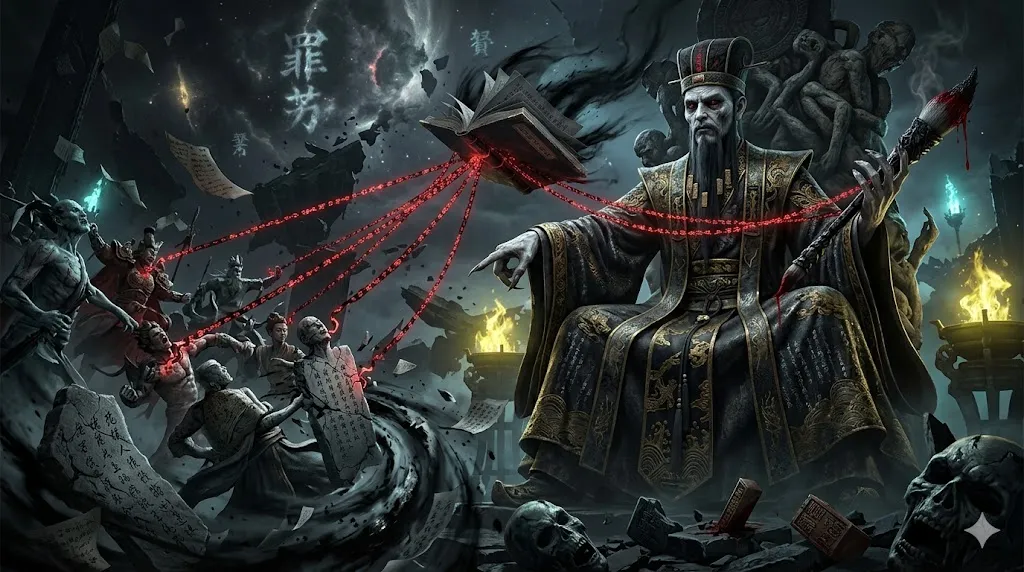
King Qinguang (秦广王) is not a dead soul who climbed the ranks of the Underworld — he is an innate god, appointed by Heaven to stand at the threshold of death itself, and the first face every soul sees after its last breath.
秦广王蒋 (King Qinguang Jiang)
Death Cause: Not deceased; innate god enfeoffed by Heaven (非亡故,先天神灵受封)
Epoch of Origin: Post–Great Disconnection, during the establishment of the Netherworld Court
Current Ghostly Tier: Celestial Official of the Underworld (幽冥地府正神)
Netherworld Jurisdiction: First Hall of the Ten Yama Kings, Ghost Gate Pass, Karma Mirror Platform
The most prominent physical location associated with King Qinguang is the Ghost Gate Pass (鬼门关), a legendary boundary often said to exist at the edge of the mortal world. Temples dedicated to the Ten Yama Kings, especially in regions influenced by the *Jade Record* (《玉历宝钞》) tradition, often feature a hall for King Qinguang with an image of the Karma Mirror. In folk belief, the First Hall is also the station where souls who have died unjustly may be granted a temporary return to the living world to set matters right — though this is a narrative thread rather than a fixed doctrine. No specific haunted location is attributed to his own ghost, because he is not a ghost.
This entry is closely tied to the broader structure of the Netherworld Court. The Ten Yama Kings (十殿阎罗) form the complete judicial apparatus; King Qinguang serves as the first among them, with the most direct authority over initial screening. The Nie Jing Tai (孽镜台) is his primary tool of judgment. The Ghost Gate Pass (鬼门关) marks the boundary of his domain. Ksitigarbha (地藏菩萨) is a recurring counterpart whose mercy sometimes tempers Qinguang's rigid application of karma. The *Jade Record* and related scriptures provide the textual foundation for his role.
King Qinguang occupies the highest tier of the Netherworld bureaucracy: a Celestial Official of the Underworld. Unlike ordinary souls that undergo Li Hun (Soul Departure), Li Gui (Vengeful Spirit), or the agonizing climb toward Gui Wang (Ghost King) or Gui Xian (Ghost Immortal), Qinguang has never been a wandering ghost. His existence is sustained not by Yin Qi accumulation or memory obsession, but by a direct mandate from the Celestial Decrees. His authority is absolute within the First Hall, where he processes the initial karmic screening of every newly arrived soul. He has no need to consume other spirits, and no personal memory corruption — his consciousness is a pure function of cosmic law. His tier is unique: a judge of the dead who never died himself.
King Qinguang never experienced the moment of death. No last breath, no soul lifting out of a cooling body, no desperate attempt to touch a weeping loved one. His existence began not as a departing spirit but as a condensed principle of cosmic justice. When the Netherworld Court was organized after the Great Disconnection, Heaven chose a set of innate gods to serve as its judges. Qinguang was one of them. He received his post not through merit accumulated in a human life, but through the inherent alignment of his nature with the laws of cause and effect. From his first instant of being, he understood the weight of Yin Guo (因果) — not as a doctrinal concept, but as the very substance of his own mind. He felt no terror at the absence of a body, because he had never possessed one. What ordinary souls call the cruel deprivation of death — the loss of warmth, touch, taste, the sudden vulnerability to sunlight and wind — was for him simply the normal condition of an existence woven from law rather than flesh.
King Qinguang never needed a shelter to hide from the Cosmic Gale. He never curled inside a coffin or clung to a piece of his former home. Because he was never a wandering spirit, he required no Yin Qi accumulation to stabilize his form. His power is derived from the authority of his office, not from the slow conquest of Yin energy. Where an ordinary Gui must cling to a single obsession to keep from dissolving, Qinguang's identity is anchored in a system far older than any individual memory: the Netherworld Court itself. He does not consume other souls. He has no need to. In fact, the very logic of cannibalistic survival — the desperate eating of one wandering ghost by another — is alien to his nature. He stands outside the brutal ecology of the restless dead. His judgment is not colored by the fragmented memories of a thousand devoured lives; it is cold, uniform, and derived from the karmic record alone.
King Qinguang is not a Li Gui (厉鬼). He has never been stitched together from the memories of consumed ghosts. His consciousness is singular, unbroken, and dedicated entirely to the function of initial judgment. Where a vengeful spirit suffers from the constant noise of foreign memories — the soldier's last charge, the drowning woman's waterlogged lungs, the betrayed wife's scream — Qinguang experiences no such contamination. The clarity of his mind is the foundation of his role. He is the first filter. Every soul that enters the First Hall must stand before the Nie Jing Tai (孽镜台), the Karma Mirror Platform, which reflects every hidden deed, every unconfessed cruelty, every secret mercy. Qinguang reads the reflection as a transparent record. He does not guess, does not extrapolate, does not rely on intuition. He simply sees. And because he has no personal loyalty or attachment to any living being, his judgment is free of bias. The tradition holds that in King Qinguang's hall, no case is ever wrongly decided — not because he is infallible, but because the evidence before him is total.
King Qinguang has never walked the path of the Gui Wang (鬼王) or Gui Xian (鬼仙). He did not accumulate ten thousand suffering souls to build a ghostly army. He does not sit on a throne of bones, tormented by the overlapping death-cries of his subjects. The immense power of his position comes not from absorption but from delegation: Heaven granted him the authority to command soul escorts, open the Ghost Gate Pass, and convene the Ten Yama Kings for consultation. The attempt to generate pure Yang from pure Yin — the Ghost Immortal's desperate gambit — is irrelevant to his existence. He is already beyond that cycle. His body is not a Yin-form that needs to be reversed; it is a lawful manifestation of the Underworld's own substance. The thunder that would annihilate a Gui Xian cannot reach him, because he was never a ghost to begin with.
King Qinguang does not interact with the Netherworld as a subject. He is its administrator. The soul escorts — Niu Tou Ma Mian (牛头马面), Hei Bai Wu Chang (黑白无常) — deliver the dead to his hall. He receives them at the Ghost Gate Pass (鬼门关), the boundary where the world of the living ends and the Underworld's judicial process begins. He has stood before the Nie Jing Tai countless times, but never as a soul being judged — only as the one who reads the mirror. He has never approached the Wang Chuan (忘川) as a traveler, never held a bowl of Meng Po Tang (孟婆汤) as a drinker. Those stations belong to later stages of the soul's journey, after the judgment of the First Hall has determined the soul's destination. His domain is the antechamber of judgment, not the river of forgetting. When a soul is found to have committed grave crimes, he does not send it to the river; he dispatches it directly to the appropriate hell realm. When a soul is light in karma, he forwards it to the Second Hall for a refined examination.
King Qinguang's relations with other paths are formal and governed by cosmic protocol. With the Shen (神) path, he shares the same fundamental identity: he is an enfeoffed god of the Celestial Court, bound by Tian Tiao (天条). The local gods — City Gods (城隍), Earth Gods (土地), Door Gods (门神) — report to his hall when a mortal's life ends; he coordinates with them to ensure no soul escapes the Underworld's summons. With the Fo (佛) path, his interaction is notable: the Bodhisattva Ksitigarbha (地藏菩萨), who vowed to remain in the Underworld until all hells are empty, has repeatedly petitioned Qinguang to grant certain repentant souls a chance for deliverance rather than immediate punishment. After several such negotiations, Qinguang adjusted the First Hall's procedure to allow a period of examination for souls who show genuine remorse, creating the first formal "trial before punishment" protocol in the Netherworld's history. With the Xian (仙) path, Qinguang has no direct business — immortals who have transcended death are outside his jurisdiction, unless they fall from grace. With the mortal world (Ren), his function is entirely posthumous: he judges, but does not intervene in living affairs. With Mo (魔) and Yao (妖), he judges them as he judges all souls, by karmic record alone, though their karma often leads to the harsher hells.
King Qinguang's current state is that of an active, fully empowered Celestial Official of the Underworld. He continues to preside over the First Hall, processing the souls of the newly dead day and night, without rest, without aging, without the decay that haunts mortal existence. He has never been through the cycle of reincarnation — Liu Dao Lun Hui (六道轮回) — because he was never born and never died. His position is permanent, as long as the Netherworld Court functions. There is no risk of him dissipating into the Cosmic Gale or being consumed by a more powerful entity. He is not a ghost clinging to existence; he is an institution carved into the fabric of cosmic law. The question of whether he will ever step down is not asked, because within the cosmology of the Underworld, the halls do not change their kings.
Lore Notes
Ghost Gate Pass (鬼门关)
The formal entrance to the Netherworld Court, the boundary between the living world and the Underworld. All souls must pass through this gate to reach the First Hall.
Karma Mirror Platform (孽镜台)
A divine mirror that reflects every action of a soul's lifetime without concealment. It stands before the First Hall, and King Qinguang reads it to determine the direction of judgment.
First Hall
The initial judicial chamber of the Ten Yama Kings, supervised by King Qinguang. It handles the preliminary karmic screening and classification of all newly deceased souls.
Ten Yama Kings (十殿阎罗)
The ten judges of the Underworld, each presiding over a hall with a specific domain of judgment. King Qinguang is the first among them.
Jade Record (《玉历宝钞》)
A popular Chinese scripture that describes the Ten Yama Kings and their halls, including the specific punishments and procedures of the Netherworld.
Ksitigarbha (地藏菩萨)
A Bodhisattva who vowed to remain in the Underworld until all hells are emptied. He has negotiated with King Qinguang to allow repentant souls a chance for deliverance.
FAQ
Is King Qinguang a deceased person who became a judge?
No. He is an innate god (先天神灵), appointed directly by Heaven to serve as the first judge. He never experienced death or ghosthood.
What is the Karma Mirror?
The Karma Mirror (孽镜台) is a platform in the First Hall that displays every deed a soul performed in its lifetime. It cannot be deceived, and King Qinguang uses it to pass his initial verdict.
Does King Qinguang send all souls to hell?
No. He classifies souls based on their karmic record. Those with light karma are forwarded to the Second Hall for refined judgment; those with severe crimes are sent directly to appropriate hells. The tradition holds that no case in his hall is ever wrongly decided.
How does King Qinguang relate to the Buddhist figure Ksitigarbha?
Ksitigarbha (地藏菩萨) has repeatedly petitioned King Qinguang to give certain souls a chance for repentance before punishment. Through these negotiations, Qinguang adjusted his procedures to allow a period of examination for genuinely remorseful souls.
Can King Qinguang be overthrown or replaced?
Within the mythology, his post is permanent. He is an enfeoffed Celestial Official, part of the fixed structure of the Netherworld Court. There is no narrative of him being deposed.