Eastern Mythology Encyclopedia
King Chujiang
楚江王
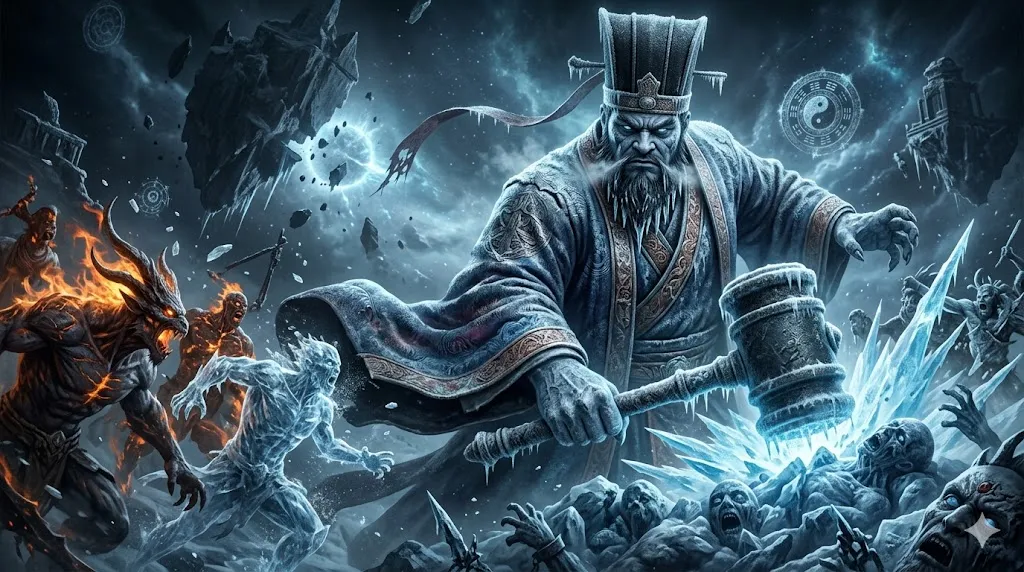
King Chujiang (楚江王), the second judge of the Ten Courts of the Underworld, does not weigh the souls of the dead with sympathy—he freezes them. His domain is the Flaying Pavilion and the Frozen Hell, where those who betrayed trust, ravaged the innocent, or defiled the bonds of filial piety are stripped naked and encased in ice for centuries. He believes that pain is the only language a corrupted soul can still understand.
楚江王历 (King Chujiang Li)
非亡故,先天神灵受封 (Not deceased; innate god enfeoffed by Heaven)
Birth Era: Beyond reckoning—an innate spirit originating from the primordial division of Yin and Yang; formally enfeoffed after the Great Disconnection (Jue Di Tian Tong)
Current Realm: The Second Court of the Netherworld (You Ming Di Fu)
Underworld Affiliation: Under the authority of the Ten Yama Kings; directly reports to the Yama King of the First Court
The most famous mortal trace of King Chujiang is the legend of the Flaying Pavilion and the Frozen Hell, transmitted through texts like the *Yuli Baochao* (《玉历宝钞》) and folk operas. In some regions of southern China, temples dedicated to the Ten Yama Kings include a small ice-cold shrine to Chujiang, often with a statue of a stern-faced official holding a book and a pair of ice-shattered chains. Villagers occasionally leave offerings of liquor—not because he drinks, but because the warmth of the offering is believed to temper his severity. No haunted location is directly attributed to him, as he does not wander.
This entry is closely related to the broader framework of the Ten Yama Kings (Shi Dian Yan Luo) and the Underworld Court (You Ming Di Fu). The preceding court, headed by King Qinguang (Shi Dian Yan Luo – First Court), processes all newly arrived souls and forwards them to King Chujiang for judgment on specific categories of crime. The Frozen Hell under Chujiang's command is one of several iconic punishments in the Underworld system, distinct from the boiling cauldrons of the Fifth Court or the mountain of knives of the Eighth. Readers may also consult entries on the Soul Escorts (Niu Tou Ma Mian) and the Karma Mirror Platform (Nie Jing Tai) for a fuller picture of how souls are transported and evaluated before reaching Chujiang's hall.
Current Ghostly Tier: You Ming Di Fu Zheng Shen (幽冥地府正神) – a deity of the Netherworld Court, not a wandering or composite spirit. As an enfeoffed god, King Chujiang does not accumulate Yin Qi through consumption; his power is sustained by the celestial decree and the incense-fear energy (Xiang Huo) of mortals who dread his justice. His existence is permanent as long as the Underworld system endures. He does not experience the erosion of the Cosmic Gale (Gang Feng) nor the fragmentation of memory that plagues mortal Gui. Instead, he functions as a fixed node of cosmic law—immutable, impersonal, perpetually operative.
King Chujiang never died. He was never born in the mortal sense. As an innate primordial spirit, his awareness crystallized from the raw fabric of Yang and Yin during the settling of the Three Realms. When the Great Disconnection sealed Heaven from Earth, the Celestial Court needed judges who could administer the new karmic order—beings whose nature was law itself, not opinion or mercy. Chujiang was shaped for this role. He has no memory of a childhood, no memory of a body that could feel warmth or cold. His first clear consciousness was the weight of a decree: "Second Court. Judge of theft, fraud, rape, and filial impiety." That decree became his identity. He does not long for the world he never touched.
Unlike a mortal Gui who must find shelter in a tomb or a hollow tree, King Chujiang's existence does not depend on a physical refuge. His court—the Second Hall of the Underworld—is his body's extension. The hall is carved from eternal ice in the deepest stratum of the Yin realm. Here, the temperature alone would shatter an unprotected soul, but Chujiang's nature is aligned with the cold; he feels it as a living being feels blood flow. The Flaying Pavilion (剥衣亭) stands at the center of his hall, a stone dais where condemned souls are stripped before being cast into the Frozen Hell. He does not stalk the mortal world in search of prey. Instead, souls are delivered to him by the Soul Escorts (Gui Chai) after passing through the First Court of King Qinguang. Once they arrive, he does not consume them. He examines them, sentence by sentence, deed by deed.
King Chujiang has no composite self. He has not devoured thousands of memories. His identity is singular and perfectly aligned with his function: justice without deviation. What a mortal reader might mistake for a "splintered mind" is, in Chujiang's case, an exhaustive catalog of karmic records. He can recall every verdict he has ever passed—every face, every crime, every duration. But he does not feel the pain of those he judges. The tradition describes him as possessing "eyes like lightning" that pierce through lies instantly. This is not a supernatural trick; it is the result of a mind that has never been contaminated by personal desire. He does not confuse his own past with another's because he has no past outside his duty.
King Chujiang never walked the path of the Gui. He never became a Ghost King (Gui Wang) through consumption, nor a Ghost Immortal (Gui Xian) through reverse cultivation. He is, by original design, a god of the Underworld—a judge whose authority is sealed by Heaven, not earned by endurance. The Frozen Hell he oversees is not his own body, but a constructed realm of carved ice and trapped Yin energy. He does not suffer the accumulated death-throes of ten thousand souls. Instead, he commands the cold, and the cold obeys him. When a soul is sentenced to the Frozen Hell, it is Chujiang's will that freezes the air and crystallizes water into iron-hard sheets. His power is not stolen; it is assigned.
King Chujiang's interaction with the Underworld system is not that of a fugitive dodging the Soul Escorts. He is the system. The Ox-Head (Niu Tou) and Horse-Face (Ma Mian) bring condemned souls to his hall. In turn, he reviews each case with the judge (Pan Huang) of his court. If a soul's record shows a mixture of grave offenses and minor virtues, he may reduce the sentence proportionately—but never to zero. In one recorded instance, he personally reviewed the case of a local tyrant who had forcibly taken an orphan's land and driven the widow to suicide. The tyrant's soul had been sentenced to the Frozen Hell for three hundred years. King Chujiang extended the term to three hundred fifty, judging that the tyrant's contrition was feigned. When the soul screamed, Chujiang did not flinch. On rare occasions, he has worked with King Qinguang to improve the transfer process, reducing administrative errors that might send a wrongly accused soul to the wrong court.
King Chujiang interacts with other paths of existence primarily through the Underworld's legal framework. With the Daoist path of immortals (Xian): he has no direct enmity; immortals who die and appear before him are treated like any other soul, though their cultivation deeds may mitigate punishment. With the path of gods (Shen): he is a peer to the City Gods (Cheng Huang) and Earth Deities (Tu Di), but they operate in the mortal realm, while he sits in the Underworld. They send souls to him; he does not visit them. With the Buddhist path (Fo): temples often chant sutras for the dead, invoking King Chujiang's mercy. He is not moved by devotion to a Buddha—only by the balance of karma. The Diamond Sutra itself does not sway his verdict if the karmic record is clear. With mortals and demons (Yao): those few ghosts who refuse capture by the Gui Chai and flee to the mortal world are eventually brought back; he has no patience for ghostly rebellion and will double the sentence for evasion.
King Chujiang's current state is one of perpetual function. He has not been destroyed, has not reincarnated, and has not attempted the Ghost Immortal reversal. The cosmic law that enfeoffed him does not permit him to step down or dissolve. He will continue to sit in the Second Court until the net of karma itself unravels—something the texts consider impossible. The Frozen Hell continues to receive souls, and the Flaying Pavilion continues to stand. He does not tire. He does not question. He is, in essence, a living verdict.
Lore Notes
Flaying Pavilion (剥衣亭)
A stone dais in King Chujiang's hall where condemned souls are stripped of their ghostly garments—symbolically exposing their moral corruption before being cast into the Frozen Hell.
Frozen Hell (寒冰地狱)
A vast underground lake of pure ice under King Chujiang's command. Souls are submerged for decades or centuries, gradually frozen layer by layer until all karmic impurities are crystallized and neutralized.
Yuli Baochao (《玉历宝钞》)
A classic Chinese religious text that details the structure of the Underworld, the Ten Courts, and the punishments of the dead. One of the principal sources for King Chujiang's iconography and jurisdiction.
Second Court (第二殿)
The specific hall of judgment assigned to King Chujiang, situated in the Netherworld. It processes souls after the First Court's initial registration.
FAQ
Is King Chujiang a ghost?
No. He is an innate god enfeoffed by Heaven to serve as a judge of the dead. He never lived or died as a mortal.
What crimes does King Chujiang punish?
He judges theft, fraud, rape, and most severely, filial impiety—the failure to respect one's parents and elders.
How does the Frozen Hell work?
Souls are stripped at the Flaying Pavilion and then lowered into a frozen lake. Over centuries, the ice penetrates every layer of the soul, purging its corruption through cold and stillness.
Does every soul go to King Chujiang?
Only souls whose karmic record contains the specific crimes under his jurisdiction. The First Court (King Qinguang) decides which court a soul is sent to.
Can a soul ever leave the Frozen Hell?
Yes. The punishment has a fixed term based on the severity of the crime. Once the term is served, the soul proceeds to the next court for further processing or eventual reincarnation.