Eastern Mythology Encyclopedia
Lingbao Tianzun
灵宝天尊
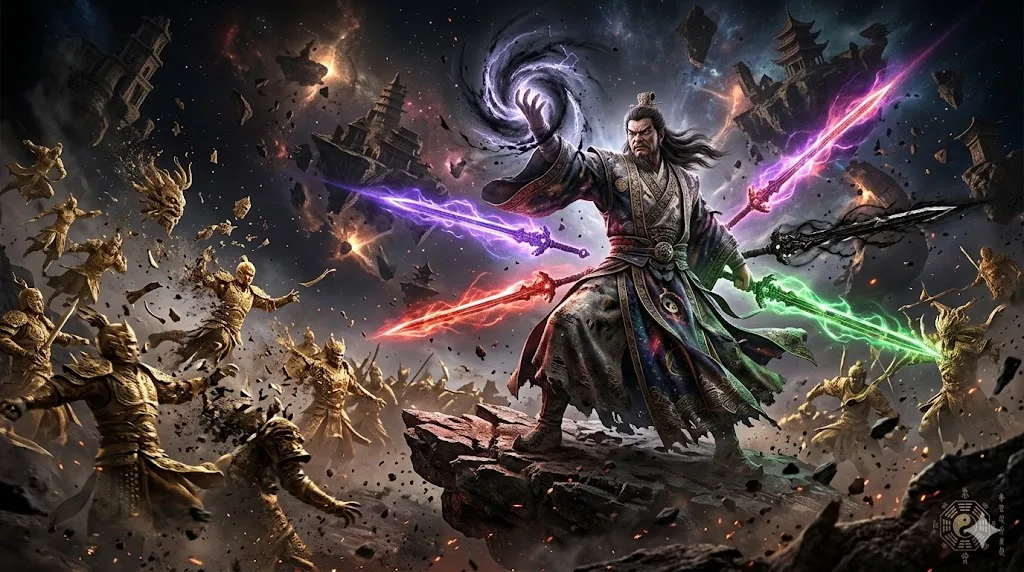
Lingbao Tianzun (the Lord of Numinous Treasure, second of the Three Pure Ones, a Xian whose essence is the power of cosmic change and nurture) existed before the Dao split into yin and yang. He was the primordial instructor who taught all beings without distinction. Yet in the Conferred God Catastrophe, he chose to challenge Heaven’s order to save his disciples—and lost. His punishment was not death, but eternal withdrawal: a living law locked away from the world he was born to shape.
灵宝天尊 · Lord of Numinous Treasure / 上清灵宝天尊 · Celestial Worthy of the Upper Pure Realm
Birth Name: None (manifested directly from the Primordial Dao)
Affiliation: 截教 · 上清境 · 三清之二 (The Teaching of Interception (Jie Jiao), residing in the Upper Pure Realm, the Second of the Three Pure Ones)
Birth Era: The dawn of creation, immediately after Pangu separated Heaven and Earth
Place of Origin: The Primordial Dao itself
Cultivation Site: 上清境 (Upper Pure Realm)
Current Realm: Great Vehicle True Immortal (大乘真仙) — identical with the Dao, a manifestation of the universal principle of transformation and nurturing
Mount Golden Ao (金鳌岛), the site of the Ten Thousand Immortals Formation, still bears traces of residual spiritual pressure. Local legends speak of fishermen seeing the ghostly outlines of swords at dusk. The Four Swords of Zhuxian (诛仙四剑) are now kept in the Celestial Treasury, though their full power is said to be sealed. The Taiji Diagram (太极图), which Lingbao Tianzun wielded to encapsulate the process of cosmic transformation, was recovered by Taishang Laojun and remains in the Great Pure Realm. No other physical relics are preserved in the mainstream tradition, though scattered stone inscriptions on remote peaks are sometimes attributed to his hand.
This entry connects closely with the other two Pure Ones: **Yuanshi Tianzun** (元始天尊), his ideological rival and the architect of the Chan Jiao victory, and **Taishang Laojun** (太上老君), the first Pure One who mediated between them. **Hongjun Daozu** (鸿钧道祖) is the supreme arbiter who enforced Lingbao Tianzun’s retreat. The **Chan Jiao** and **Jie Jiao** sects are defined in dedicated entries. Key disciples such as **Duobao Daoren** (多宝道人) and **Jinling Shengmu** (金灵圣母) appear in their own articles. The **Conferred God Catastrophe** (封神大劫) provides the narrative framework for all these events. The **Zhuxian Sword Array** and **Ten Thousand Immortals Formation** are detailed in separate lore entries.
Lingbao Tianzun does not possess a cultivation timeline in the mortal sense. He did not ascend through Lian Qi, Zhu Ji, Jin Dan, or Yuan Ying; he is the primordial source from which all later cultivators steal their energy. His current state is that of a Xian who has been forcibly retired by the cosmic order he himself embodies. After the collapse of the Ten Thousand Immortals Formation and the annihilation of his Jie Jiao sect, he was taken by Hongjun Daozu (the personification of the Dao’s ultimate authority) and commanded to withdraw from all worldly interference. He still exists, still holds his rank as a Pure One, but his agency has been curtailed. The unique ordeal he faces is not a Heavenly Tribulation but a permanent silence: he is a law that has been neutralized by the same law.
As an innate god born from the Dao’s own unfolding, Lingbao Tianzun had no moment of “entering the path.” There was no first breath of Qi, no master who chose him, no terror of internal fire. His emergence is described in the classical texts as a spontaneous manifestation: after the division of yin and yang, the three fundamental principles (the Three Pure Ones) crystallized to govern the cosmos. Lingbao Tianzun was the second, embodying the principle of change (biàn) and nurturing (yù). He descended into existence already holding the Taiji Diagram and the power of the Zhuxian Sword Array. He has no mortal family, no former name, no earthly attachments to sever. His “self” was never human; it was always the Dao’s own logical structure.
Lingbao Tianzun never underwent Foundation Establishment. He was never a mortal being with a metabolic cycle to shut down. His body is not flesh but pure condensed energy—the Upper Pure Realm’s substance made manifest. The sources record no moment of emotional necrosis because he never possessed the transient emotions of a human. Yet this original detachment carries its own cost: when his beloved disciples were slaughtered by the Chan Jiao cultivators, the legends depict him responding not with personal grief but with cosmic fury—a cold, principled rage that reshaped the battlefield. The tradition suggests that his inability to feel loss as a mortal would may have made his decision to oppose Heaven more absolute, not less. But within this mythic framework, Lingbao Tianzun’s isolation was not achieved; it was innate.
He has no Golden Core. His existence is the core around which all lesser energies orbit. The Three Calamities—Thunder, Yin Fire, Keening Wind—do not apply to him, as he is not an anomalous accumulation of stolen power but the very source of cosmic energy. However, the Conferred God Catastrophe served as his equivalent of a tribulation. When he arrayed the Zhuxian Sword Formation on Mount Golden Ao and later the Ten Thousand Immortals Formation, he was forcibly entering a state of maximum karmic entanglement. The breaking of these formations by the combined efforts of the Four Saints (Yuanshi Tianzun, Taishang Laojun, and two others) was the cosmic immune response—a forced purification that removed the threat to the ordained order. Afterward, Lingbao Tianzun owed the universe nothing more; his debt was collected by Hongjun Daozu himself.
The concept of the Three Worms (San Shi) is irrelevant to a being who never hosted greed, anger, or ignorance. He has no Nascent Soul; he is the primordial soul that animates all existence. The question of “am I still me” does not arise, because his identity has never been in doubt: he is the Dao’s principle of transformation. Yet in a deeper sense, the legend presents a subtle horror: the being who commands change cannot change himself. He cannot adapt to a world that has rejected his teachings. He remains eternally what he was—a fixed law of mutation—while the cosmos moves on without him.
Lingbao Tianzun’s core obsession was the principle of “Youjiao Wulei” (有教无类)—the conviction that all sentient beings, regardless of origin, human or demon, bird or beast, deserved access to the Dao’s teachings. This was not a personal attachment but a cosmic conviction. When the Heavenly Mandate decreed that many of his Jie Jiao disciples were fated to die in the Conferred God War, he could not accept it as justice. The tragedy is layered: the embodiment of “change” rebelled against a static mandate and lost; the embodiment of “nurture” watched his children be butchered; the ultimate cosmic teacher was silenced by the same Dao he taught. The tradition does not record whether he regrets his choice. Some readings interpret his quiet withdrawal as a final act of dignity—a being too vast to be broken, too bound to his nature to bend. The question of whether true “Great Freedom” exists for a being who is itself a law remains unanswered.
**With Xian Sects:** Lingbao Tianzun was the founder and supreme leader of Jie Jiao (截教), the Teaching of Interception. His relationship with Yuanshi Tianzun’s Chan Jiao (阐教) was one of fundamental ideological opposition: Chan Jiao taught that transcendence was reserved for the pure and chosen, while Jie Jiao welcomed all beings. This conflict escalated into open warfare during the Conferred God Catastrophe.
**With the Path of Shen (神):** Lingbao Tianzun never sought a celestial office. After his defeat, many of his disciples were forced into divine roles as officials of the Celestial Court—a fate he fought against. He himself was not enfeoffed.
**With the Mortal World:** No record of direct interaction. His presence is felt through the echoes of his teachings and the residual power of his formations.
**With the Path of Yao (妖):** Because Jie Jiao accepted demons and animals as disciples, Lingbao Tianzun was a protector of the demon-cultivators. His sect was a rare haven for those otherwise rejected by orthodox immortal paths.
**With Mo and Fo (魔/佛):** The sources do not preserve a direct conflict with Mo or Fo. The closest parallel is his confrontation with the four saints, whose alliance included Chan Jiao’s forces but was not explicitly Buddhist.
(Where no stable conflict is recorded, the legend leaves the matter open.)
Lingbao Tianzun currently resides in seclusion, location unknown, under the direct supervision of Hongjun Daozu. He has been commanded not to interfere in the affairs of the Three Realms. His potential ending is not a second ascension but a perpetual stillness: the law of change held in abeyance. Later Daoist texts speak of him as a “hidden Pure One” whose knowledge remains accessible only to the highest adepts. His legacy is twofold: the doctrinal principle of universal salvation (Youjiao Wulei), which continues to influence heterodox cultivation schools; and the physical remnants of his war—the shattered Ten Thousand Immortals Formation, the captured Four Swords of Zhuxian, and the silent testimony of Mount Golden Ao.
Lore Notes
San Qing (三清)
The Three Pure Ones: Yuanshi Tianzun, Lingbao Tianzun, and Taishang Laojun, the three primordial emanations of the Dao that govern different aspects of cosmic order.
Shangqing Jing (上清境)
The Upper Pure Realm; the highest of the three pure celestial realms, residence of Lingbao Tianzun, where the energy is the most rarified.
Zhuxian Jian Zhen (诛仙剑阵)
The Slaying Immortals Sword Formation; a four-sword array that can trap and destroy beings of any realm, deployed by Lingbao Tianzun in the Conferred God War.
Wan Xian Zhen (万仙阵)
The Ten Thousand Immortals Formation; the ultimate formation of Jie Jiao, containing thousands of disciples, broken by the allied saints.
Jin Ao Dao (金鳌岛)
Mount Golden Ao; the sacred island in the Eastern Sea where Lingbao Tianzun taught his disciples and set up the Ten Thousand Immortals Formation.
Hongjun Daozu (鸿钧道祖)
The Ancestral Teacher of the Dao; a being above even the Three Pure Ones, who enforced Lingbao Tianzun’s retirement.
Taiji Tu (太极图)
The Diagram of the Supreme Ultimate; a primordial artifact that encapsulates the process of yin-yang generation and cosmic creation, once wielded by Lingbao Tianzun.
Feng Shen Da Jie (封神大劫)
The Conferred God Catastrophe; a period of warfare and divine appointments that restructured the celestial hierarchy, central to the Feng Shen Yan Yi narrative.
Youjiao Wulei (有教无类)
“Teaching Without Distinction”; the core doctrine of Jie Jiao, asserting that all beings regardless of origin deserve access to the path of cultivation.
FAQ
Is Lingbao Tianzun the same as Tongtian Jiaozhu?
Yes. In the novel Feng Shen Yan Yi (Conferred Gods), Lingbao Tianzun appears under the name Tongtian Jiaozhu (通天教主) as the founder of Jie Jiao.
Why did Lingbao Tianzun fight against Yuanshi Tianzun?
He opposed the Heavenly Mandate that condemned his disciples to death. As the embodiment of change and universal education, he could not accept a fixed fate that excluded his followers.
What happened to him after he lost?
He was taken by Hongjun Daozu, the supreme teacher above the Three Pure Ones, and commanded to go into permanent seclusion. He no longer intervenes in the affairs of the Three Realms.
Did Lingbao Tianzun have any human students?
Jie Jiao included both human and non-human disciples (demons, beasts, spirits). His most famous disciples include Duobao Daoren, Jinling Shengmu, and Wudang Shengmu.