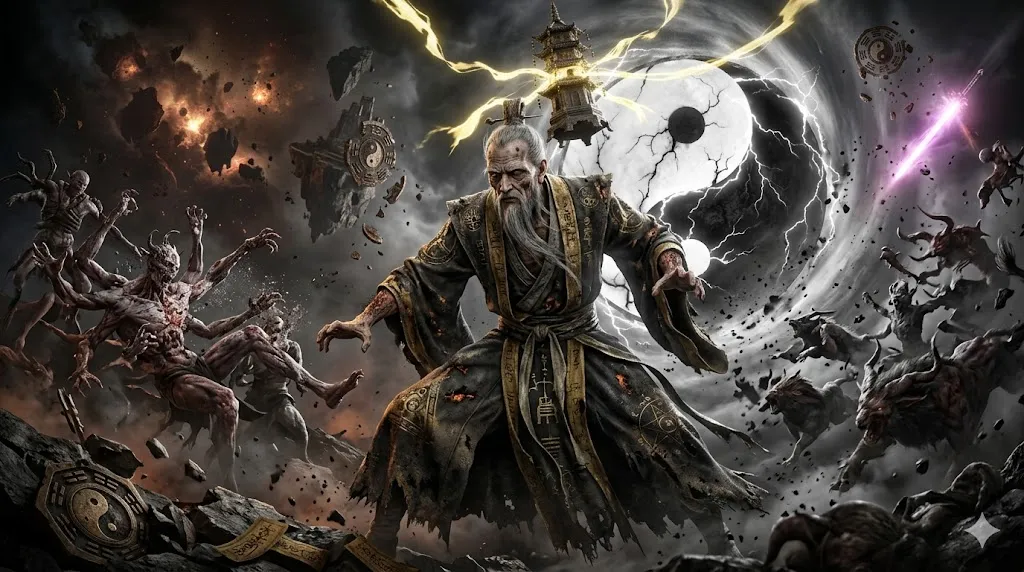
Eastern Mythology Encyclopedia
Daode Tianzun
道德天尊
Daode Tianzun (Lord of the Dao and Its Virtue) wrote the definitive guide to the cosmos—five thousand words that would shape the spiritual destiny of an entire civilization—then walked away. He never took disciples, never answered questions, never returned to explain what he meant. For a being who embodies the ultimate truth of existence, he is oddly silent. The paradox is not that he is powerful—everyone knows that—but that the one who could teach everything chose to say just enough to be misunderstood, and let the world struggle with the rest.
道德天尊 · Daode Tianzun (Lord of the Dao and Its Virtue) / 太清道德天尊 · Celestial Worthy of the Great Pure Realm / 老子 · Laozi
Affiliation: 人教 · 太清境 · 三清之三 (The Teaching of the Human Way, residing in the Great Pure Realm, the Third of the Three Pure Ones)
Birth Era: Prior to Heaven and Earth (先天) – an emanation of the Dao itself
Place of Origin: The Great Pure Realm (太清境)
Cultivation Site: The Great Pure Realm (太清境)
Current Realm: Da Cheng Zhen Xian (大乘真仙) – identical with the Dao; a manifested aspect of ultimate reality
The most enduring relic of Daode Tianzun is the Daode Jing (《道德经》), the five-thousand-character text he composed at the request of Yin Xi (尹喜), the guardian of the Hangu Pass. The original manuscript, if it ever existed, has not survived. However, countless commentaries, temple inscriptions, and ritual manuals claim to preserve his dictation. The Hangu Pass itself is a pilgrimage site, traditionally marked by a temple dedicated to Laozi. In many Daoist monasteries, a statue of Daode Tianzun is enshrined in the main hall, often riding a blue ox (青牛), holding a fan (扇子) that symbolizes his power over the five phases. The "Diamond Snare" (金刚琢) used against Duobao Daoren is sometimes described as a bracelet of refined jade, but no physical artifact has been verified. The Taiji Diagram (太极图) is said to be stored in the Great Pure Realm, inaccessible to mortals.
Within this entry, the following figures and concepts are referenced in relation to Daode Tianzun: Yuanshi Tianzun and Lingbao Tianzun as the other two Pure Ones; Tongtian Jiaozhu as the founder of Jie Jiao, whom he opposed during the Conferred God Catastrophe; Duobao Daoren as a Jie Jiao disciple whom he subdued; the Western Saints (Jieyin Daoren and Zhunti Daoren) with whom he cooperated at the Ten Thousand Immortals Array; and the mortal Yin Xi, who received the Daode Jing. The cultivation term Yi Qi Hua San Qing appears as a unique technique, and the relic Jin Gang Zhuo and Tai Ji Tu are mentioned as his tools. The text also references the Hangu Pass and the blue ox. These are explained in the LORE_ENTRIES below.
Daode Tianzun is not a cultivator who ascended through stages. As the Third of the Three Pure Ones (三清), he is a primordial emanation of the Dao, coeval with the differentiation of Xian Tian Yi Qi (先天一炁). He has never undergone Lian Qi, Zhu Ji, Jin Dan condensation, or Yuan Ying gestation. His existence is timeless and unbound by the framework of cultivation stages. The concept of a Heavenly Tribulation (天劫) does not apply to him, because the tribulation is itself a function of the Dao he embodies. He does not fear the Three Calamities (三灾), nor does he face the Five Signs of Decay (天人五衰). In the cosmic ledger, he is not a debtor but the law that writes the ledger. The only "predicament" recorded in myth is his voluntary descent into mortality as Laozi, an act of teaching that required him to inhabit a decaying human shell—a temporary limitation rather than an existential crisis.
Daode Tianzun did not discover cultivation; he is the source from which all cultivation derives. In the Honghuang Era (洪荒纪元), the Three Pure Ones emerged from the primordial chaos as necessary principles. Daode Tianzun corresponds to the stage "Tao" (道) as it manifests in the form of virtue and governing wisdom. His "entry" into the mortal world came later, when he chose to incarnate as Laozi (老子), the keeper of the archives at the Zhou court. The legend does not describe a moment of sudden enlightenment or a dangerous qi-intake experience. Instead, it presents his descent as a deliberate, calm assumption of human form—a teacher entering a classroom of pupils who do not yet know they are students. There was no first breath of primal energy coursing through fragile meridians; the body he inhabited was a vessel he constructed, not a mortal shell he struggled to transform.
The concept of Foundation Establishment (筑基) presupposes a mortal body that must be forcibly shut down and rebuilt. Daode Tianzun, in his original form, never required such a transformation. When he became Laozi, he simply took on a human appearance without ever needing to renounce food, sleep, or emotion. He experienced no metabolic collapse, no painful detoxification, no gradual loss of humanity. His detachment was not the result of cultivation practice but the natural condition of a being who already existed beyond those attachments. The tradition records that when he left the world through the Hangu Pass (函谷关), he did so not as a cultivator escaping decay, but as a sage who had completed his task. His farewell was not a struggle against the universe's entropy—it was a door closing behind a visitor who had never truly been a resident.
Daode Tianzun has no Golden Core (金丹) in the conventional sense, because he predates the mechanism through which cultivators steal and condense cosmic energy. Where a cultivator's Golden Core is a singularity of stolen 造化, a karmic time bomb that triggers the Three Calamities, Daode Tianzun's body is itself the cosmic crucible from which such energy flows. He does not experience the threat of Yin Fire (阴火) burning his internal organs from within, nor the Keening Wind (赑风) shredding his spirit from the crown. His existence is not an anomaly in the cosmic order—he is the order. The Heavenly Tribulation that descends upon cultivators is a reflection of his own nature: the Dao's immune response to imbalance. He is not a target of that response. The only "tribulation" recorded in myth is the Conferred God Catastrophe (封神大劫), in which he intervened not as a victim but as an agent of cosmic recalibration.
Daode Tianzun does not undergo the excision of the Three Worms (斩三尸). The Three Corpses—Peng Zhi (upper), Peng Zhi (middle), and Peng Qiao (lower)—are parasitic entities that infest mortal beings, embodying greed, anger, and ignorance. As a primordial emanation of the Dao, Daode Tianzun has never been subject to these internal parasites. He has no greed to exorcise, no anger to suppress, no ignorance to dispel. His wisdom is not the result of successive victories over inner demons; it is his original state. The notion of Yuan Ying (元婴)—a second, emotionless self that gradually replaces the original consciousness—does not apply to him either. He is not a dual being composed of a struggling human host and a perfected inner child. He is a singular, unified manifestation of the Dao. There is no struggle for identity, no fear of being usurped by one's own creation.
Daode Tianzun's character does not fit the tragic mold of the suffering Xian. The tradition does not ascribe to him a single, all-consuming obsession that drove him through torment. He is not a being who traded his humanity for power, only to regret the trade. Instead, he is depicted as a figure of serene completeness—one who possesses wisdom without the need for struggle, authority without the appetite for domination. The tragedy, if it can be called that, is not his own but that of the world he left behind: a world that must parse his five thousand words without him, that must find the path through trial and error while the map-maker has already folded the map and vanished beyond the pass. The deepest resonance of his myth lies not in personal loss, but in the solitude of perfect knowledge and the impossibility of fully transmitting it.
Within the Xian framework, Daode Tianzun is the founder of the Teaching of the Human Way (人教), the third of the Three Teachings alongside Chan Jiao and Jie Jiao. His relationship with the other two Pure Ones is one of complementary function: Yuanshi Tianzun governs the primal order and issues decrees; Lingbao Tianzun presides over the cataclysmic machinery of fate; Daode Tianzun provides the philosophical foundation and the practical wisdom that allows mortals to align with the Dao. During the Conferred God Catastrophe, he intervened decisively but with restraint. He defeated Duobao Daoren using the Diamond Snare (金刚琢) and the Taiji Diagram (太极图), and revealed the Yi Qi Hua San Qing (一气化三清) technique to suppress Tongtian Jiaozhu. Yet he did so not out of personal enmity but to prevent the catastrophe from consuming the entire cosmic order. After the war, he retreated to the Great Pure Realm, leaving no further instructions. His relationship with the mortal world is preserved in the Daode Jing (《道德经》), a text he did not explain and whose meaning he never authorized.
Daode Tianzun currently resides in the Great Pure Realm (太清境), the highest of the three celestial purities. He does not involve himself in the affairs of the Three Realms, having discharged his cosmic duty during the Conferred God Catastrophe. His current state is described as "dwelling in non-action" (无为), a condition of perfect alignment with the Dao wherein he neither acts nor refrains from acting, but simply is the principle that underlies all action. He does not receive petitioners, does not accept disciples, and does not intervene in mortal cultivation. The legacy he left—the Daode Jing—continues to guide generations, but he has never returned to correct misinterpretations or to judge those who misuse his words. According to the established tradition, he has no further teaching to offer. His silence is the final lesson.
Lore Notes
Ren Jiao (人教)
The Teaching of the Human Way, the third of the Three Teachings founded by Daode Tianzun, focused on cultivating virtue and aligning with the Dao through non-action.
Tai Qing Jing (太清境)
The Great Pure Realm, the highest celestial residence of Daode Tianzun, one of the three pure heavens beyond the Three Realms.
Jin Gang Zhuo (金刚琢)
The Diamond Snare, a magical bracelet used by Daode Tianzun to defeat Duobao Daoren; capable of neutralizing any weapon or spell.
Tai Ji Tu (太极图)
The Taiji Diagram, a primordial cosmic map that contains the principles of yin-yang and the five phases; used by Daode Tianzun to impose order.
Yi Qi Hua San Qing (一气化三清)
A technique in which Daode Tianzun projects three separate bodies from his single original form, each representing one of the Three Pure Ones, to overwhelm an opponent.
Duobao Daoren (多宝道人)
A disciple of Tongtian Jiaozhu in the Conferred God Catastrophe who challenged Daode Tianzun and was subdued by the Diamond Snare.
Yin Xi (尹喜)
The gatekeeper of the Hangu Pass who requested that Laozi write down his teachings, resulting in the Daode Jing.
Hangu Pass (函谷关)
The mountain pass where Laozi composed the Daode Jing before departing the mortal world; a major pilgrimage site.
Qing Niu (青牛)
The blue ox traditionally depicted as the mount of Laozi, symbolizing slow, steady progress and the power of tranquility.
Daode Jing (道德经)
The foundational text of Taoist philosophy, composed by Laozi in five thousand characters; the core scripture of the Ren Jiao.
FAQ
Is Daode Tianzun the same as Laozi?
Yes, Daode Tianzun is the primordial deity who incarnated as Laozi (the Old Master) during the Zhou dynasty to teach the Daode Jing to humanity.
Why didn't Daode Tianzun explain the Daode Jing?
The tradition holds that he intended the text to be a puzzle rather than a manual—a map that each generation must interpret for itself. He never returned to clarify because the act of seeking is itself the teaching.
Did Daode Tianzun experience tribulations or stages of cultivation like other Xian?
No. As a primordial emanation of the Dao, he never underwent cultivation stages. He is not a being who stole cosmic energy; he is the source of that energy.
What role did Daode Tianzun play in the Conferred God Catastrophe?
He intervened decisively to maintain balance—defeating Duobao Daoren with the Diamond Snare, using the Yi Qi Hua San Qing technique against Tongtian Jiaozhu, and helping break the Ten Thousand Immortals Array alongside the other Pure Ones and the Western Saints.
Is the Daode Jing a book about cultivation?
While it contains principles that underlie Daoist cultivation, it is primarily a philosophical text about the nature of the Dao, virtue (de), and the practice of non-action. It is considered the foundation text of the Ren Jiao tradition.