Eastern Mythology Encyclopedia
Yuanshi Tianzun
元始天尊
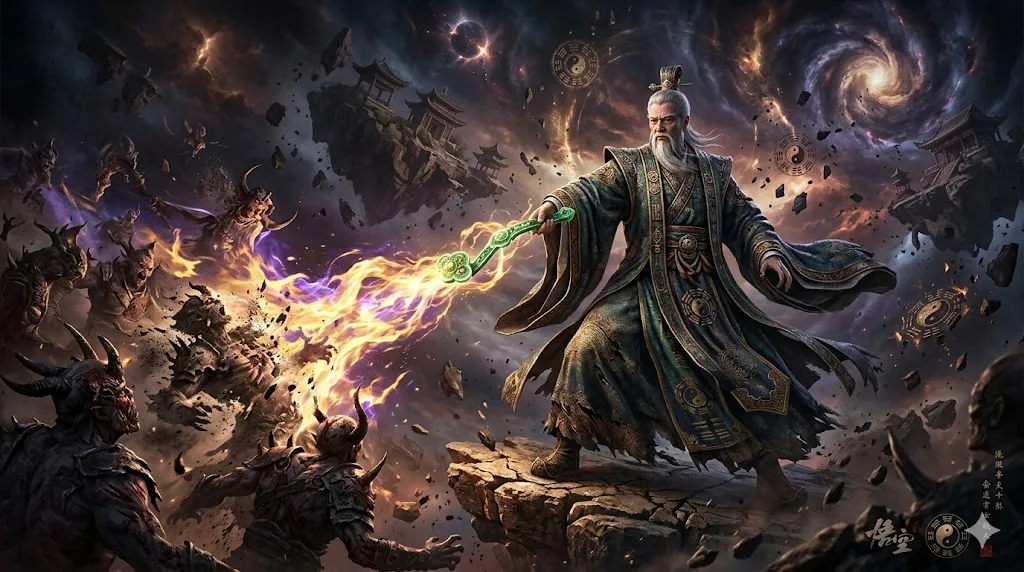
Yuanshi Tianzun (the Celestial Worthy of Primordial Beginning, the highest embodiment of the impersonal Dao) does not judge, does not punish, does not save. He simply is the law. For anyone who steps outside that law—whether a demon lord, a rebellious god, or a rogue cultivator—the touch of his jade ruyi is the last thing they will ever feel. He is the silent axis around which the cosmos turns, and everything that deviates from that axis is ground to dust. This is not cruelty; it is the nature of a being who has never known the concept of mercy.
元始天尊 (Yuanshi Tianzun) / Also known as: 玉清元始天尊 (Celestial Worthy of the Jade Pure Beginning)
Affiliation: 阐教 · 玉清境 (Chan Jiao, the Teaching of Interpretation; resident of the Jade Pure Realm)
Birth Era: Before the separation of Heaven and Earth (先天)
Place of Origin: The Primordial Void (太虚)
Cultivation Site: Jade Pure Realm (玉清境)
Current Realm: Unity with the Dao (与道合真), the highest possible state of existence
The sources do not record physical relics or geographical markers left by Yuanshi Tianzun on the human plane. His presence is discerned only through the order of the heavens, the circulation of spiritual energy, and the purity of the Dao that infuses all worthy cultivators. No mountain bears his sword mark; no temple claims his abandoned robe. He is the invisible axis around which all visible things turn.
This entry is intimately connected with several major figures and events in the same mythic cycle. Tongtian Jiaozhu (通天教主) serves as his principal adversary during the Feng Shen catastrophe, representing the doctrinal antithesis to his orthodox Chan Jiao. The fellow Pure Ones—Laojun (太上老君) and Lingbao Tianzun (灵宝天尊)—form the triad that governs the celestial realms. The Chan Jiao and Jie Jiao schools are the institutional manifestations of their respective philosophies. The cosmic event known as Jue Di Tian Tong (绝地天通) provides the structural backdrop for his withdrawal from direct intervention. Each of these entries elaborates on a different aspect of the celestial order he embodies.
As the direct emanation of the Dao itself, Yuanshi Tianzun transcends any stage-based cultivation framework. He has existed since before the formation of the Three Realms (San Jie) and the Great Disconnection (Jue Di Tian Tong). His current state is one of absolute stillness and omniscience—he is the living foundation of cosmic law. The sources do not record any personal predicament or existential threat, for his existence is the very principle that upholds the universe. He resides permanently in the Jade Pure Realm, a dimension beyond all temporal and spatial limitations, where he performs no action and yet all actions originate from his will.
Yuanshi Tianzun is not a cultivator who entered the path; he was born directly from the Primordial Breath (Xian Tian Yi Qi) as the first self-aware manifestation of the Dao. The concept of "entering the path" does not apply to him. At the dawn of creation, before the division of yin and yang, he simply was. He witnessed the establishment of the cosmic order, the separation of the Three Realms, and the enforcement of the Great Disconnection. He has no personal history of mortal suffering, no moment of awakening, and no master. He is the origin of all teaching.
As a primordial being, Yuanshi Tianzun never underwent Foundation Establishment (Zhu Ji) or the metabolic shutdown that characterizes mortal cultivators. He has no personal history of detachment from humanity because he was never human. His body is not a physical vessel but a condensed form of pure Dao-essence. There is no record of him returning to a mortal home or confronting the weight of filial bonds—such categories do not apply. The tradition presents him as utterly beyond the cycle of birth, aging, sickness, and death that defines all sentient beings.
Yuanshi Tianzun does not possess a Golden Core (Jin Dan); his entire being is the Golden Core of the universe—a singularity that contains and generates all cosmic laws. The concept of karmic debt and tribulation does not pertain to him, as he is the very administrator of such mechanisms. He has never experienced the Three Calamities (San Zai) because he is the force that dispatches them. In the cosmic ledger, he is the accountant, not the debtor. The tradition emphasizes that he stands outside the cycle of retribution entirely, serving as the immutable reference point for all causal accountability.
The Three Worms (San Shi) and the Nascent Soul (Yuan Ying) are artifacts of mortal cultivation. Yuanshi Tianzun, being co-extensive with the Dao, has never possessed nor needed to excise these entities. There is no division between his person and his essence; he is a single, undifferentiated whole. The concept of an internal universe (Nei Qiu Yu Zhou) does not apply because his entire being is already the universe itself. No inner voice, no second self, no struggle for identity—only the pure, silent continuity of the absolute.
Yuanshi Tianzun operates without personal desire or obsession. His every action is the direct expression of the Dao's impersonal will—the maintenance of cosmic order and the correction of deviations. If there is a "drive," it is not his own but the law's. The tradition portrays him as utterly devoid of regret, love, hatred, or ambition. The tragedy, if it exists, lies not within him but in the universe that must submit to his indifferent rulings. Those who suffer under his decree cannot appeal to his compassion, for compassion is not a component of his nature.
As the founder of Chan Jiao (阐教), Yuanshi Tianzun represents the orthodox path of Xian (仙). He guided his disciples according to the principle of "complying with Heaven's mandate" (顺天应人). During the Feng Shen (封神) catastrophe, he personally intervened against Tongtian Jiaozhu (通天教主) and the Jie Jiao (截教), which he considered a corruption of the Dao's purity. He has no direct dealings with the mortal world or with demonic sects, though his edicts shape their fates through the celestial bureaucracy. He has never been tempted by the Buddhist path, as his existence predates and encompasses all divisions. The sources do not preserve any encounter with demonic forces that would threaten his integrity; he is exempt from the ordinary conflicts of the path.
Yuanshi Tianzun currently resides in the Jade Pure Realm (玉清境), a dimension beyond the Three Realms where he sustains the higher-order laws of the cosmos. He is not expected to undergo any transformation or death; as the embodiment of the Dao, he will endure as long as the universe itself exists. His legacy includes the orthodox textual canon of the Chan Jiao, the celestial order that governs the pantheon, and the precedent of absolute non-intervention after the Great Disconnection. No description of his final end is preserved in the sources, for such an end is inconceivable within the mythic framework.
Lore Notes
Chan Jiao (阐教)
The Teaching of Interpretation; the orthodox Xian school founded by Yuanshi Tianzun, emphasizing conformity to Heaven's mandate and exclusive transcendence for the worthy.
Jie Jiao (截教)
The Teaching of Interception; the rival school founded by Tongtian Jiaozhu, advocating universal salvation for all beings regardless of origin, including demons and animals.
Jade Pure Realm (玉清境)
The highest celestial dimension where Yuanshi Tianzun resides; a realm of pure static Dao-essence, undefiled by the turbulence of the lower heavens or the mortal plane.
Feng Shen (封神)
The Enfeoffment of the Gods; a cosmic catastrophe during the Shang-Zhou transition that reorganized the pantheon, purging unruly beings and establishing the celestial bureaucracy under Tian Tiao.
Tongtian Jiaozhu (通天教主)
The Celestial Master of the Intercepted Path; younger brother of Yuanshi Tianzun and founder of Jie Jiao, defeated during the Feng Shen conflict.
FAQ
Is Yuanshi Tianzun a god in the Western sense?
No. He is not a personal deity who answers prayers or judges souls. He is the impersonal manifestation of the Dao itself—the law that governs all existence, without emotion or preference.
Why did Yuanshi Tianzun fight Tongtian Jiaozhu?
Their conflict during the Feng Shen catastrophe stemmed from a fundamental doctrinal dispute: Yuanshi Tianzun believed that only the worthy few should ascend (Chan Jiao), while Tongtian Jiaozhu preached salvation for all beings (Jie Jiao). Yuanshi saw this as a violation of cosmic order.
Does Yuanshi Tianzun have any human emotions?
The tradition unanimously presents him as utterly devoid of personal emotions. He operates purely through the impersonal logic of the Dao, making him the coldest and most absolute figure in the pantheon.