Eastern Mythology Encyclopedia
Chijingzi
赤精子
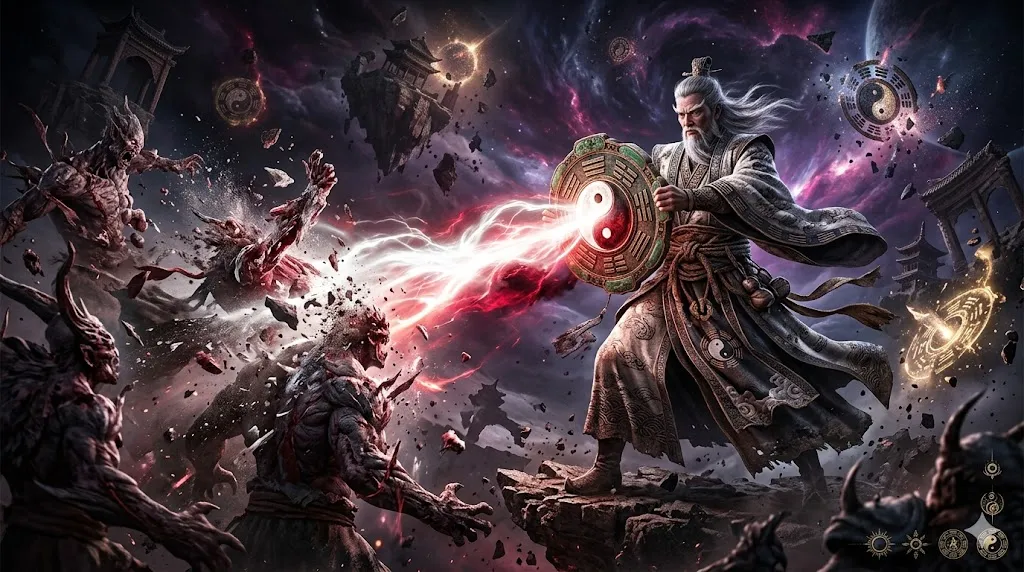
Chijingzi (a Golden Immortal of the Chan School, the Master of the Vermilion Essence) was the most cautious cultivator among the Twelve Golden Immortals—and the one who was forced to personally kill his own disciple, a betrayal that no amount of celestial foresight had prepared him to endure.
赤精子 · Master of the Vermilion Essence / 太华山云霄洞赤精子 (Chijingzi of the Cloud-Covered Cave on Mount Taihua)
Affiliation: 阐教 · 元始天尊门下 · 十二金仙 (The Teaching of Interpretation / Chan Jiao, one of the Twelve Golden Immortal Disciples of Yuanshi Tianzun)
Birth Era: Honghuang Ji Yuan (The Honghuang Era)
Cultivation Site: 太华山云霄洞 (The Cloud-Covered Cave on Mount Taihua)
Current Realm: Jin Xian (Golden Immortal within the Da Luo Celestial rank)
None. The surviving lore does not attribute any physical relic, sword mark, inscribed scripture, or preserved artifact to Chijingzi. His legacy is entirely contained within the record of the Yin Hong incident.
The entry documents Chijingzi's connection to several key figures. He is a direct disciple of Yuanshi Tianzun, founder of the Chan Jiao (Teaching of Interpretation), and stands among the Twelve Golden Immortals, the elite inner circle. His most significant recorded relationship is with his disciple Yin Hong, a prince of Shang whom he personally trained but who later betrayed the Chan Jiao, forcing Chijingzi into a confrontation. The instrument used in that confrontation was the Tai Ji Tu, a supreme treasure borrowed from Daode Tianzun, placing Chijingzi within the broader circuit of Taoist primordial relics. His mission during the Feng Shen Da Jie was carried out in service to Jiang Ziya, the appointed executor of the divine canon. The event of Yin Hong's death carries implications for the entire framework of the Feng Shen Da Jie, illustrating how personal loyalty could be broken by the larger forces at play. The names, relations, and canonical significance outlined here correspond to the entries in the structured relation blocks below.
Chijingzi's current recorded state is that of a Jin Xian (Golden Immortal, Da Luo Tian Xian rank)—a stable celestial stage achieved long before the Feng Shen Da Jie (Conferred God Catastrophe). The sources do not preserve a full stage-by-stage record of his cultivation, but his status as one of the Twelve Golden Immortals places him among the highest-tier disciples of Yuanshi Tianzun. His primary recorded difficulty is not the physical threat of Tian Jie (Heavenly Tribulation) but a psychological and karmic one: the aftermath of his disciple Yin Hong's betrayal, which forced him to personally guide his own student into a death formation. The tradition presents this event as a lasting fracture in his Dao-heart—one that drove him into seclusion on Mount Taihua, not because he was physically damaged, but because he could no longer trust his own judgment of others.
Chijingzi's initiation into the Dao is not recorded in detail. The tradition frames him as a pre-existing disciple of the great primordial epoch—one who had already reached a high level of cultivation before the events that defined him. He did not come to the Dao from a mortal life of suffering or sudden enlightenment; rather, the cycle presents him as an ancient being, already established in the era when Yuanshi Tianzun taught the first generation of Chan Jiao disciples. His first experience of Qi absorption and cultivation is not preserved in the surviving lore; what is known is that he emerged as a technical specialist among the Twelve Golden Immortals—a cultivator distinguished not by raw power but by mastery of Yin Dun (Yin Escapement Method) and array deduction. His caution, the tradition suggests, was not a flaw learned later but a temperament present from the beginning.
The sources do not preserve a detailed account of Chijingzi's Foundation Establishment period. The tradition presents him as a being who achieved transcendence without the dramatic metabolic shutdown or emotional necrosis that plague mortal-born cultivators. Among the Chan Jiao's inner circle, the path toward transcendence was guided from the start, and the human cost was less visible. What the cycle does make clear is that Chijingzi was never fully "human" in the mortal sense. As a primordial disciple who received direct transmission from Yuanshi Tianzun, his detachment from mundane bonds was not a cost he paid over time but a condition he had always possessed. The later tragedy of Yin Hong thus carries a particular weight: a being who had never learned to trust mortals intimately nonetheless chose to take a mortal disciple, and that choice shattered him.
The formation of Chijingzi's Jin Dan (Golden Core) is not recorded in the surviving texts. As one of the Twelve Golden Immortals, he belongs to the first generation of Chan Jiao disciples who achieved this state in the primordial epoch, when the Xian Tian Yi Qi (Primordial Breath) was still abundant and the natural order had not yet been hardened by the Jue Di Tian Tong (Great Disconnection). The tradition does not describe him undergoing the San Zai (Three Calamities) in the manner of later mortal cultivators. His recorded vulnerability is not one of physical tribulation but of strategic limitation: he was a master of Yin Dun, arrays, and subtle techniques—yet he could not overcome a disciple armed with superior celestial treasures. This failure, not a physical wound, is what defines him. The sources present his account not as a narrative of attrition but as a record of miscalculation and misplaced trust.
The process of excising the San Shi (Three Worms) is not preserved in the cycle for Chijingzi. As a primordial disciple, his cultivation path did not follow the same stage-by-stage sequence as later generations of Xian. The tradition does not describe a Yuan Ying (Nascent Soul) formation with the associated identity crisis—the fear of being replaced by a colder, more perfect self. What the surviving lore presents is a being whose identity was stable from the beginning. His tragedy is not that he lost himself to a higher self, but that he remained himself, unchanged, while the world around him—and the disciple he had personally trained—became unrecognisable. The inner terror, for Chijingzi, was not "am I still me?" but "was anyone ever what I thought they were?"
The central obsession that carried Chijingzi through all his recorded trials was a deep, almost religious belief in Tian Ming Shu (Heavenly Destiny) and the logic of Tian Di Gang Chang (The Cosmic Order). He operated as though the patterns of fate were legible and reliable. This conviction gave him caution instead of ambition—he did not seek to dominate; he sought to predict, calculate, and move only when the patterns were clear. His unresolved guilt is the betraying disciple Yin Hong, whom he had personally taught and trusted. The tragedy is structurally insoluble: the very caution that defined him as a cultivator made him hesitant to act decisively against his disciple until it was too late. His belief in fate became the reason fate could trap him. The tradition frames Chijingzi less as a sufferer of physical cultivation costs and more as an emblem of the risk that lurks in excessive intellectual certainty: the mind that trusts calculation more than instinct may miss what raw intuition would have seen.
**Within the Xian School (Chan Jiao):** Chijingzi is a loyal inner disciple of Yuanshi Tianzun, one of the Twelve Golden Immortals who descended to assist Jiang Ziya during the Feng Shen Da Jie. He operated within the Chan Jiao chain of command, receiving orders and executing them with technical precision. He is neither a defector nor a rebel; the tradition presents him as a faithful executor of command who was given an impossible assignment.
**Interaction with Shen Dao (The Divine Path):** The sources do not preserve a clear record of Chijingzi being personally offered a Celestial Office by the Heavenly Court. As a Golden Immortal of the Chan Jiao, his position is above the standard Shen hierarchy. He did not accept or reject a divine appointment because, in the framework of his era, he was already of a higher order.
**Lingering Ties to the Mortal World:** None recorded. Chijingzi's origins are primordial; he has no known mortal family or personal history.
**Interaction with Yao Dao (The Demonic Path):** No recorded conflict.
**Encounters with the Mo and Fo:** The sources do not preserve interaction with these paths.
Chijingzi's recorded present is a state of retreat. After the Feng Shen Da Jie, during which he was compelled to kill his own disciple Yin Hong using the Tai Ji Tu (Taiji Diagram) of Daode Tianzun, his Dao-heart was shaken. The tradition states that he withdrew to Mount Taihua, to the Cloud-Covered Cave, and ceased active involvement in the affairs of the Three Realms. He did not ascend to the highest celestial realm in a final, triumphant Fei Sheng (Ascension); he did not fall in battle; he did not leave behind a completed legacy. He simply stopped. The sources do not record his ultimate fate. Some readings treat his seclusion as permanent—a being who chose solitude not out of enlightenment but out of exhaustion. What he left behind was not a written text or a hidden treasure but a warning inscribed in the silence around his name: that even the most careful cultivator can be undone by a single mistake in trust.
Lore Notes
Twelve Golden Immortals
The twelve core disciples of Yuanshi Tianzun within the Chan Jiao (Teaching of Interpretation), each a powerful Xian who served as a master or advisor during the Feng Shen Da Jie.
Yin Yang Mirror (阴阳镜)
A magical artifact owned by Chijingzi; its white side kills living beings, its red side resurrects them.
Eight Trigrams Celestial Robe (八卦仙衣)
A protective garment given to Yin Hong by Chijingzi; it made the wearer immune to the Yin Yang Mirror's effects.
Tai Ji Tu (太极图)
The Taiji Diagram, a primordial cosmic map and treasure of Daode Tianzun; capable of dissolving beings into the chaos of yin and yang.
Yin Hong (殷洪)
A prince of the Shang dynasty, Chijingzi's disciple who betrayed the Chan Jiao and was killed by his own master.
Feng Shen Da Jie (封神大劫)
The Conferred God Catastrophe, a pivotal war between the Chan Jiao and Jie Jiao that restructured the divine order of the Three Realms.
Da Luo Tian Xian (大罗天仙)
A high celestial rank of Golden Immortal, indicating a being who has transcended the standard framework of Heaven.
Yin Dun (阴遁)
A method of escape and concealment using the yin force; one of Chijingzi's signature techniques.
Dao-heart (道心)
The spiritual core of a cultivator's conviction and resolve; a "cracked" Dao-heart is a state of crippling doubt.
FAQ
Who was Chijingzi's disciple?
Yin Hong, a prince of the Shang dynasty who was taught by Chijingzi but later turned against the Chan Jiao to fight for the Shang against the Zhou.
How did Chijingzi kill his disciple?
He could not defeat Yin Hong with his own treasures because the Eight Trigrams Celestial Robe made Yin Hong immune to the Yin Yang Mirror. Chijingzi borrowed the Taiji Diagram from Daode Tianzun and guided his disciple into its death gate.
Why is Chijingzi considered tragic?
Because he was the most cautious of the Twelve Golden Immortals, and his single act of trust toward a student resulted in that student using everything he had been taught to fight against his own master—leaving Chijingzi psychologically shattered.
Did Chijingzi achieve true immortality?
He was already a Golden Immortal (Da Luo Tian Xian) before the events of the Feng Shen Da Jie. However, the tradition states that after Yin Hong's death, he withdrew to his cave on Mount Taihua and effectively retired from all activity. He is not recorded as having ascended further or having died.
What were Chijingzi's powers?
He was a specialist in Yin Dun (yin-based escape methods) and array deduction. His most famous artifact was the Yin Yang Mirror. He is described as a technical, strategic cultivator rather than a powerhouse.