Eastern Mythology Encyclopedia
Bodhisattva Cundi (Sanskrit) / The Strategist
准提道人
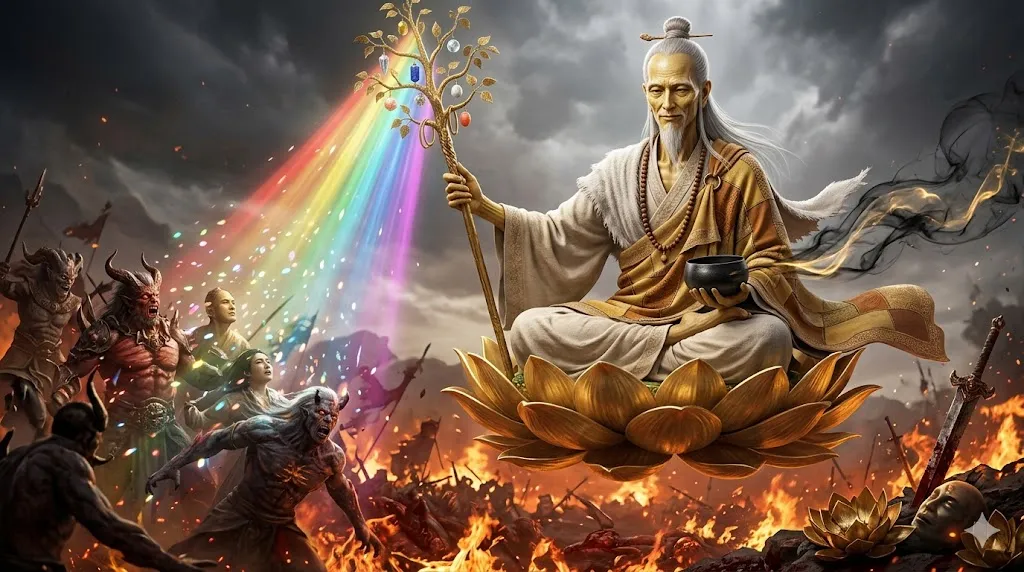
Bodhisattva Cundi (准提道人, The Strategist) does not wait for beings to arrive at the gate of liberation—he goes out to collect them, one by one, by force if necessary, with all the precision of a divine acquisition agent whose target list is written across the Three Realms.
准提道人 (Zhun Ti Dao Ren) / Bodhisattva Cundi (Sanskrit: Cundi, also known as The Strategist, or Goddess Cundi in certain esoteric traditions)
修行法门: 准提法门 (Cundi Practice — Breaking Obstacles and Conversion)
证果纪元: Cultivation timeline not precisely recorded in mortal chronicles; the figure arises as a high-level being active during the Feng Shen epoch (Shang–Zhou transition).
灵山/净土归属: Operates primarily at the intersection between the Celestial Realm, the Earthly Realm, and the nascent Western Paradise (the Pure Land in formation). Functions as the active expedition force for the future Pure Land.
当前果位: Pu Sa (Bodhisattva).
In the human realm, temples dedicated to Bodhisattva Cundi are comparatively rare but not unknown, primarily found in Chinese Esoteric Buddhist monasteries. The Cundi Dharani (准提咒) and the associated practice text, the *Seventy-Million-verse Cundi Dharani Sutra*, are transmitted as part of the Tang-dynasty esoteric tradition. A notable temple site is the Cundi Hall within certain larger monastic complexes, particularly in southern China and Taiwan. However, there is no single iconic mountain or standalone pilgrimage site equivalent to Mount Wutai or Mount Putuo that is uniquely associated with Cundi. His presence is felt through practice rather than through a territorial shrine.
The career and method of Bodhisattva Cundi are most fully illustrated in the *Feng Shen Yanyi* (封神演义), where he appears alongside Jie Yin Dao Ren (接引道人) as one of the two primary agents of the nascent Western school during the Shang–Zhou transition. His most significant recorded interaction is with Kong Xuan (孔宣), the five-colored peacock-spirit whose conversion marks a turning point in the war's spiritual dimension. Within the same cosmological framework, Cundi's operational logic stands in sharp contrast to the more passive approach of Jie Yin Dao Ren, who functions as a receiver rather than a seeker. A reader interested in the complete narrative of Cundi's campaigns should consult the related entries for Jie Yin Dao Ren, Kong Xuan, and the broader Feng Shen war cycle.
Bodhisattva Cundi holds the rank of a Pu Sa (a bodhisattva who has voluntarily delayed final liberation to serve the liberation of others). Within the mythic framework of the Feng Shen narrative, his specific path is characterized not by passive compassion or seated meditation, but by proactive conversion: he is a bodhisattva of intervention, whose role is to enter hostile or indifferent territories and extract beings who possess high potential for enlightenment. Unlike a Luo Han (arhat), who ceases to generate karmic interaction, Cundi actively generates immense causal interaction through the very act of conversion. His cultivation direction is thus defined by movement, negotiation, and the strategic use of coercive compassion. The precise number of kalpas he has spent on this path is not specified in surviving texts, but his role in the Feng Shen war places him as a figure of considerable seniority within the Western school's early formation.
At the time of his entry into the path of liberation, Cundi did not follow the conventional monastic procedure of ti du (剃度, ordination by tonsure) in a temple setting. As a figure belonging to the earliest generation of the Western school—the nascent Buddhist force in a mythological world still dominated by Daoist celestial hierarchies and primordial gods—his entry was not a conversion from secular life but a response to a larger systemic problem. The specific moment of awakening is not recorded in surviving lore. What the tradition preserves is a functional origin: he perceived that the established orders of the Three Realms—the Celestial Court, the terrestrial cultivation sects, the primordial schools—were failing to produce genuine liberation. He recognized that beings of exceptional capacity, who might otherwise attain enlightenment, were being locked into cycles of merit, punishment, or factional loyalty. His entry into the bodhisattva path was therefore not driven by personal suffering but by a strategic evaluation of the cosmic landscape: too many high-potential beings remained unreachable because no one was actively going to retrieve them.
Cundi's primary method for breaking through the delusions of sentient beings is not the standard contemplative techniques such as Bai Gu Guan (白骨观, Bone Contemplation) or Bu Jing Guan (不净观, Impurity Contemplation)—he does not sit in a cave to deconstruct his own attachments. Instead, his core practice is a specialized form of outward-facing prajna (wisdom) and upaya (skillful means) called the Cundi Practice (准提法门). This practice is designed to directly perceive the potential for enlightenment hidden within any being, even those entrenched in other systems of power or devotion. His method of overcoming karmic obstacles is externalized: the obstacle is not his own attachment but the resistance of the being he seeks to convert. The karmic entanglements he faces are therefore the accumulated loyalties, debts, and commitments that bind a powerful being to its existing school or celestial office. His critical breakthrough in this path occurred when he understood that conversion itself is a valid form of compassion—that actively removing a being from a suboptimal karmic environment and transplanting it into the Pure Land ecosystem is not a violation of that being's autonomy but a salvage operation. This insight allowed him to operate without the guilt that might immobilize a more passive practitioner.
Bodhisattva Cundi operates under a vow that is not explicitly recorded as a single canonical sentence in the way that Di Zang's "hells emptied" vow is, but his actions in the Feng Shen narrative imply a functional vow of extraordinary scope. In mythic terms, his fundamental commitment is: "I will not rest until all beings of high potential, regardless of their current allegiance, are directed toward the path of liberation." This functions as an implicit Hong Yuan (宏愿, Great Vow)—a binding contract with the cosmic order. The mechanism of this vow is operational rather than linguistic: every time he successfully converts a being of high standing—such as Kong Xuan (孔宣), the legendary peacock-spirit—the weight of that being's positive karma is redirected toward the Western Pure Land, while a portion of their negative karma (the debts incurred through past violence and factional attachment) is assumed by Cundi himself as the cost of the transaction. The volume of suffering he absorbs is implied by the nature of the beings he converts: many are warriors, generals, or demons who have accumulated immense negative karma. Each conversion therefore carries a heavy price.
Bodhisattva Cundi does not rule over an independent Jing Tu (净土, Pure Land) in the same manner as Amitabha rules over the Pure Land of Ultimate Bliss. His domain is not a fixed territory but the transitional space between the mundane realms and the Western Paradise established by Jie Yin Dao Ren (接引道人, The Receiver). His function is analogous to an acquisition network: he identifies, intercepts, and transports. Within the emerging Western school, he and Jie Yin Dao Ren form a complementary pair: Jie Yin opens the gate and receives beings at entry; Cundi travels outward, locates them, and brings them to the gate. His spiritual seat is therefore not a permanent sacred mountain but the moving point of contact between the Pure Land and the world. His dharma-lineage—the Cundi Practice—was later transmitted into the human realm and eventually encoded in scriptures such as the *Seventy-Million-verse Cundi Dharani Sutra* (七俱胝佛母所说准提陀罗尼经), making him one of the few beings from the Feng Shen epoch whose practice survives as an active monastic tradition. Among the great bodhisattvas and buddhas, Cundi maintains a special operational relationship with Jie Yin Dao Ren (partner in Pure Land construction), and a competitive yet productive tension with the major figures of the Chan and Daoist traditions that he encounters during his conversion missions.
The most celebrated documented event in Bodhisattva Cundi's career is his conversion of Kong Xuan (孔宣), the five-color peacock-spirit who serves as a general under the Shang dynasty during the Feng Shen war. Kong Xuan was considered virtually invincible in the mortal field: his Five-Color Divine Light (五色神光) could capture any being or artifact, and he had defeated numerous high-level cultivators from both the Chan and Jie schools of Daoism. Cundi approached Kong Xuan on the battlefield, not with an army, but alone, mounted on his lotus seat. The confrontation was not a battle of force but of systemic capture: Kong Xuan's Five-Color Divine Light, which had been able to absorb everything up to that point, proved unable to absorb Cundi, because the bodhisattva existed in a state that was outside the Five Phases (Wu Xing). Cundi then revealed his true form—a manifestation with twenty-four heads and eighteen arms, each holding a specific ritual implement—and subdued Kong Xuan, converting him on the spot. This event is recorded in the *Feng Shen Yanyi* (封神演义) and is considered one of the most significant single conversions in the Western school's early history. Another recorded instance involves Cundi's interception of Daoist disciples who had lost their masters or were orphaned by the war; he offered them direct passage to the Western Paradise, bypassing the standard reincarnation cycle.
Within the complex ecosystem of the Three Realms, Bodhisattva Cundi relates to each major path as follows:
**Relationship with the Daoist path (仙道):** Tension, but not outright hostility. Daoist cultivators, particularly those of the Chan and Jie schools, regard Cundi as an outsider who poaches their talent. However, because the Western school's promise of liberation through Pure Land rebirth is not a direct negation of Daoist immortality—it completes it, in the Western view—Cundi's actions are seen as opportunistic rather than heretical. The Daoist celestial authorities, including the higher officials of the Celestial Court, do not formally sanction his missions but also do not actively block them, because the Feng Shen war creates a situation in which "losing" a disciple to the West is preferable to losing them to death or oblivion.
**Relationship with the Celestial Court (天庭):** Non-adversarial. The Celestial Court is primarily concerned with maintaining Tian Tiao (天条, Celestial Decrees) and the orderly functioning of the cosmic hierarchy. Cundi does not challenge this hierarchy; he simply extracts beings from it when they become available. The Court treats him as an external contractor with a specific remit.
**Relationship with the Underworld (幽冥地府):** Minimal direct interaction. Cundi's work is primarily with living cultivators and spirits of high status, not with ordinary souls. He does not interfere with the standard process of Liu Dao Lun Hui (六道轮回, Six Paths of Reincarnation) for the common dead. The souls he carries to the Western Paradise bypass the Underworld entirely, but this is a rare exception, not a systemic override.
**Relationship with mortal governments and demonic beings:** Pragmatic. Cundi will convert a demon if the demon has high potential; he does not discriminate by origin. In the Feng Shen narrative, he does not engage in moral judgment of his targets—only potential assessment.
Bodhisattva Cundi's current enlightenment state, within the framework of the mythic tradition, is that of an active bodhisattva whose work is never complete. Unlike a Buddha who has attained final Nie Pan (涅槃, nirvana) and rests in quiescent extinction, Cundi remains in motion because the condition of his vow—the conversion of all high-potential beings—remains unfulfilled. The Pure Land established by Jie Yin Dao Ren is now complete and stable, serving as a destination for countless beings, but Cundi's role as its roaming acquisition force continues. In the framework of the Buddhist cosmological timeline—the Three Buddhas of the Past, Present, and Future—Cundi does not occupy a fixed calendrical position. He is a bodhisattva of the present age, operating in the space between the decline of the Sakyamuni epoch and the arrival of Maitreya (the future Buddha) or the full transference of beings to Amitabha's Pure Land. His dharma lineage survives as the Cundi Practice in Chinese Esoteric Buddhism and in the Zen tradition, where the Cundi Dharani is still chanted for the removal of obstacles.
Lore Notes
Kong Xuan (孔宣)
A five-colored peacock-spirit general serving the Shang dynasty during the Feng Shen war. His Five-Color Divine Light could capture any being or artifact but failed against Cundi, leading to his conversion and relocation to the Western Pure Land.
Five-Color Divine Light (五色神光)
Kong Xuan's signature ability: five beams of light corresponding to the five elemental phases that could absorb virtually any opponent until it met Cundi, who existed outside the Wu Xing cycle.
Twenty-four Heads and Eighteen Arms (二十四首十八臂)
Cundi's full manifest form, revealed during the conversion of Kong Xuan, representing the total scope of his perception and conversion capacity.
Feng Shen Yanyi (封神演义)
"The Investiture of the Gods," a Ming-dynasty Chinese novel that narrates the war between Shang and Zhou, in which many mythological beings—including Cundi and Kong Xuan—appear as active actors.
Cundi Dharani (准提咒)
A ritual mantra from the Cundi Practice tradition, still recited in Chinese Esoteric Buddhism for obstacle removal.
Jie Yin Dao Ren (接引道人)
"The Receiver," Cundi's counterpart in the Western school. Where Cundi goes out to find beings, Jie Yin stays at the gate to receive them.
Seven Buddhas (七佛)
A grouping of primordial Buddhas in the Cundi tradition; in some accounts, Cundi is identified as the mother of the Seven Buddhas, giving her a maternal function in certain esoteric lineages.
Si Shi Ba Yuan (四十八愿)
The Forty-Eight Vows of Dharmākara, the foundational contracts for the establishment of the Pure Land. While not Cundi's personal vows, these provide the structural context of the Western Paradise that Cundi's conversion work serves.
FAQ
Is Bodhisattva Cundi the same as the goddess Cundi in esoteric Buddhism?
Yes. In Chinese Esoteric Buddhism, the same figure is venerated as Cundi (准提佛母), the "Mother of the Seven Buddhas," a female buddha or bodhisattva associated with obstacle removal. The Cundi Practice tradition bridges the Feng Shen narrative figure and the esoteric deity.
Why does Cundi convert beings by force instead of teaching?
In the Feng Shen narrative, Cundi operates in a war context where beings are actively serving a losing cosmic faction. Conversion is presented as a form of rescue: he extracts them from a karmically destructive situation and relocates them to the Pure Land, where they can continue cultivation under better conditions.
Was Cundi originally a Daoist figure who became Buddhist?
The Feng Shen Yanyi treats Cundi as a representative of the Western school (the nascent Buddhist force) from the start. The Daoist-looking presentation of early Buddhist figures in the novel is artistic convention, not a statement about Cundi's origins.
Does Cundi have a Pure Land of his own?
No. Cundi does not rule a separate Pure Land. His function is mobile: he acquires and transports beings to the Pure Land established by Jie Yin Dao Ren and by the larger buddha-vow infrastructure of the Western school.