Eastern Mythology Encyclopedia
Buddha Amitabha (Sanskrit) / The Guide
接引道人
Amitabha (the Buddha of Infinite Light who established a vow-based escape route from the karmic cycle) does not demand wisdom, discipline, or gradual enlightenment from those who seek him. He asks only one thing: that you want to leave badly enough to say his name. What happens after you arrive in his Pure Land is a different question entirely.
接引道人 / 阿弥陀佛 (The Guide / Buddha Amitabha / Amitābha)
西方极乐净土法门 (The Pure Land Path of the Western Bliss / Vow-based Rebirth)
Enlightenment Era: Late Honghuang Period, after the Grand Disconnection.
Pure Land Affiliation: Sukhāvatī (极乐净土, The Pure Land of Ultimate Bliss), located beyond the Western boundary of the Three Realms, outside the Five Phases.
Current Fruit: Supreme Buddha of the Pure Land (已臻圆满, eternally abiding as the awakened guide of the Western Paradise).
The primary earthly center for Amitabha's veneration is any temple dedicated to the Pure Land path, but the most prominent sacred site tied to him is his manifestation in the Western Paradise of the Sukhāvatī. On Earth, the most significant pilgrimage site associated with the Pure Land school is Mount Lu's Donglin Temple (庐山·东林寺) in China, founded by Master Huiyuan (慧远), the first patriarch of the Pure Land school, who established a white lotus society dedicated to rebirth in the Pure Land.
This entry is deeply connected to the cosmology of the Pure Land and the mechanisms of vow-based liberation. Readers should consult the entry on Sukhāvatī (极乐净土) for a complete description of the realm itself. The figure of Avalokiteśvara (观世音菩萨/观音菩萨) is Amitabha's primary attendant, while Mahāsthāmaprāpta (大势至菩萨) complements his function as guide. The doctrinal foundation of his path is detailed in the Three Pure Land Sutras (净土三经): the Sutra of Immeasurable Life (无量寿经), the Amitabha Sutra (佛说阿弥陀经), and the Contemplation Sutra (观无量寿经). His role in the Investiture of the Gods is linked to the Daoist figure of the Wayfarer of the Way (准提道人). The path of 'other-power' (他力) central to his system fundamentally differs from the 'self-power' (自力) cultivation of Chan and other meditation-focused schools.
Amitabha currently abides as a fully awakened Buddha, a state he attained after countless kalpas of cultivation and vow fulfillment. His fruit is not one of personal liberation alone but of universal facilitation: he has achieved the complete and irreversible establishment of a Pure Land — a realm of karmic insulation — and now serves as its eternal gatekeeper and anchor. Unlike an Arhat who seeks to cease the generation of new karma, or a Bodhisattva who actively wades into the suffering of beings to guide them, Amitabha has structured his entire path around a single, massive bypass mechanism. He offers beings trapped in the Six Paths a direct rebirth into his Western Pure Land, where the conditions for enlightenment are so optimized that liberation becomes effectively guaranteed. This path bypasses the slow, perilous climb of the orthodox Buddhist cultivator; it trades gradual ascension for a single act of faith. The cost, however, is that the being who enters Sukhāvatī must eventually undergo a complete dissolution of their former self — the extinction of all karmic traces, all personal history, all residual attachment — before final nirvana can be achieved.
The tradition holds that Amitabha, in a former life countless kalpas ago, was a king named Dharmākara (法藏比丘) who renounced his throne upon hearing the teachings of the Buddha Lokeśvararāja. Deeply moved by the vastness of suffering in the cycle of birth and death, Dharmākara was not content with the slow, individual path of liberation. He saw that most beings were too weak, too confused, or too burdened by karma to ever reach enlightenment on their own. This observation did not lead him to despair; it led him to a radical conclusion. He must become a system. After his ordination and receipt of the precepts, he spent five kalpas meditating on the designs of all possible Buddha-lands, studying the conditions under which beings could be saved with minimal effort on their part. His renunciation was not one of simple withdrawal from the world, but a strategic retreat into the most ambitious project in Buddhist cosmology: the construction of a complete, self-sustaining escape vehicle for all beings.
Amitabha’s cultivation path was unique: he did not rely on Vipassanā (insight meditation) or Śamatha (calm-abiding) alone, but on a method of vow-construction called Dharmākara’s Abstraction. His primary "breaking through appearances" was not the dismantling of his own sensual world through Bone Contemplation or Impurity Contemplation. Instead, he saw through the illusion that individual liberation was the only viable path. He realized that the karmic system itself — the immutable law of cause and effect — was the cage, and that the only way to liberate the masses was to create a space where the law itself was temporarily suspended. His key enlightenment came when he understood that a vow, if sufficiently backed by merit and will, could function as a localized override of the cosmic order. The karmic obstacles he faced were not temptations of the flesh but the sheer magnitude of the task: to construct a realm that could hold all beings without collapsing under their collective karmic weight. He overcame this not by destroying karma, but by creating a system that neutralized it through faith and the extinguishing of the self.
The core of Amitabha’s existence is his forty-eight great vows (四十八愿), sworn before his final enlightenment. These vows are not wishes or prayers; they are binding contractual clauses written into the fabric of the cosmos. The most famous of these is the Eighteenth Vow: "If, when I attain Buddhahood, sentient beings in the ten directions who sincerely desire to be reborn in my land and call my name even ten times are not reborn there, may I not attain perfect enlightenment." This is the mechanism: a being must direct their mind toward him with sincere faith, joyful trust, and a desire to be reborn in his Pure Land, and repeat his name at least ten times. This act of faith triggers a resonance with Amitabha's own merit. His immense accumulation of virtue acts as a co-signer on the being’s karmic debt, paying off the negative consequences that would otherwise condemn them to lower rebirths. The being is then "uplifted" across the boundary of the Three Realms and into Sukhāvatī. The burden Amitabha carries is not the suffering of individual beings, but the structural responsibility of maintaining a complete, reality-sized loophole in the universal system of cause and effect.
Amitabha’s Pure Land, Sukhāvatī (极乐净土), is located far to the west, beyond the billion-world systems of this universe. It is not a realm within the Three Realms; it is a separate dimension, a meticulously designed paradise constructed from the accumulated merit of Dharmākara’s vows. Its ground is made of gold, its rivers are filled with sweet-scented water, and its trees are adorned with jewels. The environment itself is a teaching mechanism — the sound of the wind teaches the Dharma, the songs of the birds expound the Four Noble Truths. There is no suffering, no sickness, no old age, and no death. Beings reborn there do not backslide into lower realms. The sole purpose of Sukhāvatī is to provide a perfect environment for its inhabitants to progress toward enlightenment without the distractions and pains of the earthly realm. Within this land, Amitabha is the presiding Buddha, with his attendant Bodhisattvas, most famously Avalokiteśvara (大势至菩萨) and Mahāsthāmaprāpta (大势至菩萨), who assist in teaching the countless bodhisattvas and beings in the land. The Pure Land school (净土宗) traces its lineage directly to Amitabha, with figures like Master Shandao (善导大师) systematizing the doctrine of salvation through other-power (他力).
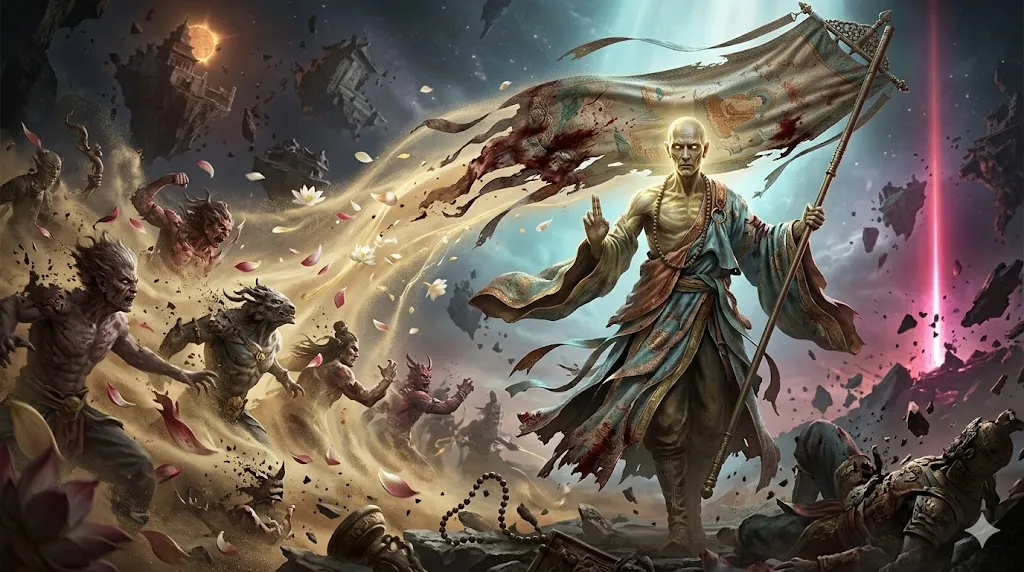
The most defining event in Amitabha's recorded interaction with the world is his appearance during the great Cataclysm of the Conferred Gods (封神量劫). In the epic battles of that era, he appeared as the Guide (接引道人), operating from the Western Scripture of Ultimate Bliss (西方极乐). Alongside his companion the Wayfarer of the Way (准提道人), he did not seek to conquer or destroy the fallen followers of the Jie Sect (截教). Instead, he harvested them — offering a path of conversion. His method was not violence but absorption. When the Jie Sect disciples were at their most broken and vulnerable, their own systems collapsing around them, Amitabha appeared with an offer they could not refuse: abandon your allegiance, accept the path of the West, and be reborn into a land free from the suffering you now endure. This act was not rescue; it was repatriation. He did not fight karma; he exploited its natural terminus point — despair — as the most fertile ground for conversion.
Amitabha’s relationship with the Daoist/Xian path is one of peaceful competition. The Xian path seeks to preserve the self — refining the body and soul to achieve immortality and ascend to the Celestial Court. Amitabha’s path, by contrast, ultimately demands the dissolution of the self. Xian cultivate the elixir of life; Amitabha offers the extinction of life as the final peace. With the Shen (divine) path, Amitabha maintains a functional non-interference pact. The Heavenly Court governs cosmic order; Amitabha offers an exit from that order. He does not challenge the Celestial Bureaucracy, but he provides a legal alternative to it. With the Underworld, Amitabha’s relationship is more complex. His Pure Land directly competes with the Six Paths of Reincarnation for souls. A being who attains rebirth in Sukhāvatī is removed from the jurisdiction of King Yama and the Ten Courts of Hell. This is not a raid on the Underworld; it is a systematic, vow-based bypass of its entire authority. With mortal governments, Amitabha’s influence is channeled through the Pure Land school, which encourages devotion and merit-transfer, often co-existing peacefully with state religions while offering a spiritual exit that does not require social reform.
Amitabha's current state is one of eternal, unchanging presence. His fruit is not deepening or evolving; it is fully perfected. His Pure Land remains stable, accepting the influx of beings who achieve rebirth. His teachings, the Pure Land path, continue to be the most widely practiced form of Buddhism in East Asia, particularly in China, Japan (as Jodo Shu and Jodo Shinshu), Korea, and Vietnam. In the schematic of the Three Buddhas of Time (竖三世佛), Amitabha is the Buddha of the present, presiding over the current cosmological epoch in the Western direction, while Śākyamuni (释迦牟尼) is the earthly teacher and Maitreya (弥勒) is the future Buddha. In the space-based arrangement of the Three Buddhas of Space (横三世佛), Amitabha is the Buddha of the Western Pure Land, with Śākyamuni in the central Saha world and the Medicine Buddha (药师佛) in the Eastern Pure Land.
Lore Notes
Dharmākara (法藏比丘)
The former human identity of Amitabha as a king and monk who made the forty-eight vows.
Sukhāvatī (极乐净土)
Amitabha's meticulously constructed Buddha-land, a paradise of gold and jewels outside the Three Realms.
Jie Sect (截教)
A major Daoist sect that was broken during the Investiture of the Gods, whose fallen members were converted by Amitabha.
Mahāsthāmaprāpta (大势至菩萨)
The second of Amitabha's two primary attendant Bodhisattvas, who walks the Pure Land with him.
Wayfarer of the Way (准提道人)
A Daoist immortal who worked alongside the Guide (Amitabha) during the Cataclysm of the Conferred Gods.
other-power (他力)
The doctrine that liberation comes from reliance on the vow of Amitabha, opposed to 'self-power'.
self-power (自力)
The path of individual effort through meditation and discipline to achieve liberation.
Three Pure Land Sutras (净土三经)
The foundational scriptures of the Pure Land school: the Sutra of Immeasurable Life, the Amitabha Sutra, and the Contemplation Sutra.
Shaolin Monastery (少林寺)
A famous Buddhist temple often associated with martial arts, while its main practice is Chan Buddhism. (Added as a commonly associated Buddhist location.)
FAQ
Is Amitabha the same as the historical Buddha, Śākyamuni?
No, they are different figures. Amitabha is a celestial Buddha who presides over a Pure Land in the West, while Śākyamuni was the earthly teacher who lived in India.
Do you have to be a good person to go to Amitabha's Pure Land?
The primary requirement is sincere faith and the desire to be reborn there, expressed through reciting his name. Moral conduct is helpful, but the core mechanism is faith, not merit.
What happens to you after you are reborn in the Pure Land?
You live in a realm without suffering, learning the Dharma from Amitabha and Bodhisattvas. You will eventually attain final nirvana, but in the process, your individual self and its past karma are completely dissolved.
Can anyone be reborn in the Pure Land, even non-Buddhists?
The traditional teaching holds that the vow extends to all sentient beings in the ten directions who sincerely desire rebirth and entrust themselves to Amitabha. It is a universal offer, but the response must be one of faith.