Eastern Mythology Encyclopedia
Sakyamuni Buddha / The Tathagata
如来佛祖
Sakyamuni Buddha (a being who burned away every trace of his own humanity beneath the Bodhi tree, leaving only a perfect vessel of awakened silence) did not become the Tathagata by gaining something. He became it by losing everything—every desire, every fear, every memory, every sense of a separate self. What remains at the end of that destruction is not a god who saves, but a mirror that shows you your own emptiness.
释迦牟尼佛 / 如来佛祖 (Sakyamuni Buddha / The Tathagata)
禅定 (Dhyana — Meditation that dissolves mental constructs) / 四圣谛、八正道 (The Four Noble Truths, The Noble Eightfold Path)
Current Era of Enlightenment: Approximately 2,500 years ago, in the present kalpa.
Pure Land Affiliation: None permanent; his presence is understood to manifest wherever the Dharma is taught.
Current Fruition: Buddha — the final, irreversible extinction of all karma and self-referential consciousness.
Bodh Gaya (Bihar, India) — The site of his enlightenment.
Sarnath (Uttar Pradesh, India) — Deer Park, site of the first sermon.
Kushinagar (Uttar Pradesh, India) — Site of his parinirvana.
Lumbini (Nepal) — His birthplace.
In China, many temples are dedicated to the historical Buddha, with a prominent representation in the Giant Buddha statue at Leshan, and a central presence in the Mahavira Hall of virtually every Chinese Buddhist monastery.
The figure of Sakyamuni Buddha is deeply connected to the foundational architecture of the Buddhist cosmos as described in the Fo Scroll. His life and teachings articulate the mechanism of self-dismantling that defines the entire path: from karmic entanglement through the Great Vow system of bodhisattvas to the ultimate quiescence of nirvana. In contrast to the Daoist immortal path, which seeks to prolong and perfect the physical self, or the Shen path, which relies on divine investiture and celestial decrees, Sakyamuni's path is one of systematic subtraction. His enlightenment at Bodh Gaya under the Bodhi tree stands as the archetypal event that validates the Four Noble Truths and the Noble Eightfold Path as practical, repeatable methods of liberation. The Pure Land established by Amitabha Buddha is often considered a derivative or alternative expression of the same principles, offering a grace-assisted method for beings in the degenerate age. Sakyamuni also appears in Journey to the West as the supreme authority who subdues the Monkey King and enforces cosmic discipline, representing the apex of the triad of major religious forces in the Ming-era novel. His relationship with the spirit world includes delegating to the Four Heavenly Kings as protectors, and his historical Sangha forms the earthly institution that preserves and transmits the Dharma.
Sakyamuni Buddha holds the consummate fruition of the Buddha path: the complete and irreversible cessation of all karma, all sensory attachment, and all cognitive structures that perpetuate the illusion of a self. He is no longer a being, but a state in which the causal chain has been fully unwound. His cultivation spanned countless lifetimes of bodhisattva practice before this final life, culminating in the night of his enlightenment beneath the Bodhi tree. The fruition he attained is not a reward or a state of bliss in any conventional sense; it is the permanent dissolution of the very framework that generates suffering. Unlike a Luo Han (Arhat), who ceases generating new karma but still bears the residual traces of past causes, a Buddha has fully extinguished even the karmic seeds. There is no further rebirth, no further becoming. The path he walked is defined by the Four Noble Truths: the truth of suffering, the truth of its origin (craving), the truth of its cessation, and the truth of the path leading to that cessation. The Noble Eightfold Path—right view, right intention, right speech, right action, right livelihood, right effort, right mindfulness, and right concentration—constitutes the operational manual for executing this self-dismantling.
In his final life, Sakyamuni was born as Siddhartha Gautama, crown prince of the Shakya clan in what is now southern Nepal. His father, King Śuddhodana, shielded him from all exposure to suffering, surrounding him with palaces, luxuries, and pleasures. Siddhartha married Yasodhara and fathered a son, Rāhula. The turning point came when he ventured beyond the palace walls and encountered four sights: an old man, a sick person, a corpse, and a wandering ascetic. These encounters shattered the illusion of permanence that his life had been built upon. He realized that youth, health, and life itself are provisional and doomed to decay. At the age of twenty-nine, in a final act of renunciation, he left the palace in the dead of night, cut off his hair with a sword, exchanged his royal garments for a monk's robe, and formally entered the homeless life. This was not a moment of despair but of cold-eyed recognition: the sensory world is a cage, and every pleasure is a lock holding the door shut. The ordination was a surgical separation, not a sentimental farewell. He did not say goodbye to his sleeping wife and son; he left them without looking back, knowing that attachment to them was the very chain he had to break.
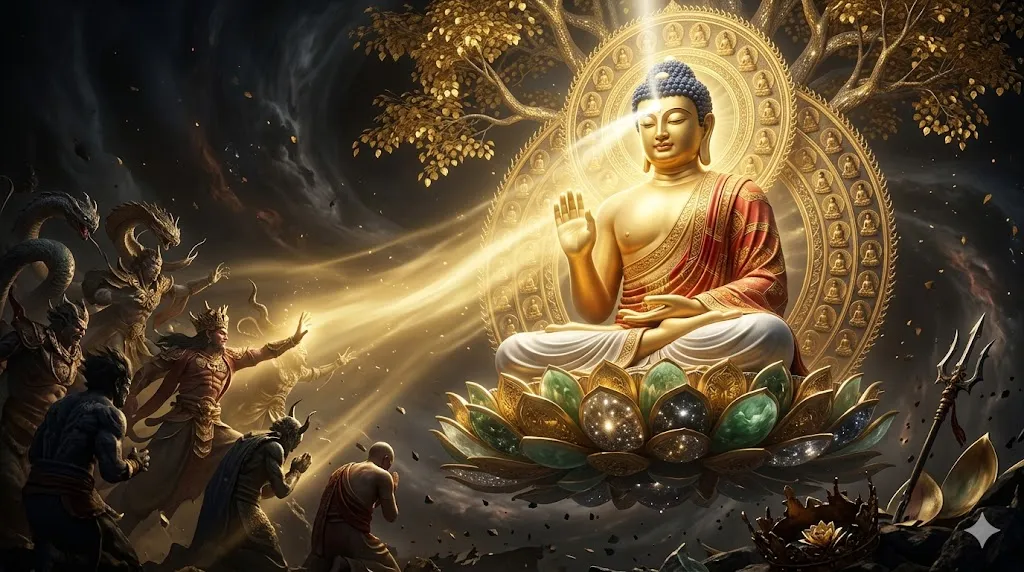
Sakyamuni's early practice was an assault on the body itself. He joined two groups of ascetics and subjected himself to extreme austerities: fasting until his backbone protruded like a rope, sitting in open air through scorching heat and bitter cold, pressing his tongue against the roof of his mouth so hard that spit dried up. He practiced breath control until he heard strange noises in his ears and his joints burned. This was Bone Contemplation (Bai Gu Guan) and Impurity Contemplation (Bu Jing Guan) pushed to their logical extreme—a systematic demolition of the sensory apparatus. Yet after six years of this, he realized that self-mortification was as much a form of craving as self-indulgence: it was still grasping at control. He abandoned the extreme path, accepted a bowl of rice milk from a village girl, and sat down under a Bodhi tree in what is now Bodh Gaya, India. He made a vow: "I will not rise from this seat until I have attained the ultimate truth, even if my skin dries up and my bones crumble." That night, he entered the deepest meditation. Māra, the cosmic embodiment of desire and death, assaulted him first with demonic armies—thunder, fire, raining weapons—then with the seductions of three beautiful daughters. Siddhartha did not fight. He touched the earth as his witness, and the ground shook. The attacks dissolved because there was no self left to threaten. By the first watch of the night, he saw all his past lives. By the second watch, he saw the entire cycle of death and rebirth in all realms. By the third watch, just before dawn, he saw the chain of dependent origination and how to reverse it. The moment the morning star appeared, his consciousness shattered like a glass struck by a stone. The illusion of a separate self dissolved utterly. He was no longer Siddhartha. He was the Tathagata—the one who has thus gone, the one who has thus come. Not a man who found answers, but a mind that ceased to exist as a subject.
Unlike a Bodhisattva who explicitly takes a Great Vow (Hong Yuan) to delay nirvana for the sake of others, Sakyamuni's path was different. In his final life, he did not take a formal vow to remain in the world. Rather, after his enlightenment, he faced a temptation: to enter parinirvana immediately, to vanish without teaching a word. According to tradition, the god Brahmā came and asked him to teach, arguing that some beings have only a little dust in their eyes and could be helped. Sakyamuni consented. This decision was not a vow of unyielding commitment like that of Kṣitigarbha; it was a conditional agreement to teach as long as the conditions held. For forty-nine years, he walked the cities and forests of northern India, gathering disciples, establishing the Sangha, and giving discourses. But he never wavered from the fundamental logic: every being must save themselves. The Dharma he taught was a method, not a rescue. The burden he carried was not the active absorption of others' karma as in the bodhisattva path; it was the burden of speaking the unspeakable, of translating the immediate experience of nirvana into the clumsy medium of human language. Every word he spoke was a compromise, a finger pointing at the moon, never the moon itself.
Sakyamuni did not establish a Pure Land (Jing Tu) in the sense that Amitabha or Bhaiṣajyaguru did. His field of activity was the human realm, specifically the Indian subcontinent. He taught at five major locations during his life: Deer Park at Sarnath (first sermon), the Jetavana Monastery in Śrāvastī, the Vulture Peak near Rajagriha, the town of Vaishali, and the region of Shravasti. Within the broader cosmic geography, his Dharma is understood to be the founding teaching of the current kalpa. After his parinirvana, his teachings were preserved orally by his immediate disciples and later compiled into the sutras. The direct lineage runs through Mahakashyapa, Ānanda, and the early patriarchs. In the Mahayana tradition, his influence is considered infinite, radiating through the ten directions. He is often depicted seated in the lotus posture, one hand touching the earth in the Bhumisparsha mudra (the "earth-touching" gesture) that witnesses his victory over Māra.
The most defining event of Sakyamuni's teaching career is the first sermon at Deer Park, where he turned the Wheel of Dharma (Dharmachakra) for the first time, teaching the Four Noble Truths and the Noble Eightfold Path to five former ascetic companions. They became the first members of the Sangha. Another significant episode: the conversion of the serial killer Aṅgulimāla, who had murdered 999 people and wore a necklace of their fingers. When Aṅgulimāla tried to kill the Buddha, Sakyamuni walked calmly while the murderer ran and could never catch up, despite his speed. When Aṅgulimāla yelled "Stop!", the Buddha replied, "I have stopped. You have not." This wordless teaching shattered Aṅgulimāla's mind, and he joined the order. Sakyamuni also returned to his homeland after his enlightenment, where his father, his son Rāhula, and many of his relatives became his disciples. His cousin Devadatta attempted to kill him multiple times, including by releasing a mad elephant; the Buddha simply lifted his hand in a gesture of non-fear, and the elephant knelt. Perhaps the most poignant episode is his final meal, when he knowingly accepted poisoned food offered by a blacksmith named Cunda. He ate it without reproach, told Cunda that no blame lies with the giver, and entered mahaparinirvana at the age of eighty, lying between two sala trees. His last words: "All composite things decay. Strive on with diligence."
Sakyamuni's relationship with other cosmic systems is defined by the ground logic of the Buddha path: he does not participate in the governance of the material universe. He is not a god who can be petitioned for rain or victory in war. In relation to the Daoist immortal path (Xian Dao), the Buddha path treats the pursuit of physical longevity as a form of attachment—immortality is still conditioned existence, still subject to death and rebirth when the vital energy runs out. There is no record of direct debate between Sakyamuni and Daoist immortals in the canonical sutras, but later Chinese narratives (such as the Journey to the West) place the Buddha as a figure whose authority surpasses that of the Daoist celestial bureaucracy. In relation to the spirit path (Shen Dao), Sakyamuni interacted with devas (heavenly beings) such as Indra and Brahmā, who came to him for guidance. He did not challenge their existence but taught that even the highest heaven is impermanent and within the cycle of suffering. In relation to the Underworld (Di Fu), Sakyamuni revealed the mechanisms of karma and rebirth but did not assume the role of a judge. He taught that no external being judges souls; one's own actions generate the results. In relation to secular kingdoms, he criticized the caste system and treated kings as fellow beings subject to the same laws of death and karma. He did not ally with any political power. As for the demonic path (Mo Dao), Māra is the cosmic principle of obstruction, and Sakyamuni's victory over Māra was total on the subjective level, but Māra remains as a force for unenlightened beings. The Buddha did not attempt to destroy Māra; he recognized that Māra is a projection of the unawakened mind.
Sakyamuni's fruition is complete. He has entered mahaparinirvana—the final, irreversible extinction without remainder. There is no further deepening possible because there is no subject left to deepen. His Dharma, however, continues to be transmitted. The Sangha he founded remains active, though divided into multiple schools: Theravada, Mahayana, and Vajrayana. In the chronological framework of the three Buddhas, he is the central Buddha of the present age: Śākyamuni, the historical Buddha. Before him came the past Buddhas (such as Dīpaṃkara), and after him will come Maitreya, the future Buddha. In the spatial framework of the four directions, he is often linked with the eastern and western Pure Lands through Mahayana cosmology, but he himself is not bound to any single paradise. Within the Chinese Buddhist pantheon, he stands at the apex, flanked by Ānanda and Kāśyapa as his two main disciples, and often accompanied by the Bodhisattvas Mañjuśrī and Samantabhadra.
Lore Notes
Tathagata
A title of the Buddha meaning "the one who has thus gone" or "the one who has thus come," indicating one who has transcended all conceptual frames.
Bodhi tree
The sacred fig tree under which Siddhartha Gautama attained enlightenment at Bodh Gaya.
Mahaparinirvana
The final, complete nirvana entered at death, with no remainder of conditioned existence.
Mara
The cosmic personification of desire, death, and obstruction; the tempter who tried to prevent the Buddha's enlightenment.
Sangha
The community of Buddhist monks and nuns established by the Buddha.
Four Sights
The old man, the sick man, the corpse, and the ascetic—the four encounters that motivated Siddhartha to renounce the palace.
Deer Park
The location in Sarnath where the Buddha gave his first sermon.
Bhumisparsha mudra
The "earth-touching" gesture, symbolizing the Buddha's calling the earth to witness his victory over Mara.
Aṅgulimāla
A notorious serial killer who converted to Buddhism after an encounter with the Buddha.
Devadatta
The Buddha's cousin and rival, who attempted to kill him and cause schisms in the Sangha.
Cunda
The blacksmith who offered the Buddha his final meal, which contained spoiled food.
FAQ
Was the Buddha a god?
No. The Buddha was a human being who attained liberation through his own effort, not through divine grace. He taught that anyone can achieve the same.
Did the Buddha teach that the world is an illusion?
Not exactly. He taught that phenomena are empty of inherent existence, but they still function conventionally. The illusion is the belief in a permanent self, not the world itself.
Does the Buddha still exist after nirvana?
The question is considered invalid in Buddhist logic. Nirvana is the extinction of all defining characteristics, so "existence" and "non-existence" no longer apply.
Why did the Buddha leave his wife and child?
In the traditional account, he left because attachment to family was a chain binding him to the cycle of rebirth. His renunciation was an act of ultimate compassion, aiming to find a way to free all beings, including his family.
How is the Buddha portrayed in Journey to the West?
As the supreme cosmic authority who subdues the Monkey King and enforces the order of the Three Realms, representing the apex of the Buddhist cosmic hierarchy in that narrative.