Eastern Mythology Encyclopedia
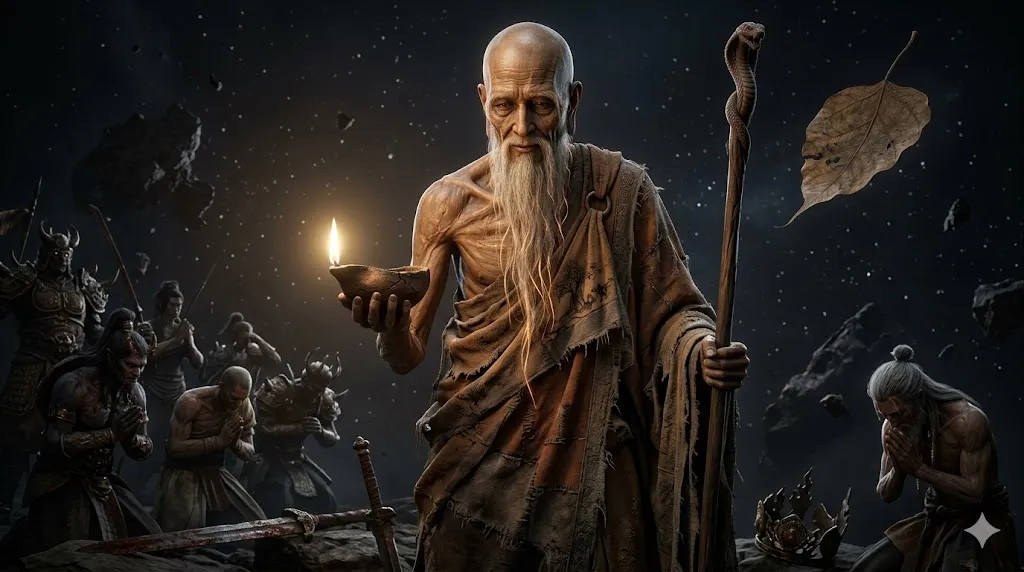
Dipankara Buddha / The Lamp of the Past
燃灯古佛
Dipankara Buddha (燃灯古佛), the Lamp of the Past, is not a being who walks forward through time. He is the living archive of everything that has already happened—the cold, eternal record of all cause and effect that can never be changed. His light does not illuminate the future; it burns as a monument to the irrevocable past.
燃灯古佛 (Dipankara Buddha) / 燃灯佛 (The Lamp of the Past)
三世因果法门 (Dharma of Three Times) / 燃灯观想 (Lamp Contemplation)
Attainment Era: Before all measurable kalpas, in the primordial dawn of the Buddhist cosmos.
Pure Land: Lamp-Land (燃灯佛国), a realm located at the terminus of the causal time line.
Current Station: Buddha (佛陀), fully awakened and beyond all karmic conditioning.
None. No major earthly pilgrimage site is uniquely associated with Dipankara Buddha. Statues of him appear in many Buddhist temples as part of the Three-Buddha arrangement, but there is no single mountain or temple claimed as his primary sacred ground.
The figure of Dipankara Buddha is intimately linked to Shakyamuni Buddha, to whom he gave the famous prediction of future Buddhahood. His Daoist identity as Randeng Daoren connects him to the Fengshen cycle, particularly the story of Zhao Gongming and the transformation of the Twenty-Four Heavens. Within the Buddhist hierarchy, he ranks above Tathagata as the origin point of the Three Buddhas. The Twenty-Four Heavens he created serve as a boundary realm between the Buddhist Pure Land system and the Daoist celestial structure.
Dipankara Buddha holds the station of a complete Buddha—one who has extinguished every trace of ignorance and craving, severed all bonds to the cycle of rebirth, and penetrated the ultimate nature of reality. His cultivation spans an incalculable number of kalpas, beyond any human measure. As the Buddha of the Past, his function is not to guide beings forward but to embody the immutable record of all events that have already been determined by cause and effect. The Lamp of the Past is the cosmic memory that cannot be rewritten—a silent witness to every completed karmic chain.
According to the sutras, in a distant kalpa now beyond the grasp of even advanced practitioners, a young ascetic named Ding Guang (锭光) encountered a previous Buddha and felt an overwhelming certainty that the cycle of suffering could be transcended. He took tonsure and received the precepts under that Buddha, severing all worldly ties. His former identity—whether prince, scholar, or commoner—was not preserved in any record. Only the act of renunciation remains. The tradition states that he then retreated into deep meditation, determined to comprehend the very fabric of time itself.
Dipankara’s primary method of breaking through appearances was the Lamp Contemplation, a meditative technique in which he visualized every point of time as a distinct flame, each containing a complete causal chain of cause, effect, and cessation. By systematically observing the arising and passing of every mental event across past, present, and future, he directly saw that time is not a river but a vast, interdependent web. His key realization was that the past is not gone—it is permanently fixed in the causal structure, like ink dried on parchment. The present is merely the boundary at which new causes are formed, and the future is an open field that will be determined by present actions. This insight released him from the illusion of time as a linear progression. No longer bound by temporal sequence, he became the eternal witness of all that has already occurred.
Dipankara Buddha did not take a Bodhisattva vow in the conventional sense—his path was that of a solitary ascetic who achieved complete enlightenment without a vow to delay his own nirvana. However, his enlightenment itself functioned as a vow: to remain as a guiding light for all beings who seek to understand the nature of time and karma. In the Buddhist framework, his existence as the Past Buddha is a necessary anchor for the causal structure of the Three Times. Without him, the chain of cause and effect leading to Shakyamuni’s enlightenment would lack a verified starting point. This role, while not a formal vow, carries the weight of an irreversible cosmic contract.
Dipankara’s Pure Land, known as the Lamp-Land (燃灯佛国), is situated at the edge of the causal time line—a realm where the completed events of all past kalpas are preserved in a state of perfect stillness. It is neither within the Three Realms nor the Five Elements, but rather exists as a self-contained archive of what-has-been. His dharma lineage is transmitted through the Three Buddhas system: he is the first, Shakyamuni is the second, and Maitreya will be the third. The most famous transmission is the prediction he gave to Shakyamuni, marking the official handover of the Buddhist mission. In the higher ranks of the Buddhist cosmos, he is often depicted as seated above Tathagata, serving as the foundational point from which all other Buddhas derive their temporal position.
The most celebrated event in Dipankara’s recorded history is the “Dipankara Prediction” (燃灯授记). According to the sutras, in a past life, the young ascetic Sumedha (who would later become Shakyamuni) saw Dipankara walking through a muddy road. Sumedha spread his own hair over the mud and laid down his body for the Buddha to walk upon. Dipankara then declared that in a future kalpa, Sumedha would attain enlightenment as Shakyamuni Buddha. In the Fengshen Yanyi (《封神演义》), Dipankara appears under the Daoist name Randeng Daoren (燃灯道人). During the war of the gods, he obtained Zhao Gongming’s twenty-four Dinghai Pearls (定海珠) and transformed them into the Twenty-Four Heavens (二十四诸天), converting a Daoist treasure into a Buddhist cosmic structure. This act permanently linked the Buddhist Pure Land system with the Daoist celestial hierarchy.
In relation to the Daoist path (仙道), Dipankara’s incarnation as Randeng Daoren shows a temporary alliance during the Fengshen War, where he operated within the Daoist framework before fully returning to his Buddha nature. With the Celestial Bureaucracy (神道), he maintains a formal distance: as a Buddha, he is above the jurisdiction of the Heavenly Court, though his Twenty-Four Heavens serve as a bridge between the two systems. With the Underworld (冥界), Dipankara has no direct administrative role; the judgment and recycling of souls belong to the Ten Kings. However, his function as the Keeper of Past Events ensures that the karmic records of every soul are permanently stored in his lamp, providing an eternal reference for the justice of the Underworld. Toward mortals, he appears rarely, but his prediction of Shakyamuni’s enlightenment is the foundational event that gave the Buddhist path a historical anchor.
Dipankara Buddha is currently in a state of complete and irreversible enlightenment, having attained nirvana countless kalpas ago. He does not continue to deepen his realization, for there is no further depth to reach. His dharma lineage is the Three Times lineage, with Shakyamuni as his spiritual heir and Maitreya as the future holder. In the spatial layout of the Buddhist cosmos, he occupies the seat of the Past Buddha in the Three-Buddha Hall (横三世佛), the one who has already completed the cycle of teaching. His method, the Dharma of Three Times, is still studied in some esoteric traditions, though its direct transmission is rare. In the Pure Land system, his Lamp-Land remains unchanging, accepting no new beings, for it is not a place of cultivation but a frozen record of all that has been completed.
Lore Notes
Lamp Contemplation
A meditative practice in which the practitioner visualizes each moment of time as a distinct flame, observing the arising and cessation of all causal chains. The core method of Dipankara's cultivation.
Ding Guang
The former name of Dipankara before his enlightenment, meaning "lamp-light." The name reveals his destined function as a source of illumination for the past.
Twenty-Four Heavens
Twenty-four celestial realms created by Dipankara (as Randeng Daoren) from the twenty-four Dinghai Pearls of Zhao Gongming. They function as a bridge between the Buddhist Pure Land system and the Daoist celestial hierarchy.
Three Times
The Buddhist framework of past, present, and future, personified by the three Buddhas: Dipankara (past), Shakyamuni (present), and Maitreya (future).
Randeng Daoren
The Daoist incarnation of Dipankara during the Fengshen War, where he acted as an immortal strategist and converted Daoist treasures into Buddhist structures.
Dinghai Pearls
Twenty-four pearls that originally belonged to Zhao Gongming, capable of calming the seas. They were captured and transformed by Randeng Daoren into the Twenty-Four Heavens.
FAQ
Why is Dipankara called the Lamp of the Past?
Because he embodies the function of preserving every completed causal event. His "lamp" is the cosmic record of all that has already occurred—unchanged and unchangeable.
How did Dipankara predict Shakyamuni's enlightenment?
In a past life, the ascetic Sumedha spread his hair over muddy ground for Dipankara to walk on. Seeing this selfless devotion, Dipankara declared that Sumedha would become a Buddha in a future kalpa.
Is Dipankara the same as Randeng Daoren in the Fengshen Yanyi?
Yes. In the Fengshen War, the Buddha Dipankara appeared under the Daoist name Randeng Daoren, acting as a strategist and converting Zhao Gongming's pearls into the Twenty-Four Heavens.
Does Dipankara have a Pure Land like Amitabha?
Yes, it is called the Lamp-Land (燃灯佛国), a realm where all completed past events are preserved. Unlike Amitabha's Pure Land, it does not accept new beings for cultivation—it is a static archive.
Where does Dipankara rank among the Buddhas?
He is the first of the Three Buddhas (past, present, future), often depicted seated above Tathagata in temple arrangements. He is the foundational point of the Buddhist time line.