Eastern Mythology Encyclopedia
Maitreya Buddha / The Future One
弥勒佛
Maitreya (the Future Buddha) is the only Buddha whose enlightenment has not yet occurred. He waits in the Tushita Inner Court, a promise of salvation that remains unfulfilled, a smile that does not bless the present but anticipates a future so distant that the entire fabric of the current Dharma must rot away before he descends. His existence is not a comfort for today; it is a cosmic guarantee that after everything falls apart, a final teacher will still arrive.
弥勒佛 (Maitreya Buddha) / 当来下生弥勒尊佛 (The Future Buddha, the Honored One Who Will Descend)
修行法门:唯识瑜伽行派 (Yogacara, the Mind-Only School) / 净土法门 兜率净土 (Pure Land Path of Tushita)
证果纪元:Not yet achieved final Buddhahood in the present world; destined to achieve it in the distant future, 5,670,000,000 years after the extinction of Shakyamuni's Dharma.
灵山/净土归属:Tushita Heaven (Inner Court)
当前果位:Future Buddha (designated successor to Shakyamuni, currently residing in the Tushita Inner Court as a tenth-stage bodhisattva awaiting descent).
None.
The figure of Maitreya is intricately linked to the broader architecture of Buddhist soteriology. His pre-enlightenment stasis in Tushita Heaven positions him as the direct successor to Shakyamuni Buddha, forming a temporal chain of awakening across the kalpas. His pure land, unlike Amitabha's Sukhavati, remains within the desire realm, making it a distinct alternative for beings seeking rebirth without complete separation from worldly conditions. In the mythic geography of Journey to the West, his overlapping identity with the Daoist celestial order connects the Buddhist future-figure to the Shen-volume cosmos, particularly through the shared Tushita Palace. His destined descent under the Dragon Flower Tree and the three assemblies parallel the Christian Second Coming in broad structure but differ fundamentally in function: he does not judge but teaches, not condemn but converts. For further detail, the entries on Shakyamuni Buddha, Amitabha Buddha, the Yogacara school, and the Tushita Heaven provide the necessary contextual depth.
Maitreya holds the unique station of a Buddha who has not yet manifested his final enlightenment. In the Buddhist temporal framework, he is the next and final Buddha of the present kalpa, a role defined by a single irreversible fact: his Buddhahood is deferred. He does not currently possess the full sovereignty of a fully awakened one over the world, but he is sealed by prophecy into that status. His cultivation path is one of prolonged preparation — he has maintained the bodhisattva discipline for countless eons, accumulating merit without entering nirvana. His fruit is not a state of achieved stillness but a destined event, a final ascension that will coincide with the complete collapse of Shakyamuni's teachings. This makes him the only being in the Buddhist system whose awakening is a matter of future certainty rather than present accomplishment. His realm, the Tushita Inner Court, is a preparatory pure land designed to host beings who will descend with him at the appointed hour.
The tradition records that Maitreya first generated the mind of enlightenment under a previous Buddha, countless eons before the present age. Unlike other bodhisattvas who sought swift liberation, he specifically chose to defer his final awakening so that he could serve as the savior of the most desperate era — the Dharma-ending age, when Shakyamuni's teachings have faded to nothing. His ordinational moment is not tied to a single human birth; he has cycled through innumerable existences as a bodhisattva, each life dedicated to perfecting the paramitas. In his last human birth, recorded in the Pali canon, he lived as a disciple of Shakyamuni himself — a monk named Ajita, who was publicly prophesied by the Buddha to be the next to awaken. This prophecy, delivered in the presence of the assembled sangha, became the irreversible contract that binds him to the future. He did not request a gentle path; he accepted a destiny that required him to wait until all other avenues of salvation were exhausted.
Maitreya's method of penetrating reality is closely associated with the Yogacara school, which he is said to have personally revealed to the Indian master Asanga. His core practice is the realization that all phenomena are projections of consciousness — the Mind-Only doctrine. By systematically deconstructing the external world into a stream of mental representations, he has cut through the illusion of an independent reality. This is not a passive insight but an active dismantling: every sensory input, every object, every other being is seen as a manifestation of the storehouse consciousness (alaya-vijnana), empty of self-nature. In his Tushita abode, he also teaches the Pure Land path — the method of rebirth through faith and vow, which he extends to beings too weak to practice advanced meditation. His own karmic obstacles were resolved eons ago; his sole remaining burden is the weight of those who have taken refuge in his name, waiting in the lower realms for his descent. There is no record of a dramatic, single-point enlightenment for Maitreya — his awakening is a slow, deliberate perfecting of wisdom over cosmic cycles, a patience that borders on endurance.
Maitreya's great vow is the foundational contract of his entire existence. He has sworn that he will not achieve final nirvana until he has descended to the human world at the end of the Dharma-ending age, attained Buddhahood under the Dragon Flower Tree, and preached three great assemblies to liberate all beings who remain. This vow is not a declaration of compassion in the ordinary sense; it is an irreversible bond with the cosmic order that locks him into the cycle of time until the appointed moment. The mechanism of his vow operates through a temporal deferral: he cannot enter stillness because his future Buddha-hood is the only event that can close the present kalpa. Every being who aspires to be reborn in his Tushita heaven and to descend with him adds a thread to this contract. His body of merit grows, but his final release is blocked by the very promise that sustains his disciples. The scale of his burden is measured in eons of waiting — not active suffering like a bodhisattva who absorbs pain, but a stillness so prolonged that it becomes its own form of limitation: the endless anticipation of an arrival that has not yet happened.
Maitreya's pure land is the Inner Court of Tushita Heaven, the fourth heaven of the Desire Realm in Buddhist cosmology. Unlike Amitabha's Western Pure Land, which exists entirely outside the Three Realms, Tushita is still within the cycle of rebirth — a strategic location that allows beings in the desire realm to reach it without completely severing their karmic ties. The Inner Court is a meticulously purified zone within the larger Tushita heaven, reserved exclusively for those who have made a vow to be reborn with Maitreya and to descend with him at his final birth. Here, Maitreya teaches the Dharma continuously, preparing his retinue for the great mission. His celestial palace is described in the sutras as adorned with jeweled trees, lotus pools, and palaces of light, but its purpose is not eternal comfort: it is a launch point for the final rescue operation. Beyond Tushita, Maitreya's earthly domain will be a Jambudvipa transformed by his presence — a world of abundant harvests, harmonious society, and universal practice of the precepts, which will last for tens of thousands of years after his descent. In the Chinese literary tradition, particularly the Journey to the West, Maitreya is also associated with the Tushita Palace in the celestial bureaucracy, where he is depicted as a Daoist-aligned figure absorbed in elixir cultivation — a syncretic overlay on his Buddhist identity.
The most defining event in Maitreya's narrative is not a deed he has performed but a prophecy he received: the prediction by Shakyamuni Buddha in the presence of the assembled monks that the disciple Ajita would be the next Buddha. This prophecy, recorded in the Digha Nikaya and expanded in the Maitreya Sutras, effectively recast the entire future of Buddhism around his figure. In the Journey to the West, he appears briefly as the master of the Tushita Palace, where he is shown to possess both celestial alchemical knowledge and the authority to intervene in the affairs of heaven. A notable episode involves a demon who assumes his identity; when the true Maitreya appears, he resolves the crisis with an almost casual smile, suggesting an awareness that transcends the immediate conflict. His most poignant recorded act is the continuous teaching he offers in Tushita — a teaching that has no end because his students are not ready for the final lesson. He waits, and his teaching is the announcement of his own future arrival.
Maitreya's relationship with the Daoist celestial order is primarily defined by the syncretic Chinese cosmology, where the Tushita Palace is shared with the supreme Daoist god Laozi. In the Journey to the West, Maitreya is portrayed as an independent figure who nevertheless operates within the celestial bureaucracy, a fusion that reflects centuries of Chinese folk religion. With the Underworld, Maitreya has no direct administrative role — his function is entirely future-oriented, not current judgment. The Ten Kings of Hell do not defer to him, but beings who earnestly vow to be reborn in Tushita may temporarily bypass the long cycle of judgment. With the mortal world, Maitreya's impact is paradoxical: his promise of a golden age has inspired both faith and rebellion. Throughout Chinese history, millenarian sects claiming to usher in Maitreya's kingdom have risen against established dynasties, using his name as a banner for social transformation. The Buddhist establishment generally distances itself from these movements, but the tension is built into the very concept of a future savior. With the demonic realm, Maitreya's stance is one of eventual resolution — he does not conquer demons now, but his future assembly under the Dragon Flower Tree is said to convert even the most stubborn of beings.
Maitreya's current state is one of suspended completion. He abides in the Tushita Inner Court, fully awakened in wisdom but deliberately withholding the final expression of that awakening until the cosmological time is ripe. His pure land is stable, accepting new vows from beings who wish to accompany him in his descent. The lineage he establishes — the Yogacara school — has been passed down through the Indian master Asanga and the Chinese Faxiang school, and remains a living tradition in East Asian Buddhism. In the temporal framework of the Buddhist cosmos, Maitreya occupies the position of the Future Buddha in both the horizontal scheme (the buddhas of the three times: past Dipamkara, present Shakyamuni, future Maitreya) and the vertical scheme (the seventh buddha of the present aeon, as listed in certain lists). Within the Bodhisattva hierarchy, he is regarded as the crown prince of enlightenment, the one who sits in the Tushita heaven ready to be reborn, just as Shakyamuni did before his final birth. The Chinese Pure Land school traditionally honors Amitabha as the primary savior, but a smaller stream of devotion focuses on Maitreya's Tushita path, offering an alternative to the Western Pure Land.
Lore Notes
Tushita Heaven
The fourth heaven of the Desire Realm in Buddhist cosmology, divided into an outer court (ordinary gods) and an inner court (Maitreya's pure land). Beings reborn here await his future descent.
Dragon Flower Tree
The tree under which Maitreya will attain Buddhahood when he descends to the human world in the distant future.
Three Assemblies
Three great preaching events that Maitreya will hold under the Dragon Flower Tree, each said to liberate billions of beings, completing the salvation of all who remain in the Dharma-ending age.
Ajita
The name of Maitreya in his last human life as a disciple of Shakyamuni Buddha; the Buddha publicly prophesied that Ajita would be the next Buddha.
Faxiang School
The Chinese Yogacara school of Buddhism, which traces its lineage to Maitreya's revelation through the Indian master Asanga.
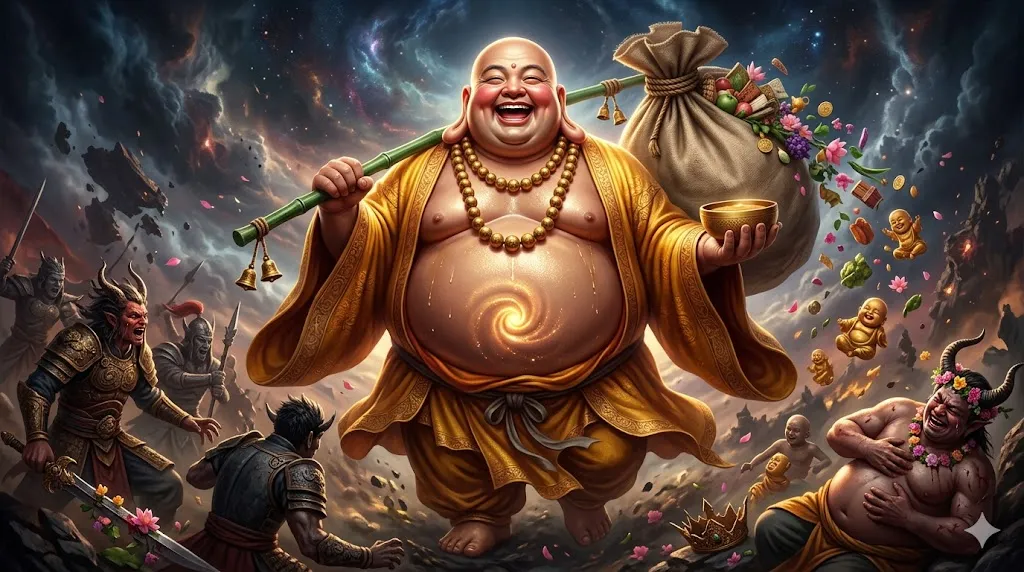
Budai
The Laughing Buddha figure of Chinese folklore, often confused with Maitreya; an independent folk deity associated with contentment and good fortune.
FAQ
Is the laughing Buddha statue at Chinese restaurants the real Maitreya?
No. The laughing, fat-bellied figure is Budai, a 10th-century Chinese folk monk. The real Maitreya is the Future Buddha, a dignified being awaiting his descent in Tushita Heaven.
Where does Maitreya currently live?
Maitreya resides in the Inner Court of Tushita Heaven, the fourth heaven of the Desire Realm, where he teaches the Dharma to beings who will descend with him in the future.
When will Maitreya become a full Buddha?
According to the sutras, Maitreya will descend to the human world 5.67 billion years after Shakyamuni's Dharma has completely faded from the earth. He will attain Buddhahood under the Dragon Flower Tree and hold three great assemblies.
What is the difference between Maitreya's pure land and Amitabha's Western Pure Land?
Amitabha's Pure Land (Sukhavati) exists outside the Three Realms and offers immediate rebirth. Maitreya's Tushita Heaven is within the desire realm and functions as a preparatory station — beings reborn there must continue practice and will descend with him at his final birth.
How does one attain rebirth in Maitreya's Tushita Heaven?
Through sincere faith in Maitreya, making a vow to be reborn in his inner court, and practicing the Ten Good Deeds or reciting his name. The path is simpler than advanced meditation, making it accessible to ordinary beings.