Eastern Mythology Encyclopedia
Pangu Banner
盘古幡
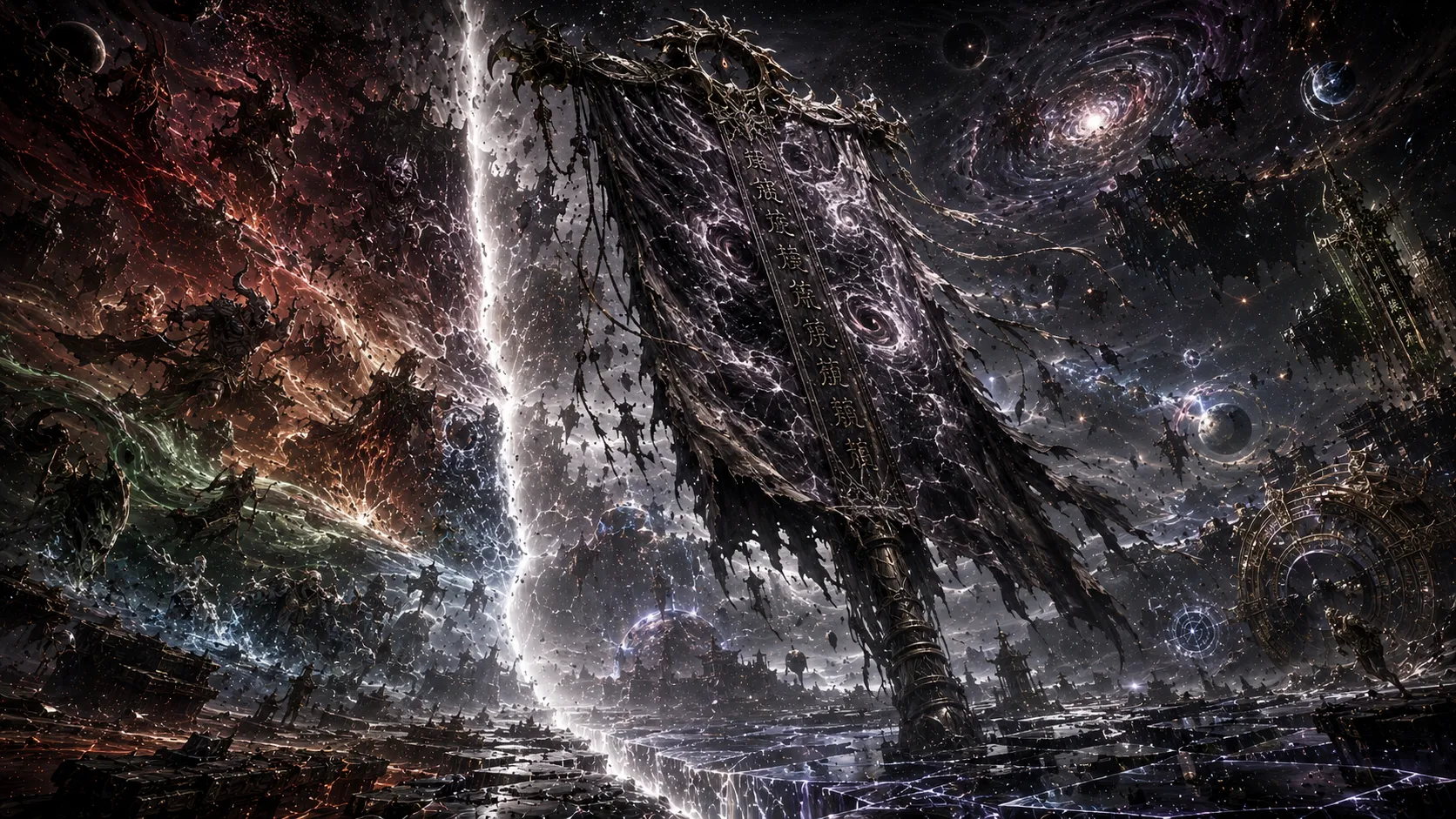
Pangu Banner (盘古幡) — Primordial Supreme Treasure, the embodied will of Pangu's cosmic severance made manifest as a war-standard of absolute annihilation. It does not cut: it erases the space an enemy occupies from the fabric of existence. To wield it is to hold the lever by which creation unmakes itself.
盘古幡 Pangu Banner
先天至宝 Primordial Supreme Treasure
Artifact Tier: Primordial Divine Armament (太古神兵)
Current Holder: Yuanshi Tianzun (元始天尊), the first of the Three Pure Ones.
Current Status: Held within the Jade Purity Palace (玉虚宫), Yujing Mountain, in the Celestial Realm. Maintained in a semi-dormant state, requiring the Saint's constant vigilance to prevent its own 'Creation-Severing' principle from eroding the reality it occupies.
None. The Pangu Banner's forging process predates history, leaving no physical forge, stone carving, or mortal-authored book that describes its creation. The only source is the oral tradition and the written epic of the Fengshen Yanyi.
This entry's account of the Pangu Banner is deeply interwoven with the story of its sole master, Yuanshi Tianzun, the supreme head of the Chan Sect. The banner's nature as the will of Pangu's creation act links it directly to the foundational cosmology of the universe. Understanding its principle of 'Unmaking' is key to grasping the nature of the 'Taiji Diagram's' principle of 'Making'; they are the two sides of a single cosmic coin. Further entries within the artifact volume on the Four Swords of Immortal Slaying or the Fan of the Plantain Leaf will provide illuminating comparisons of how different degrees of Primordial power interact with the 'Tian Di Gang Chang.'
The Pangu Banner is classified as a Primordial Supreme Treasure, forged not by mortal hands but by the condensation of the Great Dao's 'Opening Principle' itself. Its core function is absolute destruction—the unmasking of existence back into primordial chaos. When a single scroll of the banner is shaken, it unleashes a barrage of 'Hun Dun Jian Qi' (混沌剑气), or Chaos-Severing Sword-Energy, that tears through dimensional barriers, nullifies standard spell and treasure defenses, and attacks the metaphysical foundation of the target rather than its physical form. Its ultimate divine power is to manifest a pocket universe in its most primordial state, overwriting the existing 'Tian Di Gang Chang' (天地纲常) of a region and imposing a 'Creation Field' that is advantageous to the banner's master. There are no explicit limits on the number of uses, but the cosmic cost of each activation is prohibitive. To be wielded with any degree of safety, the wielder must possess a cultivation base at the Saint-level (圣人) of the Dao. A non-Saint who merely attempts to unfurl the banner will have their entire personal cultivation—millennia of accumulated 'Xian Tian Yi Qi' (先天一炁)—drained in a single thought.
The core material of the Pangu Banner is not a separate ore or gem. It is the manifest 'Kai Pi Bu Mie Zhen Yi' (开辟不灭真意), the Unkillable True Intent of Creation-Severing, which is said to be the essential crystallization of Pangu's spinal marrow after he transformed his body into the cosmos. Its collection was not a separate act of mining; it was an inseparable, spontaneous part of the aftermath of Pangu's death—a byproduct of the most fundamental act of cosmic creation. The material carries the raw, untamed 'Sha Qi' (煞气) of absolute change. It possesses an unyielding principle that rejects all 'Postcelestial' (后天) concepts—any formed matter, any stabilized law, any 'finished' reality is seen as a cage to be broken. This material essence contains the residual will of Chaos to reassert itself, making the banner as much a natural disaster compressed into cloth as it is a tool.
The Pangu Banner explicitly lacks a 'Qi Ling' (器灵) in the sense of a bound, sacrificed soul. No sentient being was thrown into a furnace to become its guardian. Its spiritual force is a 'self-originating will' derived from the law itself—a form of 'Dimming Consciousness' born from the sheer weight of the 'Kai Pi' principle. This "mind" is not a prisoner; it is the law's own desire to fulfill its function. It does not think in human terms of loyalty or rebellion. It simply *is* the compulsion to separate the mixed and tear apart the formed. This makes it arguably more dangerous than a confined, vengeful spirit—because it cannot be reasoned with, soothed, or tricked. It is the function of undoing, awaiting only an aperture through which to act.
Master Recognition (认主) of the Pangu Banner is not a ritual of blood offering but a process of 'Lawful Suppression.' The wielder does not invite the artifact into their soul; they impose their personal Dao over the artifact's will to annihilate. The relationship is one of 'Mutual Constraint' rather than symbiotic feeding. There is no requirement for the wielder to provide 'Ben Ming Jing Xue' (本命精血) as fuel, as the banner generates its own power. The transactional cost is entirely about capacity. The wielder's soul must possess enough 'Dao Fortitude' to withstand the artifact's constant, passive desire to 'open' the world around it. If the wielder is wounded, if their 'Jing Jie' (境界) drops, or if their concentration wavers for an instant, the 'Kai Pi' principle will not 'eat' them in a literal, greedy sense. Instead, it will treat their physical form—including their soul and cultivation base—as just another 'postcelestial structure to be broken down.' The threat is not a spirit chewing on your entrails; it is the certainty that the very concept of 'you' will be unraveled should your grip on the leash slip.
Within the established mythos, the Pangu Banner has only one recorded stable wielder: **Yuanshi Tianzun** (元始天尊), the first master of the Jade Purity sect and the supreme Saint of the 'Kunlun' lineage. He has been its keeper since the dawn of the Honghuang Era, and his status as a 'Saint of the Great Dao' (天道圣人) is the only thing that allows him to contain its power. Before Yuanshi Tianzun, the banner had no 'owner.' It is said to have drifted in the chaos between realms, a raw force of anarchy looking for an anchor. Any other recorded ‘wielder’ is either a speculative addition in later folklore or a fictional character in derivative works. The central tradition anchors this treasure firmly to its one true Master.
The most famous recorded invocation of the Pangu Banner's power is its participation in the great conflicts of the Fengshen Yanyi (《封神演义》) era, during the battles between the Chan (阐教) and Jie (截教) sects. On the orders of Yuanshi Tianzun, a single wave of the banner was capable of shattering the 'Swords of Immortal Slaying' battle array and neutralizing the most powerful 'Jie Sect' treasures. The banner's use has no predetermined 'maximum charge' limit, but its law-disrupting function is self-curbing. Each major use carves an 'Unstable Poetic Fracture' into the 'Tian Di Gang Chang' (天地纲常) of the 'San Jie' (三界). The tradition holds that if used too freely, it could accelerate the Great Dao's own self-correcting mechanisms and trigger a 'Heavenly Tribulation' (天劫) of a scale not seen since the Honghuang Era.
The Pangu Banner is one of a small set of peer-level Primordial Supreme Treasures. Its most direct companion is the **Taiji Diagram** (太极图), which governs creation, stabilization, and the binding of Yin and Yang. Where the Banner *unmakes*, the Diagram *makes*. Together with the **Pangu Axe** (or its conceptual fragments), they represent the three-fold path of the Daos: to separate, to hold, and to form. There is no directly countering treasure; its force is absolute within its domain. However, its own nature as a 'destroyer' means it is meaningless against a vacuum—it requires a reality to sever. Mythologically, it is the final expression of Pangu's act, a memory of the first blow that no other weapon can fully replicate or oppose.
The Pangu Banner is currently held in the Jade Pure Palace, the primary dojo of Yuanshi Tianzun at the summit of Yujing Mountain in the Celestial Realm. It is not 'asleep' or waiting for a master. It is under constant, active suppression by its Saint-level wielder. It is the central artifact representing the authority of the Chan Sect and is not lent out or deployed lightly. There are no records of it being damaged in battle, as its own essential material is the concept of indestructibility in the face of pre-existing structure. It remains intact, dangerous, and irreplaceable.
Lore Notes
Pangu Banner
A Primordial Supreme Treasure forged from Pangu’s dying will of cosmic separation, embodying the principle of absolute creation and destruction.
Chaos-Severing Sword-Energy
The primary attack form of the Pangu Banner, a form of energy that erases the metaphysical foundation of its target rather than merely cutting it.
Yuanshi Tianzun
The first of the Three Pure Ones, the supreme Saint of the Dao and the sole recorded wielder of the Pangu Banner, who keeps its power in check.
Kai Pi Bu Mie Zhen Yi
The Unkillable True Intent of Creation-Severing; the core material of the banner, representing the final, irreducible essence of Pangu's act of opening the cosmos.
FAQ
Does the Pangu Banner have a trapped soul or artifact spirit?
No. It has no Qi Ling (器灵). Its "mind" is a law echo—a concentrated principle of destruction that exists to fulfill its function, not a conscious entity.
Can a mortal cultivator wield the Pangu Banner?
No. It requires a Saint-level cultivation base to simply hold it without being unmade. A non-Saint attempting to use it would have their cultivation drained in an instant.
Is the Pangu Banner the most powerful treasure in existence?
It is the supreme treasure of destruction, but it is paired with the Taiji Diagram (the supreme treasure of creation). The two are opposite and complementary halves of a whole.