Eastern Mythology Encyclopedia
Palace of Vast Cold (Guanghan Gong)
广寒宫
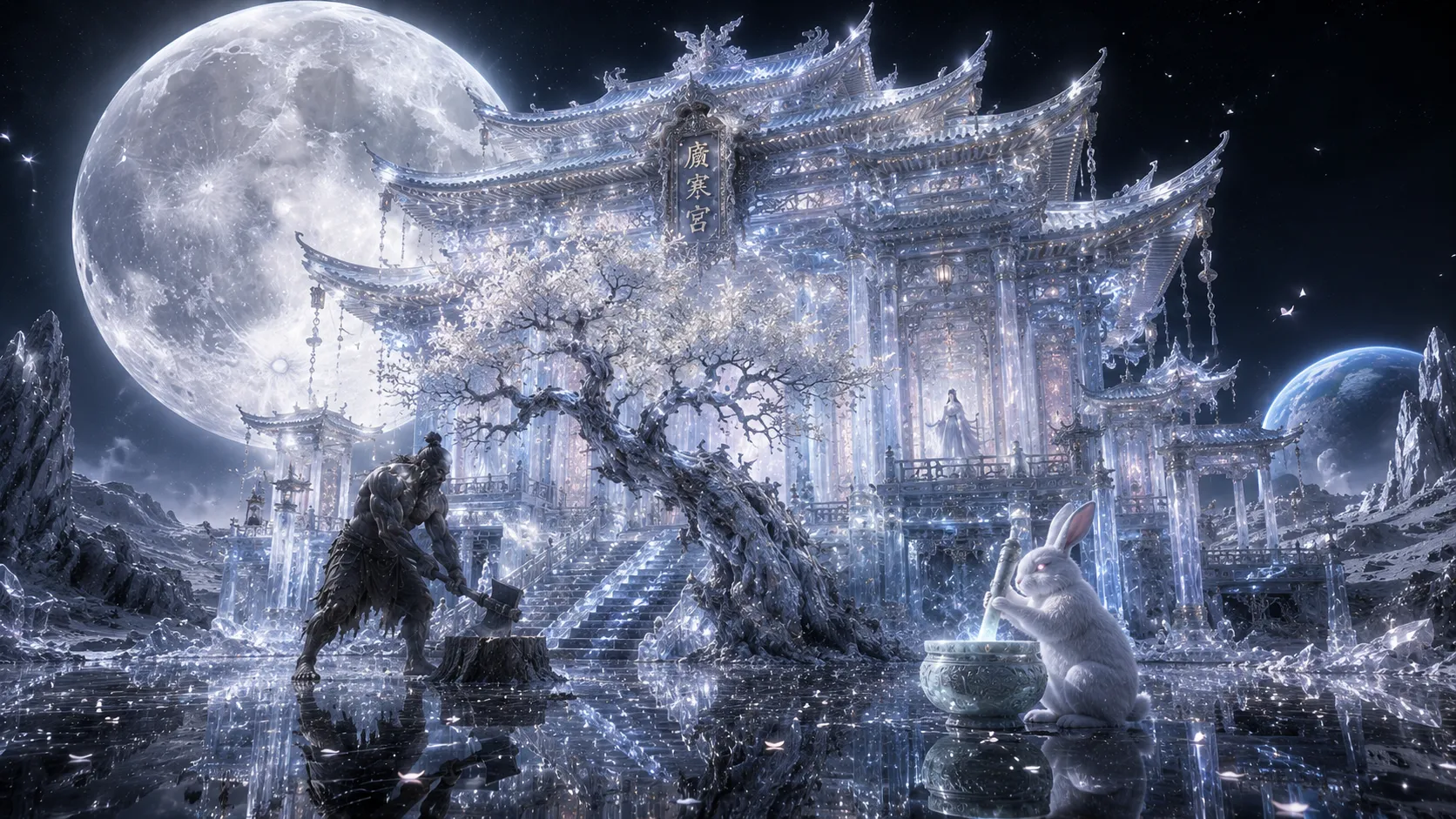
Palace of Vast Cold (Guanghan Gong) is not a palace—it is the frozen heartbeat of the Taiyin Star, a law-condensed crucible of pure lunar yin where every mortal memory is peeled away like skin, and where the only sound is the slow echo of souls being purified for reincarnation.
广寒宫 / Palace of Vast Cold (Guanghan Gong)
Type: 月宫仙阙 (Lunar Celestial Palace)
Domain: Celestial Realm (Tian Jie) — specifically anchored on the Taiyin Star (the moon)
Law Aspect: Extreme Purity of Yin (至阴至寒); Lunar Law (月华法则)
Spiritual Density: Supreme — the entire palace is a single solid condensation of lunar essence, utterly devoid of any yang or fire-aspected energy
Spatial Extent: The palace complex spans approximately the entire visible face of the Taiyin Star, with its true reach extending into hidden void-chambers where lunar law bends space
Visible remnants of the palace’s presence in the mortal world are almost nonexistent. The most notable is the long-extinguished "Moon Tower" (月楼) at the summit of Mount Kunlun, rumored to be an ancient anchor-point for the palace’s lunar mirror; today only a circular depression in the rock marks the spot. Also, the "Silver Pool" (银池) in the Changbai Mountains is said to reflect moonlight that is colder and sharper than elsewhere, hinting at a residual connection to the palace. No direct gate remains open.
This article connects to several key cosmic locations and entities. The Palace of Vast Cold is an integral part of the Taiyin Star, which itself is one of the two primary celestial bodies alongside the Sun, both of which are regulated by the Heavenly Court. The palace directly interacts with the Underworld through the resonance of lunar tides and soul streams. The figure of Chang'e, who resides here, is tied to the terrestrial myth of Hou Yi and the elixir of immortality. The Taiyin Star Sovereign is a major divine official within the Celestial administration. The palace’s unique law properties also place it in a neutral relationship with Lingshan (due to yin-yin incompatibility) and with the dragon-vein system (complete independence).
The Palace of Vast Cold lies deep within the Celestial Realm, anchored to the Taiyin Star—one of the two primary celestial bodies (sun and moon) that regulate cosmic rhythm. Before the Great Disconnection, the moon was physically closer to the Earthly Realm, and its tides directly channeled the souls of the dead toward the Underworld’s reincarnation cycle. After the Great Disconnection, the moon was locked into its current orbit, and the palace became the only regulated passage between the Celestial and Underworld realms for lunar-cleansing functions. No direct spatial link remains to the Earthly Realm; the palace can only be accessed via divine authorization or through the resonance of the lunar tide with the Underworld’s soul-stream. The nearest major cosmic hub is the Heavenly Court, approximately one celestial day’s travel by star-chariot. The nearest main dragon-vein trunk is absent—the Taiyin Star is a self-contained yin-null nexus.
The Palace of Vast Cold is not built from stone or wood—it is a direct crystallization of the Taiyin Star’s essence. The entire structure is formed from chan guang (蟾光, moon-frog radiance), a perpetual, self-renewing substance that neither melts nor shatters. Beneath the palace, a subterranean network of Taiyin Cold Veins (太阴寒脉) radiates outward like frozen roots, drawing primordial yin energy from the deep void of the cosmos. This energy is the purest form of Xian Tian Yin Qi (先天阴气) remaining after the Great Disconnection, and it is entirely distinct from terrestrial spiritual energy. The palace’s spiritual density is so extreme that any being with residual yang qi feels a crushing pressure upon entry; lower-level cultivators would have their fire-aspected meridians frozen instantly. There is no earth energy—no Wu Xing interaction—only the single, monopolistic power of lunar yin. The palace does not consume terrestrial spiritual energy; it generates its own through the law of lunar reflection.
The Palace of Vast Cold hosts a unique, minimal ecosystem shaped entirely by lunar yin. The only known flora is the cassia tree (桂树, gui shu), a petrified, eternally flowering plant that absorbs lunar essence and sheds blossoms of solid moonlight. The only fauna are the Jade Rabbit (玉兔, Yu Tu), a lunar-aligned beast that pounds the elixir of immortality in a jade mortar, and the Golden Toad (金蟾, Jin Chan), a three-legged creature that occasionally surfaces from the deep yin pools. No other animals survive; the cold is too absolute. Spatially, the palace is layered: outer halls where time flows normally, inner chambers where lunar law slows time to a crawl (a single day outside equals a year inside the deepest meditation hall), and the central Moon Gazing Platform (观月台) where the law of identity itself weakens—beings here can feel their karma being read and rewritten by the moonlight. Climate is perpetually sub-lunar winter, with no wind, no clouds, and a constant, soundless snowfall of frozen moonlight particles.
The first recorded occupant of the Palace of Vast Cold is the primordial Taiyin Star Sovereign (太阴星君), a pre-Honghuang innate deity who claimed dominion over the lunar sphere. The palace itself existed before any named being—it was already there when the first gods opened their eyes. The most famous volatile event was the Chang'e (嫦娥) incident during the reign of the legendary archer Hou Yi. Chang'e, after consuming the elixir of immortality, fled to the moon and took residence in the palace. Her arrival triggered a shift in the palace’s function: where before it merely regulated yin energy, it now began actively absorbing mortal memories and unresolved attachments from the Earthly Realm. The palace has never been retaken by force; it remains under the joint supervision of the Taiyin Star Sovereign and the Heavenly Court, with Chang'e as its permanent, voluntary anchor. No sect or external force has ever attempted to seize it—the sheer cold and the palace’s self-sealing nature make it indefensible in any conventional sense.
The Palace of Vast Cold serves four interlocking cosmic functions, each essential to the stable operation of the Three Realms:
1. **Suppression of the Supreme Yin Vein**: The palace is the keystone that seals the origin point of the universal yin cold-current, preventing chaotic yin from flooding the Celestial Realm and destabilizing the sun.
2. **Mirror and Purifier of Karma**: Lunar light from the palace is not passive illumination; it actively reflects across the cosmos, revealing hidden karma and burning away grudges from soul-fragments. The palace processes millions of such reflections per cycle.
3. **Reincarnation Resonance Relay**: The lunar tide generated by the Taiyin Star resonates with the Underworld’s soul-tides. The palace amplifies and stabilizes this resonance, ensuring orderly passage of souls awaiting reincarnation.
4. **Godly Garrison**: It serves as the formal residence and operational base for all celestial officials assigned to the lunar domain, including the Taiyin Star Sovereign, the moon charioteers, and the guardians of the lunar passes.
Several mysteries remain unresolved within the Palace of Vast Cold:
- The exact depth and scope of the Taiyin Cold Veins beneath the palace have never been charted; attempts to probe them have resulted in permanent freezing of divine consciousness.
- The origin of the petrified cassia tree is unknown—no record matches its appearance to any known botanical category; some speculate it is the corpse of an ancient lunar goddess.
- A sealed chamber beneath the Moon Gazing Platform is said to contain the "Frozen Heart of the First Moon," an artifact that predates Pangu. No one has been able to enter it; the lock mechanism is composed of solidified negation of the law of heat.
- The Jade Rabbit appears to have independent will beyond its alchemical duties; its origin and purpose remain unexplained in any surviving text.
- **Celestial Path (仙道)**: The palace is not a domain of cultivation for terrestrial cultivators; no xian sect has ever established a branch here. However, solitary immortal hermits have occasionally been permitted to meditate in its outer halls. The palace grants a unique form of purification that strips away karma but also eliminates the desire to cultivate further—a risk most xian avoid.
- **Divine Path (神道)**: The palace is directly administered by the Heavenly Court. The Taiyin Star Sovereign is the ranking deity, and Chang'e holds a special title that blends celestial official and resident. The Palace's operations are tied to the Feng Shen Bang—every moon-phase change requires a formal report to the Heavenly Court.
- **Buddhist Path (佛门)**: No Buddhist presence exists in the palace. The lunar yin law is fundamentally incompatible with the emptiness-centered dharma of Lingshan. Any Buddhist practitioner entering the inner halls would experience dissolution of their vow-constructs.
- **Mogui and Ghosts (妖魔鬼)**: The palace actively repels all demons and malevolent spirits. However, it passively attracts weak, lost souls from the Underworld that need gentle purification before reincarnation. Those souls float through the outer halls like ambient frost, slowly being cleansed before sinking back into the lunar tide.
The Palace of Vast Cold is currently in a state of stable equilibrium. Its yin energy is not depleting—it self-generates through the moon's tidal cycle. However, subtle signs of stress have been observed: the golden toad has been retreating deeper into the cold pools, and the cassia tree has stopped blooming for the past three celestial cycles (approximately three hundred earthly years). Some celestial astronomers suggest that the resonance between the palace and the Underworld’s soul-stream has grown slightly out of phase, requiring recalibration. No one expects another major conflict over the palace—it is too cold and too lethal for most beings—but the internal stress may herald a slow, imperceptible shift in its function. The current consensus is that the palace will remain operational for at least another Great Cycle (one epoch of Pangu’s world-cycle) unless the moon itself is destroyed.
Lore Notes
Taiyin Star
The moon in Chinese cosmic geography; a celestial body of pure yin essence, anchoring the Palace of Vast Cold.
Chang'e
The legendary woman who consumed the elixir of immortality and fled to the moon, now permanently residing in the Palace of Vast Cold as its anchor for memory absorption.
Jade Rabbit (Yu Tu)
A lunar-aligned beast that pounds the elixir of immortality in a jade mortar within the palace; origin unknown.
Golden Toad (Jin Chan)
A three-legged creature that surfaces from deep yin pools within the palace, a sign of yin pressure balance.
Cassia Tree (Gui Shu)
A petrified, eternally flowering tree that grows only in the Palace of Vast Cold, absorbing lunar essence.
Moon Gazing Platform
A central hall within the palace where lunar law weakens identity and karma is read by the moonlight.
Silent Snowfall
A perpetual, soundless fall of frozen moonlight particles within the palace, creating a constant sub-lunar winter.
FAQ
What makes the Palace of Vast Cold different from other celestial palaces?
It is not built by any deity—it is a natural crystallization of the Taiyin Star’s pure yin law, functioning as a cosmic cold-valve, karma mirror, and reincarnation resonance relay.
Why does Chang'e live there permanently?
She serves as a living anchor that absorbs earthly memories and unresolved attachments, allowing the palace to purify souls. This duty is voluntary and irreversible.
Is the palace safe for mortal cultivators to visit?
No. The extreme yin density will freeze any yang-aspected meridians instantly. Even immortals must have special authorization and protection to enter the inner halls.
What is the "Frozen Heart of the First Moon"?
A sealed artifact in a chamber beneath the Moon Gazing Platform, predating Pangu. Its lock is made of "the negation of heat," and no known being can open it.