Eastern Mythology Encyclopedia
Heavenly Court
天庭
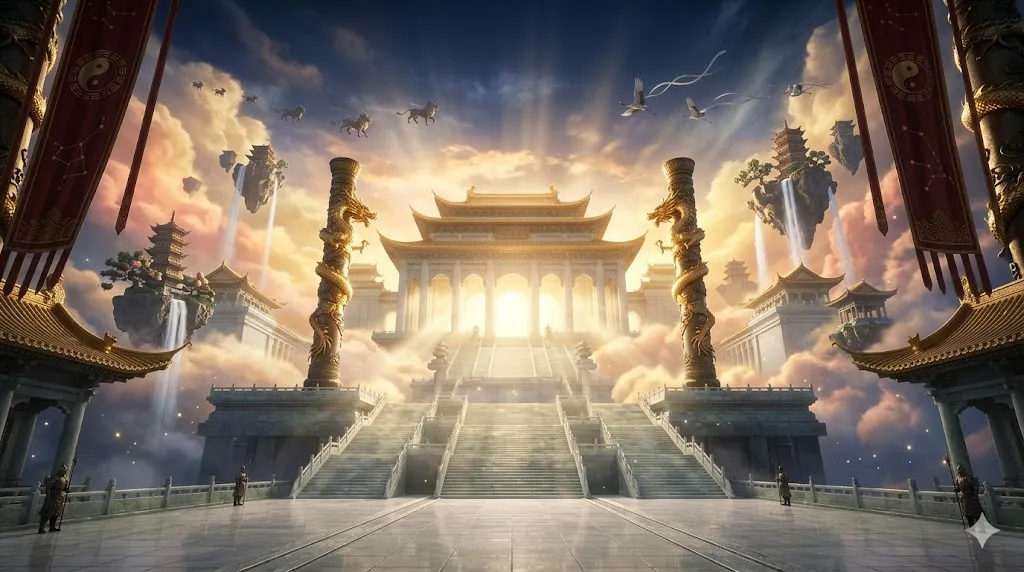
Heavenly Court (天庭) is not a palace—it is the solidified law of the cosmos, a spatial machine woven from the revolutions of 365 ancient stars, where every brick is stamped with the Celestial Decrees and the density of pure yang energy alone would collapse an unrefined mortal body into dust. It does not rule the world from a throne; it is the command center of the cosmic order itself.
天庭 / Heavenly Court (Tian Ting)
Type: 天道秩序的最高显化机关 (Supreme Manifestation of Celestial Order)
Domain: Celestial Realm (天界 — the highest pure-yang spatial layer)
Law Aspect: Celestial Order, Karmic Regulation, Star Destiny
Spiritual Density: Extreme — pure Xian Tian Ling Qi (Primordial Spiritual Energy), lethal to unrefined flesh
Spatial Extent: Covers the entire Celestial Realm, with its core structure anchored on 365 ancient stars forming a single grand formation
To the mortal eye, Heavenly Court is not directly accessible. However, there are several locations in the Earthly Realm that serve as symbolic gateways or points of connection: (1) The Summit of Kunlun Mountain — after the Great Disconnection, it is no longer a literal stair, but it remains a place of exceptional spiritual clarity, and certain ascension rites are still conducted there. (2) The "Star Observation Terrace" on Mount Song — an ancient observatory built by a reclusive immortal society, said to resonate with the star formation above and allow limited communication with the Court. (3) The "Celestial Mirror Pool" in the Western Regions — a high-altitude lake at the center of a volcanic caldera, where, under specific celestial alignments, the surface reflects not the sky but the marble halls of the Court. None of these locations serve as functioning portals; they are merely residual spatial echoes. Actual entry requires formal ascension or a summoning order from a recognized divine authority.
This entry is closely linked to several other major cosmic nodes. The Jade Emperor, as the supreme executive of the Heavenly Court, is the central figure in the divine governance system. The Feng Shen Bang (List of Investiture) is the contractual document that binds all deities to the Court's authority. The Thunder Department operates as the Court's enforcement arm. The Celestial Decrees (Tian Tiao) define the laws that the Court upholds. The Heavenly Tribulation (Tian Jie) is the cosmic penalty mechanism that the Court administers. Across the Three Realms, the Court interacts most directly with Lingshan (Spirit Mountain) in matters of diplomatic protocol, and with the Underworld through the judgment and reincarnation systems. In the Earthly Realm, the Court monitors dragon-vein flows and indirectly influences mortal dynasties through its star-mastery. For a fuller understanding, readers may consult the entries on the Jade Emperor, the Feng Shen Bang, the Thunder Department, the Underworld, Lingshan, and the Great Disconnection.
Heavenly Court is located at the apex of the Celestial Realm, occupying the region where yang qi is most concentrated and the Tian Di Gang Chang (天地纲常 — Cosmic Order) operates with maximum precision. It is not a floating island or a mountain peak: its foundation is the framework of 365 major ancient stars, and its spatial coordinates shift with the celestial revolutions of the heavens. Before the Great Disconnection (Jue Di Tian Tong), there were physical pathways — the Jianmu tree, the Kunlun stair — connecting Heaven and Earth; after that event, all direct links were severed, leaving only sanctioned ascension or divine summons as permissible crossings. The nearest major celestial institution is the Thunder Department, which operates as an enforcement arm beneath the Court's authority. The nearest terrestrial dragon-vein trunk is the prime meridian of the mortal world, but the Realm Barrier renders any direct spatial relationship purely theoretical.
Heavenly Court is not built upon ordinary rock or soil. Its architecture is a direct condensation of celestial law. Every beam, column, and tile is formed from crystallized Tian Tiao (天条 — Celestial Decrees), the iron commandments that bind all gods. The terrain is not terrestrial: it is a lattice of pure yang energy filaments, interwoven with star-fiber harvested from the 365 ancient stars. The spiritual energy here is exclusively Xian Tian Ling Qi (先天灵气 — Primordial Spiritual Energy), undiluted and volatile, arriving directly from the cosmic womb through the star network. There are no dragon veins beneath the Court, because the Court itself is the dragon vein of the Celestial Realm — it is the main artery through which celestial authority and spiritual energy flow downward to the lower realms. The energy is not generated locally; it is channeled from the primordial source of the Dao through the star formation, and then modulated by the Court's own law-engines before being distributed as Hou Tian Ling Qi (后天灵气) to the Earthly Realm.
The ecology of Heavenly Court is unlike anything in the lower realms. Vegetation, where it exists, is composed of immortal peach trees, jade bamboo, and golden lotus — all grown from seeds infused with Xian Tian Ling Qi and watered with celestial dew. These plants produce fruits that extend lifespan or grant minor divine powers, but they are carefully controlled and rarely granted to outsiders. Animal life is limited to divine beasts: cranes with feathers that shine like polished steel, qilin with breath that tastes of orchids, and dragons bearing the mark of the Five-Phase transformations. The space itself exhibits slight temporal anomalies: time flows at a uniform rate within the Court's core, but the boundary layers between the Court and the outer Celestial Realm experience a gradient — one day inside the Court may equal several weeks in the mortal world. There is no weather as mortals know it; the seasons are governed by the Court's own decrees, and rain falls only when the Rain Master is ordered to release it. The sky is perpetually clear, with the 365 anchor stars visible at all times, shining with a steady, unnaturally even light.
The earliest recorded occupation of Heavenly Court predates mortal history. According to the canon documents, the Court was formed simultaneously with the establishment of the Tian Di Gang Chang, and its first "occupants" were the primordial laws themselves — personified later as the Jade Emperor and the celestial bureaucracy. In the Honghuang Era, the Court was a nascent structure, loosely organized, with innate gods and ancient spirits holding autonomous domains. The Great Disconnection fundamentally rewrote this: the Court became the central administrative organ, and a series of "divine investiture" events — notably the Feng Shen Bang (封神榜 — List of Investiture) — brought the majority of independent spirits under its authority. The most critical conflict was of course the war that led to the Feng Shen Bang itself: a massive karmic rearrangement where countless ancient beings were forced onto the list and bound to the Court's service. Since then, the Court's control has been absolute. There is no record of a successful invasion from the lower realms; the Celestial Realm barrier and the Court's own star formation make direct assault impossible. The current occupant is the supreme bureaucracy headed by the Jade Emperor, supported by the Four Heavenly Kings, the Star Lords, the Thunder Department, and the myriad gods of wind, rain, and fate.
Heavenly Court serves as the supreme regulatory and executive hub for the entire cosmic order. Its functions are not ceremonial; they are existential. (1) It monitors and modulates the flow of spiritual energy across the Three Realms, ensuring that the balance of yin and yang is maintained. (2) It administers the Feng Shen Bang (封神榜), the binding contract that determines which beings are granted divine office and which are bound by the Tian Tiao (天条). (3) It oversees the timing and intensity of Heavenly Tribulation (Tian Jie — 天劫), the Dao's self-correcting mechanism that forcibly reclaims excess power from cultivators who have stolen too much energy from the system. (4) It records the merit and demerit of all cultivators and deities, adjusting their rank, lifespan, and spiritual allocation accordingly. (5) It tracks the flow of dragon-vein qi in the Earthly Realm and, through its subordinate Star Lords, influences the rise and fall of mortal dynasties — not by direct intervention, but by adjusting the celestial parameters that govern earthly fortune. In short, the Court is the central nervous system of the cosmos; without it, the star positions would drift, the seasons would fall into chaos, and the accumulated karmic debt of all beings would spin the universe into collapse.
Despite its immense surveillance network, Heavenly Court still holds unsolved mysteries. (1) The "Hidden Star Chamber" — a sub-space within the Court that does not appear on any celestial map, rumored to contain records of the primordial universe before even Pangu's awakening. No deity below the rank of the Four Heavenly Kings has ever been confirmed to have entered it. (2) The origin of the Feng Shen Bang itself is debated: some texts claim it was forged from the remnant will of Pangu, others that it is a self-manifesting law-object born from the Dao. Neither theory has been corroborated by any surviving source. (3) There is an anomaly at the deepest foundation of the Court — a point where the crystalline law-structure becomes permeable to chaotic energy from the void. This "Chaos Leak" has been contained by a seal placed by an unknown primordial being, and its maintenance is a closely guarded secret. If the seal were ever to fail, the Court would be flooded with undifferentiated, reality-dissolving chaos. (4) The exact nature of the Jade Emperor's own cultivation level is never officially recorded; speculation ranges from a quasi-Dao, to a perpetual state of self-negation, to a being that has transcended the need for a body entirely.
Heavenly Court is the apex of the divine administration and therefore interacts with all four major paths. (1) Xian Dao (仙道 — Immortal Path): The Court oversees all immortals who have achieved ascension. Even the most powerful loose immortals are theoretically subject to the Court's jurisdiction, though some remote hermits manage to evade its attention. (2) Shen Dao (神道 — Divine Path): The Court is the core of the divine system. All gods, whether they are star lords, city gods, earth gods, or river guardians, receive their authority and incense-fire allocation from the Court. (3) Fo Dao (佛道 — Buddha Path): Lingshan (Spirit Mountain) exists outside the Court's jurisdiction due to its Karmic Insulation property. However, there is a formal diplomatic channel between the two supreme institutions; the Court acknowledges the Buddha's authority in matters of transcendence, and the Buddha acknowledges the Court's authority in matters of cosmic governance. (4) Yao, Mo, Gui (妖、魔、鬼 — Demon, Devil, Ghost): The Court is fundamentally hostile to all chaotic or unregistered beings. Demons (Yao) without official recognition are hunted; devils (Mo) are annihilated on sight; and ghosts (Gui) are channeled to the Underworld for judgment. The only exceptions are those who have successfully passed the Heavenly Tribulation and been granted a formal position on the Feng Shen Bang.
The current state of Heavenly Court is one of stable, if cautious, isolation. The spiritual energy reserves of the Celestial Realm are vast but finite; the Court's own formation continuously recycles and condenses primordial energy from the star network, preventing localized depletion. The spatial stability of the Court is considered excellent — the law-structure is self-healing, and minor distortions are corrected automatically by the Tian Tiao. However, the long-term prognosis is guarded. The Chaos Leak mentioned earlier is slowly growing; the seal requires periodic reinforcement by the most senior gods, and there are whispers among the higher echelons that the seal's effectiveness will degrade over the next few kalpas. In terms of future conflict: the Court is not currently threatened by any known power within the Three Realms. Lingshan maintains a respectful neutrality, the Underworld is subordinate, and no Earthly Realm sect has the capacity to challenge it directly. The greatest risk comes from internal corruption — gods who accumulate too much personal power or karmic debt could trigger a localized rebellion, but the Court's enforcement mechanisms (the Thunder Department, the Star Lords) have historically been sufficient to contain such incidents.
Lore Notes
Feng Shen Bang (封神榜)
The List of Investiture; a binding celestial contract that grants divine office while imposing obedience to the Celestial Decrees.
Tian Tiao (天条)
The Celestial Decrees; the iron laws that all gods of the Heavenly Court must follow, woven into the very structure of the Court.
Jade Emperor (玉皇大帝)
The supreme executive of the Heavenly Court; a position bound by the Tian Tiao and the Feng Shen Bang, not a sovereign monarch.
Thunder Department (雷部)
The enforcement arm of the Heavenly Court, responsible for executing punishment on rogue gods and cultivators who violate celestial law.
Chaos Leak (混沌裂隙)
A hidden rupture in the law-structure beneath the Heavenly Court through which undifferentiated primordial chaos seeps in, contained by a seal of unknown origin.
Star Lords (星君)
Deities in charge of the 365 ancient stars that form the foundation of the Heavenly Court, responsible for controlling stellar movements and influencing mortal fate.
FAQ
Is the Heavenly Court the same as heaven in Western religions?
Not exactly. It is the central administrative hub for the cosmic order, not a paradise for the souls of the righteous. It operates on rigid laws (Tian Tiao) and a binding contract (Feng Shen Bang). It is more like a divine bureaucracy than a promised afterworld.
Can a mortal visit the Heavenly Court?
Only through formal ascension (passing Heavenly Tribulation and being granted a celestial rank) or by being summoned by a deity with proper authority. Spontaneous travel is impossible due to the Realm Barrier and the lethal spiritual energy density.
What is the Chaos Leak?
A hidden, unhealed wound in the foundational law-structure of the Heavenly Court through which primordial chaos (the pre-creation substance) seeps in. It is contained by an ancient seal; if the seal fails, the Court could be dissolved back into chaos.