Eastern Mythology Encyclopedia
Fuxi
伏羲
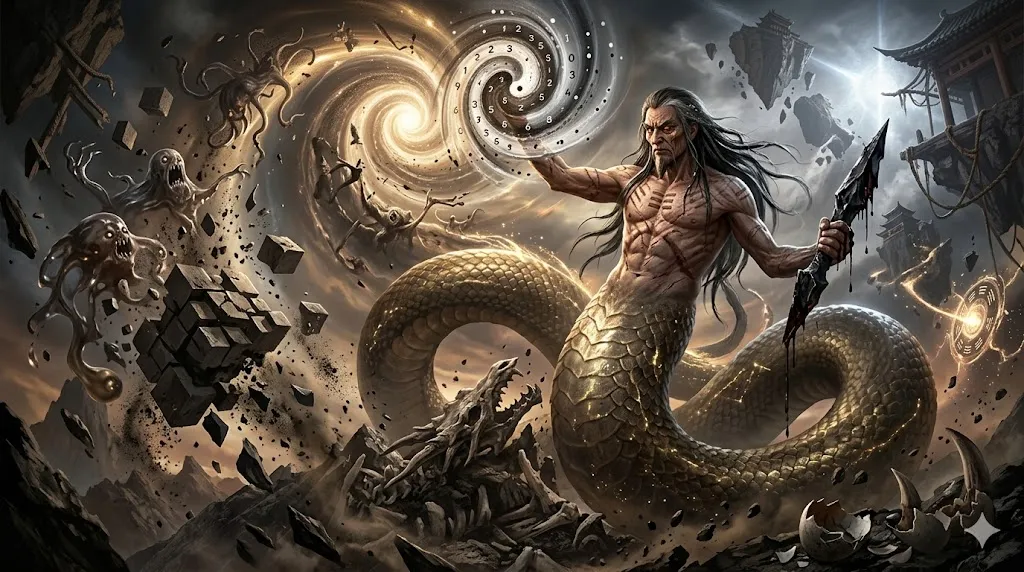
Fuxi (the Primordial Lord of Reason who inscribed the cosmic order into symbols and taught humanity to read the universe) is not a god who governs through command—he is a law that made itself visible, carved into the patterns of heaven and earth. Before him, chaos was merely felt; after him, chaos became knowable. But the price of making the Dao legible is that the one who wrote the script can no longer be seen.
伏羲 (Fuxi) / 八卦祖师 / 人文始祖 (Patriarch of Trigrams / Cultural Ancestor)
Celestial Patterns & Earthly Veins, the Numbers of All Change; Giver of Order and Founder of Civilization. He discerned and revealed the cosmic laws, taught humanity the wisdom of the Eight Trigrams, and laid the foundation of all culture.
Era of Manifestation: Primordial Birth, concurrent with the separation of Heaven and Earth.
Current Realm: Integrated into the cosmic order as pure principle (Li); no longer retains a discrete divine form.
Rank: San Zhi Xiao Shen (散职小神) — a minor divine office without fixed territorial jurisdiction or stable incense-fire income; an honorary classification assigned by later celestial records.
Incense-Fire Coverage: Global, through cultural temples and ancestral shrines; not required for continued existence.
Fuxi Temple (伏羲庙) in Tianshui, Gansu Province — a major pilgrimage site, built during the Ming dynasty.
Taihao Mausoleum (太昊陵) in Huaiyang, Henan Province — a grand tomb complex and temple, site of annual sacrifice ceremonies.
Longma Temple (龙马庙) in Mengjin, Henan — small temple near the legendary site where the River Map appeared.
Fuxi Cultural Square and associated shrines exist in many cities across China.
This entry is connected to the primordial cosmic framework described in the First Volume (至高起源与创世框架). The concept of Xian Tian Yi Qi (先天一炁) explains Fuxi’s origin as a being born from the primordial breath. The Great Disconnection (绝地天通) marks the transition in which Fuxi dissolved into principle. The creation of the Eight Trigrams stands as the central event linking him to the later development of Daoist cosmology, divination, and the I Ching (《易经》). His temple sites and folk cult are detailed in separate entries on Chinese folk religion and the Three Sovereigns. For relation entries, see the structured block at the end of this document.
Fuxi holds no territorial jurisdiction. His divine office, such as it is, is an honorary vestige recorded in the celestial ledgers after the Great Disconnection. He does not patrol any domain, answer to any ministry, or receive commands from the Heavenly Court. The boundary of his authority is the boundary of reason itself: he reveals, but does not enforce. The Celestial Decrees do not bind him because he has never entered the Shen Dao contract. His power—the power to make cosmic order legible—was never granted and cannot be revoked. It simply is.
Fuxi was never appointed to a divine office. He is a Xian Tian Shen Sheng (先天神圣) — a primordial being born directly from the interaction of the Xian Tian Yi Qi (先天一炁) and the emerging cosmic framework. No ceremony, no decree, no inscription on the Feng Shen Bang. His existence predates the Celestial Court, the Jade Emperor, and the system of divine appointment itself. When the Great Disconnection severed the realms, Fuxi did not ascend or descend; he dissolved his discrete form and became the pattern of the Dao itself—a universal law legible in the movement of stars and the arrangement of mountains. The earthly temples that bear his name are memorials to a presence that is everywhere and nowhere.
Fuxi’s authority is the authority of the universe made legible. He does not command rain or thunder; he revealed the Eight Trigrams (Bagua), the complete symbolic system that maps the dynamic interplay of Yin, Yang, and the Five Phases. His function is not to intervene but to illuminate. The sole restraint upon him is the natural limit of his own nature: he can only reveal what is true. He cannot deceive, distort, or withhold. When asked to show the cosmic order, he shows it fully. This is not a restriction imposed by Tian Tiao (天条); it is the definition of his being. He has never faced a conflict between duty and will, because he has no will separate from the truth he embodies.
Fuxi possesses no Jin Shen (金身) in the sense used for appointed deities. His existence is not sustained by incense-fire faith. The temples dedicated to him—scattered across China under names such as the Fuxi Temple (伏羲庙) in Tianshui, the Taihao Mausoleum (太昊陵) in Huaiyang, and countless ancestral shrines—are expressions of cultural gratitude, not power conduits. The incense burned before his statue does not feed him; it honors the memory of the one who first taught humanity to see order in chaos. When the human race forgets his name, Fuxi will not cease to exist—he will simply become illegible again, waiting to be rediscovered.
Fuxi has no hierarchy. He answers to no superior, commands no subordinates, and reports to no ministry. The Heavenly Court lists him on its records as a San Zhi Xiao Shen (散职小神) out of bureaucratic formalism, but he has no duties to fulfill, no inspections to pass, no colleagues to coordinate with. The only relationship that matters is the one between him and the Dao: he is the Dao’s self-awareness made manifest. Among mortals, his legacy is carried by generations of scholars, diviners, and rulers who studied the trigrams and applied them to governance and daily life. He left no contract with any human priest or medium.
The single most significant event in Fuxi’s recorded existence is the creation of the Eight Trigrams. According to the received tradition, while meditating on the banks of the Yellow River, he observed a dragon-horse (Longma) emerging from the water, carrying on its back a pattern of spots—the He Tu (河图, River Map). Inspired by this vision, and by the patterns of the constellations and the veins of the earth, he drew the Qian (乾 ☰, Heaven), Dui (兑 ☱, Lake), Li (离 ☲, Fire), Zhen (震 ☳, Thunder), Xun (巽 ☴, Wind), Kan (坎 ☵, Water), Gen (艮 ☶, Mountain), and Kun (坤 ☷, Earth). This act transformed an ineffable cosmic logic into a language any human could learn. There is no record of any sanction, punishment, or official recognition by any celestial authority. The creation of the trigrams was not a mission; it was an outpouring of the nature he is.
Fuxi’s relationship with the Five Paths is indirect and conceptual. With the Shen Dao: he is older than the system and has never participated in its bureaucracy. With the Xian Dao: the trigrams became a foundational text for many alchemical traditions, but Fuxi never taught cultivation—only discernment. With the Fo Dao: Buddhist contemplatives have sometimes interpreted the trigrams as a map of dependent origination, but no direct interaction exists. With the Yao Dao: beasts inspired by the patterns of the earth may have sensed the trigrams before humans, but recorded history does not mention Fuxi interacting with any non-human intelligence. With the Gui Dao: the trigrams serve as talismans in funerary rites, but Fuxi himself holds no authority over the underworld. With the Ren Dao: this is his deepest connection. He gave humanity the tools to build civilization—not by handing down laws, but by showing them how to read the laws already written into the world.
Fuxi’s current state is one of static presence. He no longer manifests in any discrete form; the individual named Fuxi has dissolved into the universal principle he embodied. His cultural temples remain active in the twenty-first century, visited by pilgrims and tourists alike. In the pantheon of Chinese folk religion, he is ranked among the Three Sovereigns (San Huang, 三皇) and is often paired with Nüwa as a co-founder of human civilization. His office of San Zhi Xiao Shen (散职小神) is a posthumous honorific inserted by celestial record-keepers who could not leave a being of his stature unclassified. No evolution in his divine function has occurred since the Great Disconnection; he is as stable as geometry.
Lore Notes
He Tu (河图)
The River Map; a pattern of spots on a dragon-horse's back that inspired Fuxi to create the Eight Trigrams.
Bagua (八卦)
The Eight Trigrams; three-line symbols representing fundamental forces of the universe.
Longma (龙马)
The dragon-horse; a mythical creature that emerged from the Yellow River bearing the River Map.
San Huang (三皇)
The Three Sovereigns; legendary culture heroes who preceded the dynastic era, of whom Fuxi is the first.
Taihao (太昊)
An epithet of Fuxi meaning "Great Brightness," often used in temple names such as Taihao Mausoleum.
FAQ
Is Fuxi considered a god in Chinese mythology?
Yes, but not in the typical sense. He is classified as a San Zhi Xiao Shen (minor scattered deity) by later records, but he never received a divine office from the Celestial Court. His power comes from being the embodiment of cosmic law itself.
Did Fuxi create humans?
No. That role belongs to Nüwa, who is sometimes paired with Fuxi as his sister or wife. Fuxi's contribution was giving humanity the tools to understand and organize the world: writing, fishing nets, marriage rituals, and especially the Eight Trigrams.
Does Fuxi answer prayers?
No. Because he is not sustained by incense-fire faith and has no active office, he does not respond to requests. Temples dedicated to him are sites of cultural reverence, not petitionary worship.
What is the Eight Trigrams?
The Eight Trigrams (Bagua) are symbols consisting of three lines each—either solid (yang) or broken (yin). They represent the fundamental forces of Heaven, Earth, Thunder, Wind, Water, Fire, Mountain, and Lake, and form the basis of the I Ching (Book of Changes) system.
Where can I visit a temple of Fuxi today?
Notable sites include the Fuxi Temple in Tianshui, Gansu; the Taihao Mausoleum in Huaiyang, Henan; and the Longma Temple in Mengjin, Henan.