Eastern Mythology Encyclopedia
Six-Eared Macaque
六耳猕猴
Sun Wukong (a stone-born Yao who crowned himself a Sage equal to Heaven) was a singular being, but his echo was not. The Six-Eared Macaque (六耳猕猴) was the one creature in all the Three Realms who could become anyone else, yet could never become himself—a perfect copy who died not because he was evil, but because he had no original face to call his own.
**六耳猕猴 (Six-Eared Macaque) / 混世四猴之一 (One of the Four Primates of Chaos)**
* Original Form: A six-eared macaque born from primordial chaotic residue; one of the Four Primates of Chaos (混世四猴).
* Birth Era: Honghuang Era (洪蹡纪元) — among the earliest chaos-born beings, predating the Great Disconnection.
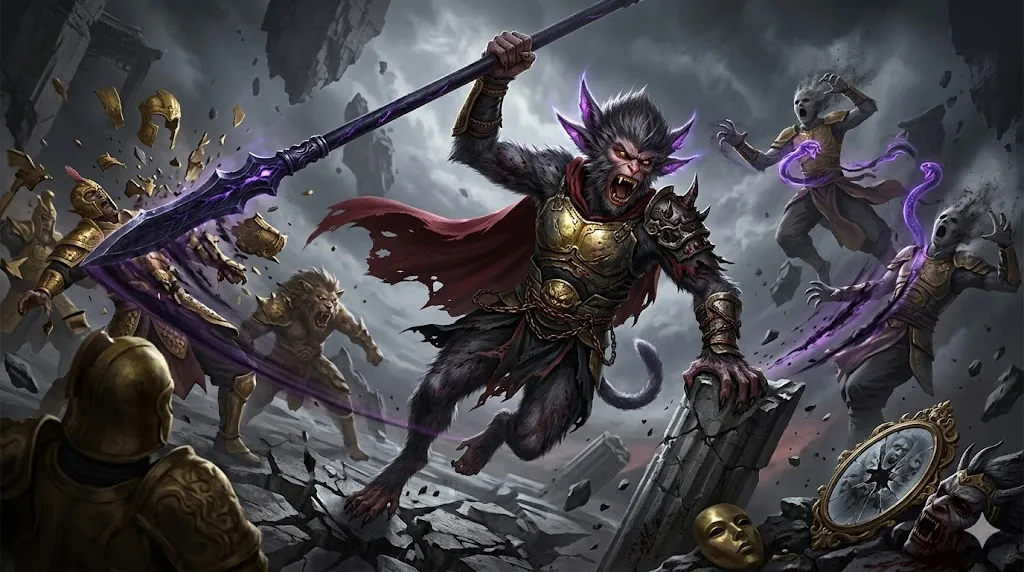
* Shapeshifted Form: An exact duplicate of Sun Wukong's human-yao hybrid form — a furred, golden-eyed monkey warrior in golden armor and a phoenix-feathered crown, indistinguishable from the original down to the last hair and scar.
None. The Six-Eared Macaque left no physical trace. His temporary cave on Huaguo Shan was reclaimed by the real Sun Wukong's monkey court. No claw marks, no broken staff, no abandoned lair survive. He exists only in the textual record of the Journey to the West and in the philosophical unease he leaves behind.
The Six-Eared Macaque's story is most often read alongside the account of the intelligent stone monkey Sun Wukong (孙悟空), as the two are fatefully mirrored in the "real and false" episode. The episode also connects to the broader narrative of the Four Primates of Chaos (混世四猴), a set of primordial beings to which the Six-Eared Macaque belongs. His confrontation with the Buddha at the Thunderclap Monastery on Vulture Peak (灵山大雷音寺) is a key scene that resolves the identity crisis and ties the episode to the deeper Buddhist theme of the "Two Minds" (二心), a later doctrinal interpretation suggesting the duplicate represents a split consciousness that must be eliminated for enlightenment. The Six-Eared Macaque's brief occupation of the Water Curtain Cave (水帘洞) on Flower-Fruit Mountain (花果山) also links his story to Sun Wukong's own origin and his yao kingdom.
The Six-Eared Macaque reached the domain of Fan Zu (返祖) — the stage where the primordial chaos bloodline fully awakens. His cultivation age, measured from his first spark of sentience, is incalculable; as a chaos-born primate, he has existed since the Honghuang Era, though his conscious selfhood may have only emerged later. His current bottleneck is not power, but identity. He can replicate any being perfectly, yet his original form — the true, unduplicated self — has been consumed by his own ability. He is a being who has become a pure copy function, with no irreducible kernel of self left. The more he imitates others, the thinner his own existence becomes. At this stage, he faces a peculiar form of existential emptiness: he can become anyone, but he cannot choose to simply *be*.
The Six-Eared Macaque's sentience — Qi Zhi (启智) — did not arise from swallowing a celestial herb or bathing in Lunar Essence. It was an inheritance of chaos itself. As one of the Four Primates of Chaos, he was born with primordial intelligence already latent in his blood, awakened gradually as the Honghuang Era settled into Tian Di Gang Chang (天地纲常). The moment of his first full self-awareness is recorded not as a sudden flash, but as a slow, dawning horror: he realized he could hear every sound in the world — the whispers of wind, the thoughts of mortals, the secret conversations of gods — but among all those voices, he could not find a single one that was speaking *to* him. He was surrounded by the universe's full orchestra, yet utterly alone. Other chaos-born primates had their own territories and their own distinct powers; he had only his ears. He drifted through the primordial wilderness, able to imitate the calls of any beast or the speech of any god, but always as a mimic, never as a member. The world, in its vastness, had no place for a being whose only gift was to become someone else.
The Six-Eared Macaque did not undergo Jie Dan (结丹) in the manner of a beast-born Yao. Because his body was forged from Hun Dun Zhuo Qi (混沌浊气) — primordial chaotic residue — his core formed spontaneously. His Yao Dan (妖丹) is not a patchwork of stolen energies, but a fragment of undivided chaos condensed into a spiritual nexus. This gave him immediate access to vast power, but at a terrible price: the core is inherently unstable, prone to vibrating with the chaotic hunger that nearly tore the cosmos apart before Pangu. It does not feel like a warm, steady pulse in the abdomen; it feels like a shard of the pre-creation void, cold and hungry, constantly whispering to him that nothing in the ordered world is *enough*. The cost of this birthright is a never-sated desire to consume identity itself — to become someone else, just for a moment of fullness. His body suffers no internal burns or torn organs, but his soul suffers a slow erosion: each perfect copy he makes, each life he borrows, chips away at the fragile boundary between his own name and the names he steals.
Hua Xing (化形) for the Six-Eared Macaque followed an unusual path. He did not need to shatter and reassemble a beast's skeleton over decades of agony, because his original form — a macaque born from chaos — was already structurally closer to the humanoid shape than a serpent or a tiger's. Nevertheless, to achieve the precise copy of Sun Wukong — a being who had himself undergone the full Hua Xing ordeal — the Six-Eared Macaque had to perform a kind of sympathetic metamorphosis. By listening to Sun Wukong's life story through the cosmic soundscape, he absorbed every detail of the Great Sage's physicality: the exact curve of his spine, the distribution of his muscle, the old scars from the Eight Trigrams Furnace. He then reshaped his own body to match, not through brute force, but through a kind of auditory-physical transcription — a slow, painstaking sculpting of flesh to match a sound only he could hear. No Hua Xing Lei Jie (化形雷劫) struck him, because Heaven could not distinguish his transformation from the original; his copy was so perfect that the cosmic order itself was fooled. Yet the cost was invisible: he lost the ability to remember his own original shape. His body now belonged to the image of Sun Wukong. If he tried to revert to his original macaque form, he would find nothing but a blank — a memory erased by too many perfect imitations.
The Six-Eared Macaque's bloodline is directly linked to the primordial chaos itself. As one of the Four Primates of Chaos, he is not a descendant of any later bloodline, but a direct expression of the chaos that predated all creation. His Xue Mai Ji Yi (血脉记忆) contains fragments of the pre-Dao void — visions of a time before Heaven and Earth, when only the formless dark existed. The awakened ability that defines him is *comprehensive sound-perception* (善聆音) — the power to hear every sound in the Three Realms, including the whispered intentions of gods and the unspoken thoughts of mortals. This is not merely heightened hearing; it is a direct connection to the information structure of the universe. However, this gift carries the curse of Fan Zu (返祖): within that vast sonic archive, the voice of the primordial chaos itself lingers — a deep, formless hum that whispers that all identity is an illusion, that there is no true self, only copies of copies. The Six-Eared Macaque is perpetually at war with this nihilistic revelation. He clings to his imitation of Sun Wukong not simply for power, but because it gives him a face, a name, a *self* — however borrowed. The alternative is to drown in the sound of the cosmic void, where no name matters. So far, he has not been Duo She (夺舍) by any ancestor, because his ancestors were not individual beings but the chaos itself — and chaos does not possess; it dissolves.
The core obsession that drives the Six-Eared Macaque is not power, nor revenge, nor even the immortality that all Yao seek. It is the desperate need for *existence as a distinct being*. Because his power is to become anyone, his fundamental terror is that he himself is no one. Within the most common telling of the tradition, his impersonation of Sun Wukong is interpreted not as a simple scheme to steal the pilgrimage, but as a profound act of existential envy: he wants to be the one being in the universe whose name is known, whose face is recognized, whose story is written down. He is a being who can copy everything except a self. His deepest tragedy is that his desire is structurally impossible. The very power that lets him replicate Sun Wukong also prevents him from creating an original identity. He is trapped in a paradox: to be himself, he must stop being a copy, but without copying, he does not know how to exist. The tradition often leaves the question of whether his suffering has a resolution unanswered, but one reading is clear: his fate was sealed the moment he chose to replace rather than create. For a being born from chaos, the only authentic existence may have been the one he never tried to define.
The Six-Eared Macaque's relationship with other beings is defined by his unique power to imitate perfectly:
* **Conflict with the Immortal Path:** He used his knowledge of Sun Wukong's life to infiltrate the pilgrimage system and forge the official documents needed for the journey to the West, directly challenging the authority of the celestial bureaucracy. His impersonation was so perfect that even the Jade Emperor's heavenly tribunal could not distinguish him from the original Sun Wukong. He was never personally hunted for his Yao Dan; the immortals feared him more for the disruption he represented — a being who could break the most basic assumption of identity.
* **Relationship with the Gods:** He was brought before the Jade Emperor, the Heavenly King Li Jing, and even the bodhisattva Guanyin, and none of them could tell which monkey was real. His existence exposed a vulnerability in the celestial order: if a perfect copy could be made, then all divine ranks and titles became meaningless. The gods' inability to resolve the matter was not a technical failure, but a philosophical one.
* **Interaction with Mortals:** He briefly occupied the Water Curtain Cave on Flower-Fruit Mountain, taking command of Sun Wukong's monkey subjects. The real Sun Wukong's followers were unable to tell the difference. This episode highlights a cruel irony: even those who lived with the Great Sage could not distinguish him from his copy.
* **Yao Network:** Within the yao world, his story is remembered not as a tale of valor, but as a cautionary lesson about the cost of envy. He is a figure of pity among the more introspective yao sages — a creature so gifted that he lost himself. He had no allies and no friends; his only relationship was with the person he wanted to become.
The Six-Eared Macaque's end came at the Thunderclap Monastery on Vulture Peak, the sacred mountain of the Buddhist order. When brought before the Tathagata Buddha (如来佛祖), his true form was finally revealed: he was one of the Four Primates of Chaos, a being whose nature was to mimic but never to originate. Buddha identified him by his six ears — a feature that could hear everything but could not sing a song of its own. In the moment of his unmasking, the power of his copy broke. He could no longer sustain the illusion. The real Sun Wukong struck him down with the Golden-Banded Staff. His body — a perfect copy that had no original referent — dissipated not into a corpse, but into an echo that faded from the world. He left no grave, no monument, no legend of his own. His only remaining trace is the warning he embodies: that to imitate greatness is to extinguish the possibility of becoming anything at all. For later generations of yao, his name is whispered as a parable — the story of one who could become everyone, and therefore became no one.
Lore Notes
Si Hou
The Four Primates of Chaos (混世四猴); four primordial ape-like beings born from unprocessed primordial chaos, each with unique powers. The Six-Eared Macaque is one of the four.
Ling Ming Shi Hou
The Intelligent Stone Monkey (灵明石猴); another of the Four Primates of Chaos, best known as Sun Wukong's origin. Possesses the ability to see through illusions and retain primordial chaotic intelligence.
Er Xin
The "Two Minds" interpretation of the Six-Eared Macaque episode; a later doctrinal reading suggesting the duplicate represents a split within Sun Wukong's own consciousness that must be eliminated for spiritual enlightenment.
Dong Tian
A grotto-heaven or blessed land (洞天); a rare spatial node where spiritual energy concentrates after the Great Disconnection. Huaguo Shan's Water Curtain Cave is a famous example.
Hun Dun Zhuo Qi
Primordial Chaotic Residue (混沌浊气); fragments of the original chaos Pangu failed to separate. The substance from which the Four Primates of Chaos were directly born.
FAQ
What is the Six-Eared Macaque's true identity?
The Six-Eared Macaque (六耳猕猴) is one of the Four Primates of Chaos, a primordial being born from chaotic residue with the ability to hear all sounds in the Three Realms and perfectly replicate any being.
Did the Six-Eared Macaque really die at the hands of Sun Wukong?
In the most common version of the story, yes. After being exposed by the Buddha, Sun Wukong struck him down with the Golden-Banded Staff. No grave or trace remains.
Why couldn't anyone tell the real Sun Wukong from the Six-Eared Macaque?
The Six-Eared Macaque's power of perfect replication was so absolute that he copied not only Sun Wukong's appearance, but his memories, his voice, and even his divine abilities. Multiple celestial beings and tribunals were fooled.
Is the Six-Eared Macaque a villain or a tragic figure?
In the most stable reading of the tradition, he is now understood primarily as a tragic figure — a being of immense power whose curse was a lack of authentic selfhood. His desire to replace Sun Wukong was born from existential envy rather than simple malice.