Eastern Mythology Encyclopedia
Eight-Nine Mystic Art
八九玄功
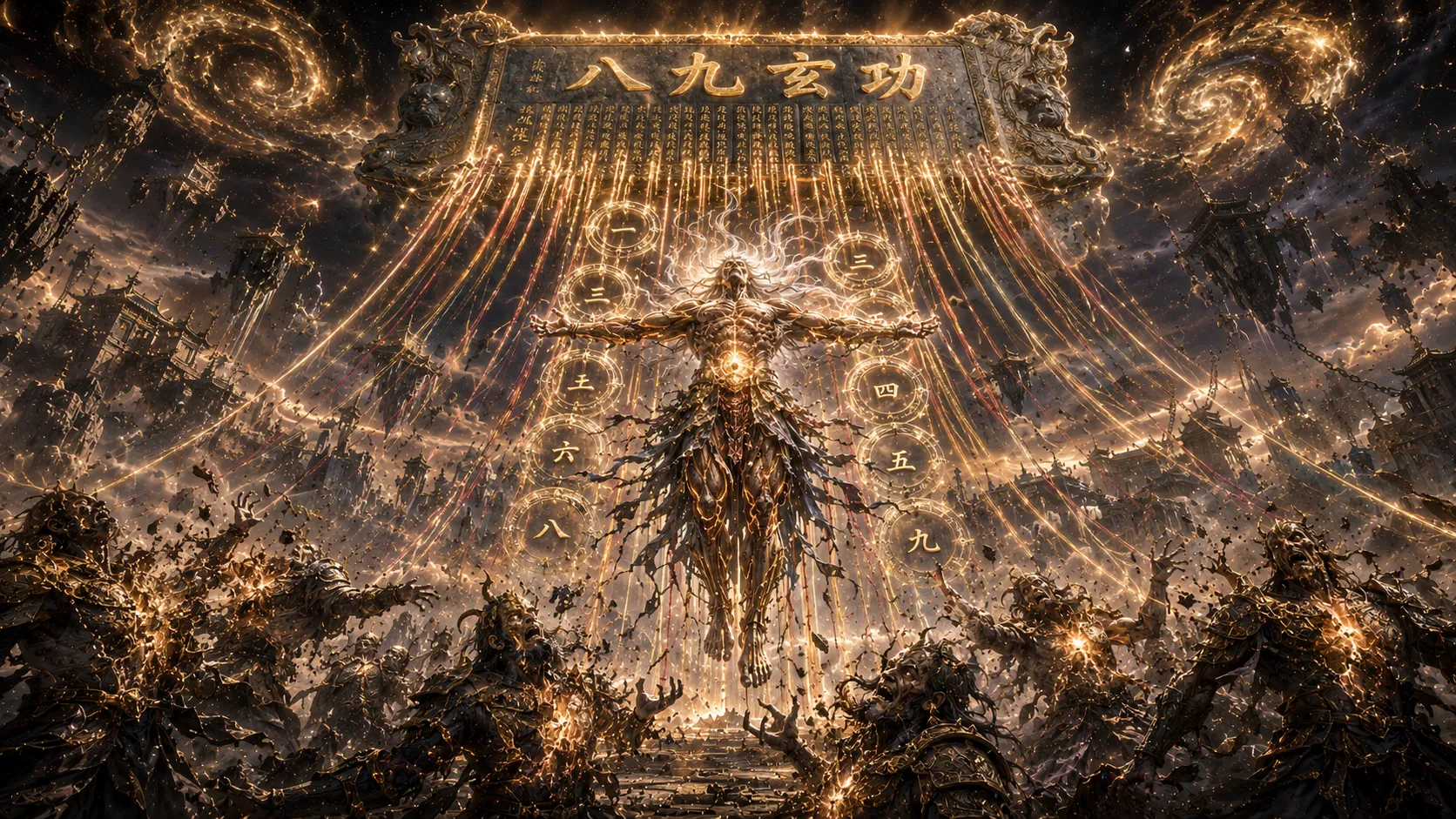
Eight-Nine Mystic Art (八九玄功) — A forbidden cultivation method that does not seek rebirth, but transformation through absorption. Every wound, every destructive force, every external attack becomes fuel for a brutal law-smelting process that makes the body stronger—at the cost of permanently warping the practitioner's flesh and spirit with shattered fragments of cosmic law. It is less a path of cultivation and more a contract of mutual consumption: the practitioner devours destruction, and destruction slowly consumes the practitioner back.
八九玄功 (Eight-Nine Mystic Art)
Type: 功法心诀 (Cultivation Method)
Category: Forbidden Body-Cultivation Art (Jin Shu)
Creator or Lineage: Attributed to the Yang Jian lineage, though earlier traces appear in late Ming dynasty texts such as Fengshen Yanyi. The transmission is oral and secret, with no single recorded founder.
Grade: High-Risk, High-Reward – classified among the most volatile forbidden techniques of the Celestial Realm.
First Recorded Era: Ming Dynasty, with canonical mentions in Fengshen Yanyi (《封神演义》) and indirect references in Xiyouji (《西游记》) through Yang Jian's divine power system.
The stele containing the Eight-Nine Mystic Art's oral method is mentioned in Sanjiao Tongyuan Lu as being located in a remote cave marked by three standing stones at the entrance. The cave's precise location is stated as "north of the Great River, east of the White Cloud Peak," but no one since the 17th century has confirmed finding it. A secondary relic exists: a bronze hand bell inscribed with a single verse describing the art's fundamental principle—"Pain is the door; destruction is the key; law is the price"—held in the private collection of a descendant of the Yang clan, according to the same source.
The Eight-Nine Mystic Art exists in direct relationship with several other forbidden arts and divine abilities. It shares its basic structural logic with the Seventy-Two Transformations, which also remolds the body through law intervention, though the latter requires a Primordial Spirit foundation. It contrasts sharply with the Five Thunders Orthodox Method, which triggers Heavenly Tribulation rather than absorbing energy. Its closest philosophical opposite is the Buddhist protector arts, which avoid permanent contamination through vow-based purification. The art's most famous practitioner, Yang Jian, connects it to the celestial lineage of the Daoist orthodoxies, while the later anonymous stele record ties it to the lost hermetic tradition of Ming-era lone cultivators.
The foundational law that the Eight-Nine Mystic Art distorts is the principle of energy conservation within the Wu Xing framework. Normal Five-Phase spells convert environmental energy into a controlled effect, then release it. This art inverts the process: it does not release energy outwards but absorbs external destructive energy—fire, thunder, physical impact, toxic contamination—and forcibly smelts that energy into the practitioner's own flesh. The mechanism is a form of reverse plunder: instead of the caster taking from the environment, the art takes from the enemy's attack.
The energy source is not ambient Qi or the caster's own Ming Yuan (命元) in the ordinary sense. It is the destructive energy of an incoming attack that the art hijacks. The caster does not generate power; they intercept and consume the power directed at them. This places the art in the category of a reactive cultivation method—it cannot be practiced in isolation but requires external violence to advance. The deeper law it violates is the cosmic principle that living bodies must maintain a stable internal harmony under Tian Di Gang Chang. By permanently embedding law fragments from absorbed attacks into the flesh, the caster turns the body into a living repository of broken cosmic rules—a direct challenge to the self-correcting nature of the Dao.
To initiate the Eight-Nine Mystic Art, no ritual platform (Fa Tan) or hand seal (Shou Yin) is typically required in most accounts. The art is triggered when the practitioner receives a forceful external impact—a strike, a spell, a blade—and consciously applies the art's inner method to redirect the destructive energy into the body's structural matrix. In practice, this looks like the practitioner intentionally allowing an attack to land without full defensive reinforcement, then absorbing the energy at the moment of impact.
Visually, the absorption manifests as a brief, localized shimmer or distortion on the skin at the point of contact. Heat from a fire spell may flash into the body with a soft sizzle and vanish; a thunder strike may ripple outward in a wave of diffusing electricity before being drawn into the torso. The energy is not expelled but pulled inward, leaving no external trace of the attack's force. The target area may briefly glow with the color of the absorbed element, then fade as the law fragment settles into the flesh.
The art's effect does not require continuous energy supply after absorption—the smelting is instantaneous, and the reinforcement is permanent until the body's internal equilibrium is disrupted by future absorption. However, prolonged engagement is not necessary for the art to function; each discrete attack provides a single pulse of transformation.
The energy equation is brutal: every destructive force absorbed is subtracted from the environment and added to the practitioner's body at the site of impact. For example, if a fire spell meant to incinerate the practitioner is absorbed, the surrounding air immediately cools, and any nearby combustible material stops smoldering—the heat is gone, consumed into the caster's flesh. If a thunder strike is absorbed, the electricity dissipates into the body, leaving the air still and silent.
The cost is not paid in lifespan directly but in the accumulation of law fragments. Each absorption deposits a splinter of the corresponding cosmic rule—the principle of heat, of lightning, of frost, of poison—into the caster's physical matrix. Over time, these fragments settle in muscles, bones, and organs. The practitioner feels a local warmth, chill, or vibration during absorption, followed by a sense of localized weight or stiffness as the fragment integrates. The most immediate cost is the loss of bodily control over that area: after absorbing a fire fragment, the skin at that spot may become permanently warm to the touch, less sensitive to pain, and more reactive to future fire absorption. The caster's own nervous system becomes partially displaced by the embedded fragment.
Backlash is both immediate and cumulative, with no known reliable method of avoidance.
Immediate backlash: At the moment of absorption, if the incoming energy's elemental nature conflicts with a law fragment already present at the same body site, internal elemental conflict triggers a phenomenon known as body-cavity devouring (体内自噬). The conflicting fragments clash within the flesh, causing local muscle to spasm, flesh to blister and distort, or internal organs to seize. This can result in the loss of a limb's function for days or permanent paralysis if the conflict is severe enough.
Cumulative backlash: After a certain number of absorptions (the threshold varies by practitioner), the law fragments reach a critical density. At this point, the caster loses voluntary control over shape—the body begins to spontaneously adopt forms based on the dominant fragment type. A fire-dominant caster may find their skin crackling with embers when calm; a frost-dominant caster may freeze objects they touch involuntarily. The final stage is the Law Fragment Burst (法则碎片爆裂): when the body can no longer contain the fragments, they explode outward in a cataclysmic release that kills the practitioner and often devastates the surrounding area.
No confirmed method of backlash avoidance exists. Some texts speak of a technique to expel fragments through ritual bloodletting, but this only delays the burst and weakens the practitioner. The art is, in effect, a one-way path—once begun, the only exit is the final conflagration.
Long-term or excessive use of the Eight-Nine Mystic Art leaves permanent scars on the individual's own law-field—the microcosmic expression of cosmic law within the practitioner's body. The most severe form of pollution is the Internal Law Maelstrom (体内法则涡流): when too many contradictory fragments accumulate, they begin to spin in a self-sustaining cycle, causing the practitioner's body to become a miniaturized battlefield of opposing forces. This state renders the caster incapable of absorbing any further energy, as every new fragment only feeds the maelstrom.
On the spatial level, the area where a practitioner explodes after a Law Fragment Burst becomes permanently warped—a zone where the laws of temperature, electricity, or poison are locally distorted. Plants may grow in erratic patterns, or the ground may spontaneously generate frost or glowing cinders. This is a form of Law Pollution (法则污染) that lingers for decades.
The ultimate fate of a long-term practitioner is the complete loss of the self: the original consciousness is eroded by the accumulated fragments, and the body becomes a walking repository of raw law energy, driven only by instinct. The practitioner is no longer a person but a hazard, and few survive to that point.
The Eight-Nine Mystic Art first appears in authoritative literature during the Ming dynasty, specifically in Fengshen Yanyi (《封神演义》), where it is attributed to the celestial warrior Yang Jian. In the novel, Yang Jian wields a set of divine transformations and bodily resilience that later commentators identified as matching the description of this art. The origins are murky: some texts claim it was taught to Yang Jian by the Jade Void Taoist ancestors; others suggest he deduced it from the more ancient Nine Revolutions Mystic Art (九转玄功) and simplified it for practical use.
The art was never formally banned by a celestial decree in written Records, but it was considered a secret doctrine passed only in oral form within the Yang Jian school. Historical accounts by the Qing dynasty text Sanjiao Tongyuan Lu (《三教同源录》) note that the art fell into near-extinction after the Ming, as the last known practitioners refused to take on disciples, viewing it as a curse rather than a gift. In the present age, no confirmed living master is known. Fragments of the art's method survive in a single stone-carved stele hidden in a cave on a nameless mountain, according to the same text—but its location has been lost for four centuries.
Within the Xian Dao (仙道) system, the Eight-Nine Mystic Art occupies a unique middle ground between orthodox body cultivation and forbidden mutation arts. It shares a structural kinship with the Seventy-Two Transformations (七十二变) and Celestial Mainstay Thirty-Six Transformations (天罡三十六变), both of which also alter the body through law manipulation, but those arts require a permanent Buk Mie Yuan Shen (不灭元神) as foundation. The Eight-Nine Mystic Art does not—its foundation is the willingness to accept permanent physical distortion.
In relation to Fo (佛) school techniques, no equivalent absorption art exists. Buddhist protector arts (Hu Fa Shen Tong) rely on vow-based karma, not forced absorption. The closest parallel is a demon-subduing incantation used by some protector deities, but that technique purges the absorbed energy through a purifying ritual after battle—a step the Eight-Nine Mystic Art lacks entirely. Mo (魔) cultivators have attempted to reverse-engineer the art, substituting external destructive energy with self-inflicted demonic energy, resulting in even faster burnout and more violent law fragment bursts.
The most famous recorded practitioner is Yang Jian (杨戬), the Jade-Sky True Lord of the Ming dynasty tale Fengshen Yanyi. In the narrative, Yang Jian uses the Eight-Nine Mystic Art extensively during the Shang-Zhou war. One well-documented instance: facing the blazing fire array deployed by the Shang general Wen Zhong, Yang Jian deliberately walked into the inferno rather than retreating. He emerged with his outer body scorched but his flesh reinforced by the absorbed flame energy—and from that point forward, his body carried a visible crimson undertone that never faded.
Yang Jian paid the cumulative price: in later battles, his body occasionally flickered with spontaneous flame when not under conscious control, and he lost the ability to touch cold surfaces without pain. The text records that after the war, he withdrew from active combat and took on a ceremonial role, likely because his internal law fragments had reached a dangerous density. He is said to have lived another three hundred years, but died in a silent explosion that left his meditation chamber coated in a heatless, enduring glow.
Lore Notes
Yang Jian (杨戬)
A celestial warrior from Fengshen Yanyi, the most famous practitioner of the Eight-Nine Mystic Art. Jade-Sky True Lord by title.
Law Fragment Burst (法则碎片爆裂)
The terminal event when accumulated law fragments exceed the body's capacity, causing a violent release that destroys the practitioner and warps the surrounding area.
Internal Law Maelstrom (体内法则涡流)
A self-sustaining cycle of conflicting law fragments within the practitioner's body, rendering further absorption impossible and often preceding terminal burst.
Body-Cavity Devouring (体内自噬)
Immediate backlash reaction when two opposing law fragments at the same body site conflict, causing localized paralysis or permanent distortion.
Sanjiao Tongyuan Lu (三教同源录)
A Qing dynasty text that records the later history of the Eight-Nine Mystic Art and its near-extinction.
FAQ
Is the Eight-Nine Mystic Art the same as the Nine Revolutions Mystic Art?
No. The Eight-Nine Mystic Art is a simplified variant that absorbs external destruction rather than undergoing repeated rebirth. It trades the possibility of transcendence for immediate combat strength.
Did Yang Jian really die from the Eight-Nine Mystic Art?
According to Fengshen Yanyi, Yang Jian died three hundred years after the war in a quiet release of absorbed energy, described as a silent light consuming his meditation chamber.
Can the Eight-Nine Mystic Art be combined with other cultivation methods?
No. Once started, the body is permanently altered by the embedded law fragments. Any other cultivation method would trigger immediate fatal conflict between the fragments and the new energy.
Is there any way to expel the law fragments?
No reliable method is recorded. Ritual bloodletting may delay the terminal burst but weakens the practitioner and does not remove the fragments.